
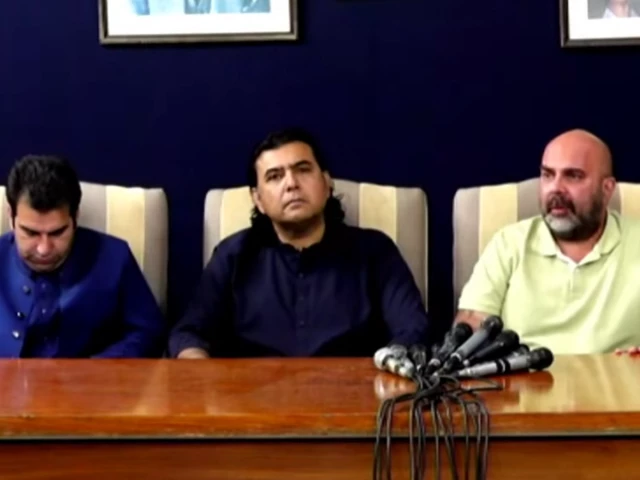
Mustafa Nawaz Khokhar warns that the “hybrid regime” risks “playing with the foundations of the country”
Tehreek-i-Tahaffuz-i-Ain Pakistan leader Mustafa Nawaz Khokhar addresses a press conference in Islamabad, flanked by PTI’s Taimur Saleem Jhagra and other party leaders. SCREEN CAPTURE
The Tehreek-e-Tahaffuz-e-Ain Pakistan (TTAP) on Sunday demanded immediate free and fair elections, release of political prisoners and proper medical treatment for Pakistan Tehreek-e-Insaf (PTI) founder Imran Khan.
At a press conference in Islamabad alongside PTI leader and former provincial minister Taimur Saleem Jhagra, Mustafa Nawaz Khokhar criticized the government’s governance and economic policies, warning that the continuation of what he called a “hybrid regime” would amount to “playing with the country’s foundations.” He added that these demands would not create a crisis but would help resolve the current one.
Khokhar said the “Form 47 government” had adopted a pattern of not taking responsibility. “The country cannot continue to function this way. People will distance themselves further and we will continue to expose their failures and show their true colors to the people of Pakistan,” he said.
جو نظام حکومت لوگوں کو ڈلیور نہ کر رہا ہے لوشالی خوشالی ان کو نہ دے پا رہا ہو
نظام پاکستان ملک … pic.twitter.com/G2YV2eGyK3— Tehreek-e-Tahafuz-e-Ayin-e-Pakistan (@TTAP_OFFICIAL) February 22, 2026
“When a system of government fails to deliver results for the people, fails to deliver economic prosperity, fails internationally and fails to maintain law and order, the people of Pakistan tire of it. Continuing in this way is tantamount to playing with the foundations of the country,” he added.
Condemning terrorism, including the incidents in Islamabad’s Masjid Khadija-tul-Kubra and attacks in Balochistan, Khokhar said effective counterterrorism requires clarity of thought. Referring to the National Action Plan drawn up after the APS tragedy, he said it had not been properly implemented.
He further highlighted the importance of political dialogue, said there was a need to address genuine grievances among the people and criticized the government for failing to reach political agreements and lacking clarity in the fight against militancy.
————-
امریکہ نے اپنے بحری جنگی بیڑے وہاں بھیج دیے ہیں
2003
اشارے بالکل واضح ہیں ہمارے برادر ملک کے ساتھ کیا ہونے جا رہا ہے بھلے حکومت فارم 47 کی ہو پارلیمنٹ میں کوئی بحث نہیں مصطفیٰ… pic.twitter.com/Dt6jlsJ3zE— Tehreek-e-Tahafuz-e-Ayin-e-Pakistan (@TTAP_OFFICIAL) February 22, 2026
He also expressed concern about regional security and warned that “war clouds were hanging over neighboring Iran.” Referring to the deployment of two US naval carrier strike groups, he said: “The signals are absolutely clear about what is going to happen in our region and in our sister country,” alleging attempts at regime change.
Khokhar criticized Pakistan’s alleged participation in US President Donald Trump’s “Peace Board”, saying the country joined without debate or consultation. “China stayed away from that Peace Board, the United Kingdom stayed away, France stayed away, but we went there to praise ourselves and present ourselves, and nobody knows it, nobody is aware,” he said.
He also questioned an alleged deal involving the Roosevelt Hotel, owned by Pakistan International Airlines, and asked on what terms it was given and who benefited from it.
2018 کی بلند ترین سطح! 📉
حکومتی ‘ڈیٹا فجنگ’ اور میڈیا سینسرشپ کے باوجود خود ان کی حالیہ ‘نیشنل دعورٹی رپورٹ 25-2024’ 4 pic.twitter.com/3DV9Mh4rbf— Tehreek-e-Tahafuz-e-Ayin-e-Pakistan (@TTAP_OFFICIAL) February 22, 2026
Meanwhile, Jhagra said foreign direct investment had declined this year compared to last year, with about $800 million invested in seven months, while total investment as a percentage of GDP stood at just 13%. He said neither foreign nor local investors were investing money in Pakistan’s economy.
It added that poverty had risen from 22% in 2018-19 to 29% in 2024-25, unemployment was at its highest level in 21 years and average household income had decreased by 10% compared to 2015-16.
He further criticized the government’s poverty line of Rs 282 per day as unrealistic, stating that according to the World Bank’s benchmark of $4 per day, 130 million Pakistanis were living below the poverty line.
Jhagra also criticized the Punjab government for purchasing a Gulfstream luxury jet for Rs 10 billion, calling it unjustifiable in a country where 130 million people live below the poverty line. He alleged that the government had not answered questions about the purchase of the plane, the extrajudicial killings by the CCD, the expenses of senior officials or the Rs 40 billion spent on a firewall.
He reiterated that in a country where 130 million people live below the poverty line, senior officials had been provided with official vehicles worth Rs 110 million and fuel expenses of Rs 700,000 per month.
25 hours اور فیملی کا مطالبہ ہے عمران خان کو شفا انٹرنیشنل ہسپتال اسلام آباد لایا جائے ڈاکٹر عاصم یوسف اور ڈاکٹر فیصل کی موجودگی ہونا ضروری ہے
تحریک تحفظ آئین پاکستان کے ترجمان اخونزادہ حسین احمد یوسفزئی کی گفتگو… pic.twitter.com/lPREHPbNbj
— Tehreek-e-Tahafuz-e-Ayin-e-Pakistan (@TTAP_OFFICIAL) February 22, 2026
On the other hand, TTAP spokesperson Akhunzada Hussain Ahmed Yousafzai spoke about Imran Khan’s eye treatment.
“Imran Khan’s eye-related problem was treated with an injection administered on the 25th. [January]and the second course expires on the 25th [February]” he said, adding that both TTAP and Imran’s family had demanded that he be shifted to Shifa International Hospital for further treatment.
He stated that Imran’s personal doctors, Dr Asim Yousaf and Dr Faisal Sultan, should be present during the treatment, along with a family member, “to ensure that a critical situation does not arise again as it had happened previously”.


