
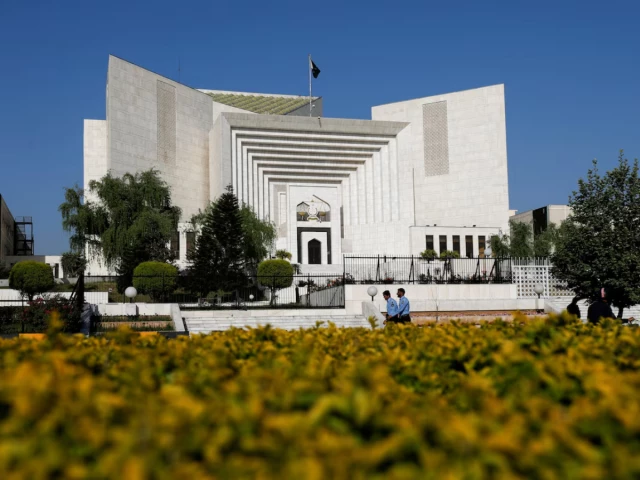
Police officers walk past Pakistan’s Supreme Court building, in Islamabad, Pakistan, April 6, 2022. REUTERS
ISLAMABAD:
Since its inception, the Federal Constitutional Court (FCC) has consistently asserted its judicial supremacy over the Supreme Court of Pakistan.
On Tuesday, FCC Judge Hasan Azhar Rizvi, while hearing a case, expressed his displeasure with a lawyer for not giving priority to the FCC and opting to appear before the SC.
Judge Rizvi made it clear that the FCC is the highest court in the land. He also warned that if an attorney does not appear before the FCC, the case could be dismissed.
Several lawyers confirmed that a practical problem arises when their cases are resolved before the FCC and the Supreme Court simultaneously. They believe that Chief Justice of Pakistan Yahya Afridi should intervene and resolve the matter.
In several rulings, the FCC has held that its decisions are binding on all courts, including the Supreme Court. He has also clarified that the SC no longer has the authority to interpret the Constitution and the law after the 27th Constitutional Amendment.
In the Riaz Hussain case, FCC Judge Rozi Khan Barrech emphasized that Article 189 of the Constitution stipulates that any decision rendered by the Supreme Court resolving a question of law or enunciating a principle of law is binding on all other courts in Pakistan except the FCC.
This exception arises from the 27th Amendment to the Constitution, which states that decisions issued by the FCC are binding on all courts in Pakistan, including the SC itself. Consequently, all courts in Pakistan are constitutionally bound to follow FCC rulings.
Similarly, another FCC judge, Judge KK Agha, held in a separate decision that while under Article 189, SC authorities are not binding on the FCC, the court may find them to have persuasive value or constitute obiter dicta, which it may choose to follow or not.
FCC Judge Aamer Farooq also observed that Article 189 provides that decisions of the SC are binding on all courts subordinate to it, including high courts. At the same time, FCC decisions are binding on all courts in the country, including both the SC and higher courts.
Recently, the FCC clarified that the SC’s authority to strike down legislation on constitutional grounds no longer belongs to it under the current constitutional framework.
“The Constitution (27th Amendment) Act, 2025 has restructured the constitutional distribution of judiciary. As a consequence, the jurisdiction of the SC has been correspondingly restricted in this regard, and the authority to strike down legislation on constitutional grounds is no longer vested in it under the present constitutional scheme,” states a judgment written by Justice Aamer Farooq.
Lawyer Abdul Moiz Jaferii, commenting on the current situation between the two high courts, said the FCC is right.
“The SC is nominally supreme only after the 27th Amendment. The fact that the FCC began functioning without adequate infrastructure or administrative support may have delayed the full assertion of its jurisdiction, which ideally should have been complete by now,” he added.
However, Islamabad-based lawyer Waqas Ahmad said that if the FCC insists that the SC respect the precedent in letter and spirit, it must equally respect the rulings of its own predecessor, the erstwhile Supreme Court of Pakistan.
“The FCC is not a court born of a tabula rasa; it emerged from the division of the former Supreme Court through the 27th Constitutional Amendment. As an institutional successor, it cannot selectively invoke stare decisis. Judicial continuity requires that it recognize and adhere to the binding force of past decisions from which it derives its authority,” he added.
Lawyer Hafiz Ahsaan Ahmad Khokhar observed that since the establishment of two high courts, lawyers face a delicate professional responsibility.
“Members of the bar deeply respect both the FCC and the Supreme Court and strive diligently to assist each court as they present their cases with fairness, professionalism, and constitutional fidelity. Advocates often appear before both forums on similar matters and do their best to address legal issues fully and respectfully without showing preference or bias,” he said.
He emphasized that judges on both courts should recognize this professional position and avoid comments or institutional attitudes that suggest lawyers should prioritize one court over the other.
Such observations could create practical difficulties, affect advocacy and foster perceptions of competition or hierarchy between the two high courts, thereby undermining institutional harmony.
Khokhar stated that Articles 175, 176, 184 (as amended), 185, 186 (as amended), 187, 189 (as amended) and 199 clearly define the jurisdiction and status of both the high courts.
He urged judges to exercise judicial restraint, respect the professional standing of lawyers, avoid adverse observations and focus on expeditious delivery of justice.
Institutional harmony, mutual understanding and constitutional discipline are essential to preserve the dignity, stability and integrity of the higher judiciary of Pakistan, he added.


