
National Assembly Speaker Highlights Inclusive AI Governance at Pakistan Governance Forum 2026 in Islamabad
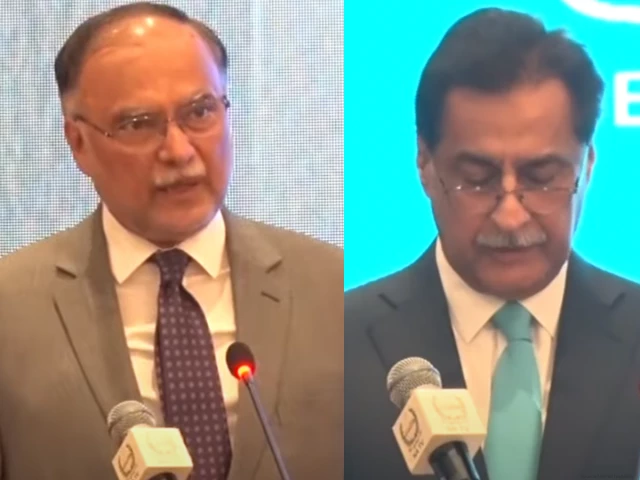
Federal Minister of Planning and Development [left] and National Assembly Speaker Ahsan Iqbal, Sardar Ayaz Sadiq [right] at Pakistan Governance Forum 2026 on February 26, 2026
Federal Minister for Planning and Development Ahsan Iqbal on Thursday announced that the government will publish a development data directory at the constituency level aimed at providing detailed information on development indicators and promoting transparency.
Addressing the Pakistan Governance Forum 2026 in Islamabad on its second day, the minister said the Ministry of Planning and Development had largely completed work on the initiative. He noted that the board would encourage “positive competition among public representatives in the development sector.”
Iqbal also underlined the need for an empowered local government system and said stronger grassroots structures were essential to improve the overall governance framework. He further called for a parliamentary debate on the Five E’s of the Uraan Pakistan program (exports, e-Pakistan, energy, environment and equity and empowerment) aimed at guiding the country towards sustainable, technology-driven and inclusive economic growth.
Speaking at the forum, National Assembly Speaker Sardar Ayaz Sadiq described the event as an important initiative and reiterated the central role of parliament in a democratic system.
Read: Stability key to lasting progress, says minister
He emphasized the need for an inclusive global digital architecture and stated that artificial intelligence should benefit the many and not the few. “Developing countries must have a voice in shaping global rules,” he said, adding that parliament must develop its capacity to legislate in critical areas such as data protection, digital rights and responsible innovation.
The speaker also highlighted the importance of diversifying partnerships, strengthening regional connectivity, upholding multilateralism and investing in human capital for sustained national progress.
Later, speaking to the media, Ayaz Sadiq said improving governance from the grassroots to the top was a collective responsibility. He emphasized that improving the functioning of institutions was vital to strengthening the country’s governance system.
Earlier, he said that Pakistan Governance Forum would prove beneficial for better governance and transparency, adding that legislation related to governance was already underway. He also noted that accountability remained essential to ensure transparency and revealed that some powers of the President’s office had been delegated to a committee.
Yesterday, at the inaugural session of the Pakistan Governance Forum 2026, Prime Minister Shehbaz Sharif called for a “whole of government” approach to address Pakistan’s economic challenges, urging stakeholders to move forward with collective efforts towards sustainable growth. He lamented that the country was suffering from an annual power theft of around Rs 200 billion and stressed that only coordinated institutional action could address the problem.
The prime minister reiterated that the government’s role was to facilitate, not manage, businesses, and emphasized supporting exporters, investors and the private sector through targeted incentives. Expressing optimism about Pakistan’s economic potential, he said the country could strengthen its global position within a few years through strong political will and joint efforts.
Shehbaz also highlighted the need to broaden the tax base, pointing out that Pakistan’s tax-to-GDP ratio had reached 10.5% due to recent measures. He stressed the importance of boosting production, exports, investment and foreign direct investment, while calling for across-the-board reductions in indirect taxes in the upcoming budget. The prime minister lamented that taxes collected from consumers were sometimes not deposited with the government, calling it a “huge injustice” to the nation.
Read more: PM Shehbaz urges ‘whole of government approach’ to overcome economic crisis
Referring to sectoral gains, he said tax collection had improved in the sugar, cement and tobacco industries, while the IT sector recorded 34% growth but still had significant untapped potential. Emphasizing the importance of the country’s large number of youth, he called for greater technical and vocational training, saying IT and AI-led initiatives would transform multiple sectors.
Meanwhile, Planning Minister Ahsan Iqbal told the forum that the initiative was aimed at generating viable policy solutions through debate and participation of stakeholders. He said good governance should be merit-based, transparent and citizen-centric, adding that the Uraan Pakistan program was designed to play a transformative role in the economy. The minister stated that in the last two years, the government had brought the country back from the brink of bankruptcy and expressed confidence that with sustained reforms and positive synergies, Pakistan could become a trillion-dollar economy by 2035.


