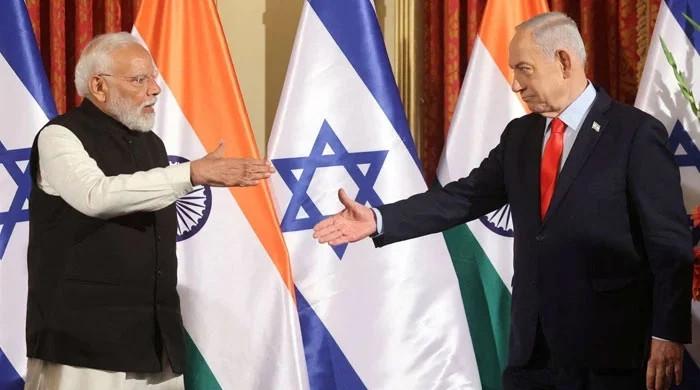
Indian Prime Minister Narendra Modi has arrived in Israel for a two-day official visit. Various online sources claim that New Delhi has finalized defense deals worth approximately $8.6 billion with Israel. Some analysts further suggest that Modi is trying to convince Israeli leaders to set up a state-of-the-art drone manufacturing facility in India.
Meanwhile, Pakistan’s Senate unanimously passed a resolution condemning what it described as provocative comments by Israeli Prime Minister Benjamin Netanyahu. According to international media reports, the Israeli Prime Minister has proposed the formation of a new “alliance hexagon” or “six-party” regional security architecture, in which India will participate.
Speaking in occupied Jerusalem, former Israeli Prime Minister Naftali Bennett also warned that a new “hostile Sunni axis” composed of Turkiye, Qatar, the Muslim Brotherhood and Pakistan is emerging, which he characterized as a major strategic threat to Israel. Although such comments were made in a broader geopolitical context of the Middle East, Pakistan’s inclusion attracted critical attention in light of India’s cordial ties with Israel.
In yet another development, Pakistan and 13 other Muslim-majority countries have jointly condemned controversial statements by the US ambassador to Israel, Mike Huckabee, who has said that Israel has the right to control the territories stretching from the Nile River to the Euphrates River.
Speculation on social media has suggested that Israel, being one of the most prominent founding members, could be given a prominent leadership role within the “Peace Board.” While there is no verified evidence to confirm such claims, online discourse has fueled concerns about how countries, such as Pakistan, that do not recognize Israel, could navigate such a diplomatic agreement if it were to materialize.
Historically, India maintained close ties with Palestinian leader Yasser Arafat. However, over the past decade, the Modi government has visibly deepened defense cooperation with Israel, often framing the partnership in pragmatic security terms.
The growing defense partnership between India and Israel, Pakistan’s principled pro-Palestine stance, and the rapid spread of conspiracy theories on social media have created an atmosphere in which separating fact from speculation is increasingly difficult.
From Pakistan’s perspective, any substantial improvement in India’s offensive capabilities could potentially shift the balance of regional deterrence. These critical developments may force Islamabad to review aspects of its own defensive preparedness. However, Pakistan has consistently demonstrated that it is a responsible nuclear state operating under a strong, internationally recognized command and control structure.
In the digital age we must understand that information spreads instantly, but so do exaggerations and conspiracy theories. Online platforms can amplify unverified claims, shape public opinion, and influence political narratives. This is why it is very important to distinguish between documented political statements and speculative personal narratives.
In the context of Modi’s current visit to Israel, we must remain strong, calm and vigilant. Our principled support for the Palestinian cause must continue, along with a firm commitment to maintaining regional stability. In my view, Pakistan must adopt a measured approach, guided by thoughtful analysis and mature decisions, to effectively address the emerging challenges on both the diplomatic and defense fronts.
The writer is a member of the National Assembly and patron-in-chief of the Pakistan Hindu Council. He tweets/posts @RVankwani
Disclaimer: The views expressed in this article are those of the writer and do not necessarily reflect the editorial policy of PakGazette.tv.
Originally published in The News