
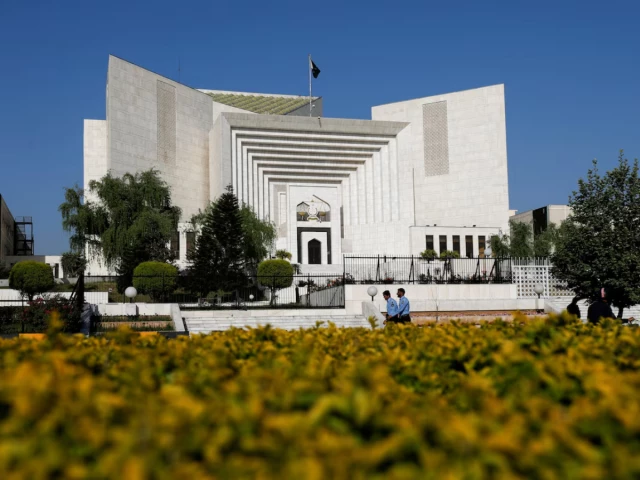
Police officers walk past Pakistan’s Supreme Court building, in Islamabad, Pakistan, April 6, 2022. REUTERS
ISLAMABAD:
Pakistan’s Supreme Court has quashed a land transfer order based on an alleged oral agreement dating back to 1992, ruling that mere possession or long-term occupation does not establish ownership. The court allowed the appeal filed by Ghulam Ali.
Justice Shahid Bilal Hassan issued the written ruling, stating that a strict standard of proof applies in cases involving oral agreements. The ruling held that the alleged oral agreement of 1992 was not proven in accordance with the requirements of law.
The Supreme Court declared null and void the judgments of the Lahore High Court, the additional district judge and the trial court. The court clarified that to establish an oral agreement, full details of date, time, place, terms and witnesses must be provided. He also considered that evidence that deviates from the procedural documents cannot be considered admissible.
According to the written ruling, the plaintiffs claimed that a settlement had been reached in 1992 following the acquittal of a defendant in a murder case involving his father. It was claimed that a jirga decided that Ghulam Ali would transfer 32 kanals of land to the plaintiffs and the possession of the land was handed over to them after the agreement.
The plaintiffs further contended that in 2016, Ghulam Ali refused to formally register the mutation.
The background of the case reveals that the trial court had initially dismissed the plaintiffs’ claim. However, on appeal the claim for specific performance was ruled. The additional district judge and later the Lahore High Court upheld the lower court’s decision.
In its ruling, the Supreme Court emphasized that a claim based on an oral agreement must be proven by solid and impeccable evidence; Otherwise, such claims cannot be sustained in law.


