
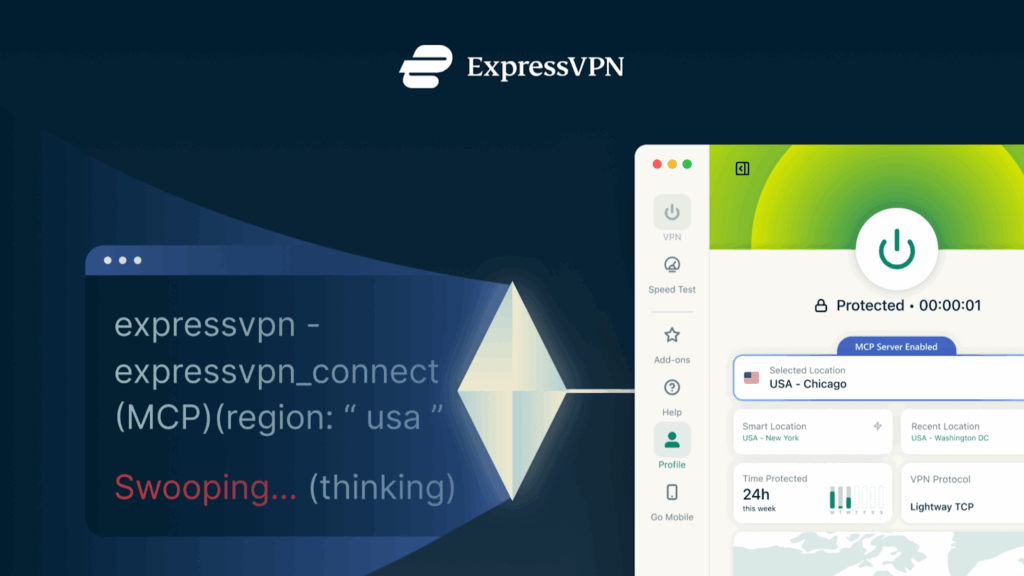
- ExpressVPN launches industry’s first Model Context Protocol (MCP) server
- Beta version allows AI agents Interact directly with your VPN desktop applications
- The feature is voluntary, runs locally, and operates under a strict no-logging policy.
ExpressVPN has announced the beta launch of its Model Context Protocol (MCP) server, becoming the first major provider to enable AI tools to interact directly with its desktop applications.
Announced today (March 5), this addition bridges the gap between the best VPN services and the burgeoning world of AI agents. By adopting the open standard introduced by Anthropic in late 2024, ExpressVPN effectively gives developers the ability to control their network security using natural language or automated scripts within their coding environments.
Previously, if a developer using an AI assistant needed to test a geographically specific API or verify a secure connection, they would have to abandon their workflow to manually toggle the settings in the VPN app. Now, supported AI tools, such as Anthropic’s Claude Code and OpenAI’s Codex, can read VPN status, change regions, and troubleshoot connectivity issues on behalf of the user.
Bringing AI to network security
The Model Context Protocol (MCP) is an open standard designed to connect AI systems with external data and tools. While many development platforms have adopted it since its introduction, network infrastructure has largely remained a manual affair, until now.
Deploying ExpressVPN creates a “strictly local bridge” between the AI tool and the ExpressVPN desktop app on macOS, Windows, or Linux. This means developers can issue commands in plain English, such as “switch to a US server.” or “check if my connection is secure”, and the AI agent runs them through the MCP server.
Shay Peretz, COO of ExpressVPN, says the move is aimed at eliminating friction for technical users who live on their endpoints.
“Developers increasingly rely on AI agents to automate complex tasks, but their network environment remains manual,” Peretz said. “Our MCP server provides VPN control to those workflows, enabling secure testing, troubleshooting, and region switching without disrupting your workflow.”
Peretz added that the company sees MCP becoming a “fundamental standard for how AI systems interact with external tools.”
Private by design
Allowing an AI to control network settings may raise questions regarding security, but ExpressVPN emphasizes that the feature is “private and secure by design.”
Crucially, the integration is disabled by default; Users must actively participate through the desktop app settings. Additionally, the MCP server operates with a fixed list of allowed commands. It cannot access account credentials or session information, ensuring that the AI agent does not have free rein over sensitive user data.
The company also confirmed that the new feature operates under its strict no-logs policy. “Activity logs, connection logs, and destination data are not collected or stored,” ExpressVPN said.
Who is this for?
While the average user may not need their AI chatbot to switch VPN servers just yet, this is a major quality-of-life improvement for software engineers and QA testers.
The beta version allows developers to automate tasks such as verifying secure connections before running scripts, testing geosensitive APIs in multiple regions, and diagnosing network issues through AI-assisted workflows. It basically eliminates the need to context switch between a code editor and the VPN client.
The MCP Server beta is available starting today, March 5, 2026, for individual users and ExpressVPN for Teams customers on all major desktop platforms. You can find more details on ExpressVPN’s features page or in their support guide.
Follow TechRadar on Google News and add us as a preferred source to receive news, reviews and opinions from our experts in your feeds. Be sure to click the Follow button!


