
- The new battery could dramatically increase the range of electric vehicles
- Semi-solid state chemistry has 30% higher energy density
- Higher density, reduced weight and smaller form factor promised
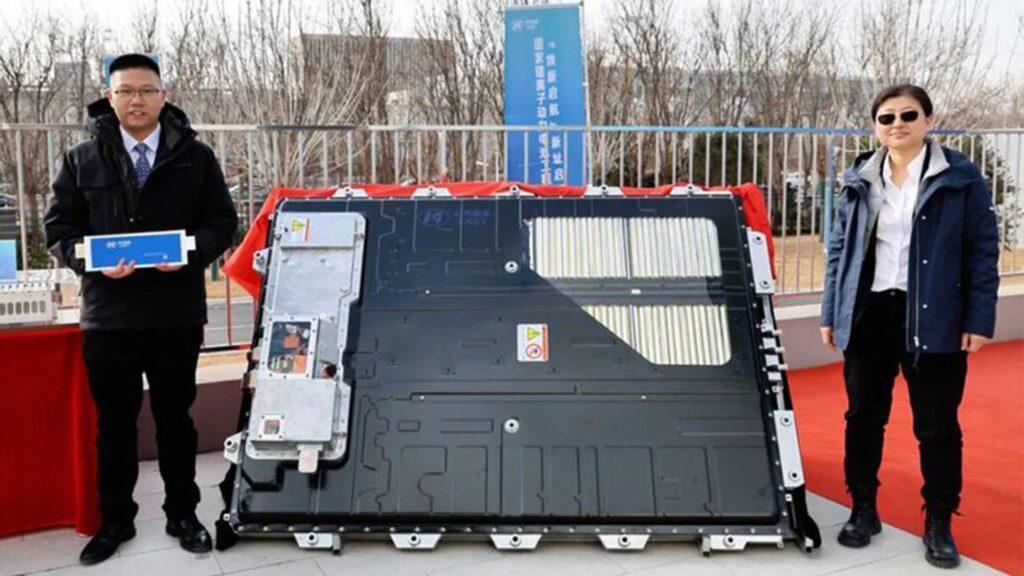
Researchers at Nankai University in Tianjin, China, have reportedly developed and tested a semi-solid-state battery that offers a 30% increase in energy density compared to some of the leading lithium-ion batteries currently on sale.
According to an announcement from the researchers (via Live Science), the current version of their semi-solid-state battery pack offers an energy density of 288 Wh/kg at the system level, when cooling systems, wiring, structural supports, and safety hardware are considered.
The energy density of the package in isolation is said to be 500 Wh/kg, while scientists say they are already working on iterations that could exceed 340 Wh/kg at the package level.
With a smaller form factor, lower weight and higher overall energy density, the Nankai University team claims the 142 kWh production version of their research package enables an EV driving range of more than 1,000 km after installation, which is equivalent to more than 620 miles on a single charge.
Details are still unclear about which electric vehicles were used during the tests and whether these are official figures from the China Light Vehicle Test Cycle (CLTC). But reports indicate that the technology is already undergoing iterative upgrades and is expected to achieve a battery system energy density of over 340 Wh/kg, a total pack capacity of over 200 kWh, and a driving range of over 1,600 km, nearly 1,000 miles of driving on a single charge.
It’s worth noting at this point that both Europe’s WLTP test cycles and North American EPA figures are much less generous than those cited in China, while real-world driving conditions reduce the range figures even further.
A general rule of thumb is to subtract about 30% from the claimed figures to get closer to something an EV owner can achieve in real-world driving conditions. So 620 miles quickly becomes about 430 miles and 1000 miles becomes 700 miles.
Still, that’s hugely impressive compared to the range cited by some of the leading lithium-ion technologies currently on sale. According to Live Science, the Nankai University battery is based on a lithium-rich manganese cathode and a hybrid solid-liquid electrolyte system.
The hybrid design combines the advantages of solid-state architecture with a “super-wetting” composite electrolyte, which aims to improve ionic conductivity and safety.
“Superwetting refers to the electrolyte spreading and completely penetrating the surfaces and pores of the battery materials, maximizing the contact between it and the active materials so that the ions can move more efficiently,” the report states.
According to the statement issued by Nankai University, the battery technology also introduces lithium anode technology for the first time, which addresses the “high-cost and high-risk issues associated with the use of lithium metal strips,” apparently simplifying the manufacturing process, reducing production costs, and making “significant advances” in battery cycle life and safety.
Analysis: a big leap if true
We must caveat this with the fact that the results come from a university-industry collaboration with the China Auto New Energy Technology Center and have not yet been independently verified in peer-reviewed research.
However, if the claims are true, researchers are already working on semi-solid state battery technology that could exceed 340 Wh/kg at the pack level. Combine this with an admittedly huge total capacity of 200 kWh and the range could effectively surpass the 1,000 mile mark.
While this is exciting, it feels like a big jump from where we are today.
For example, MG recently became one of the first global manufacturers to widely introduce semi-solid state battery technology in its MG 4 model.
In this case, the pack includes only 5% liquid in the electrolyte, but has an energy density of 180 Wh/kg, offering a range of 333 miles in CLTC testing with a 53.95 kWh pack.
To reach the heady levels of a 1,000-mile range, researchers at Nankai University suggest almost quadrupling the battery capacity, which would naturally have a massive impact on the physical size and weight of the backpack, not to mention the associated cost implications.
That said, the researchers claim that by dramatically increasing power density, this would in turn lead to smaller form factors and reduced weight.
If that’s the case, we could well be looking at electric vehicle battery technology that far surpasses its combustion engine counterparts when it comes to distance traveled between stops.
Follow TechRadar on Google News and add us as a preferred source to receive news, reviews and opinions from our experts in your feeds. Be sure to click the Follow button!
And of course, you can also follow TechRadar on YouTube and tiktok for news, reviews, unboxings in video form and receive regular updates from us on WhatsApp also.


