
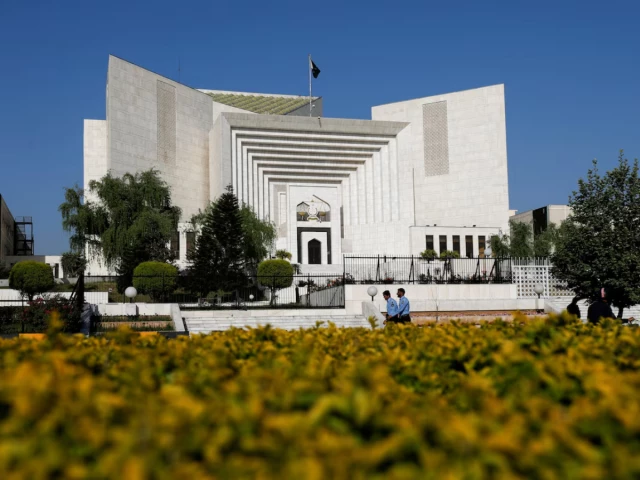
Police officers walk past the Supreme Court of Pakistan building, in Islamabad, Pakistan, April 6, 2022. REUTERS
ISLAMABAD:
The Supreme Court has issued important guidelines on court practices and has expressed concern about lengthy cross-examinations and the practice of repeatedly asking witnesses similar questions by multiple defense attorneys.
In a recent verdict, he warned that such tactics could constitute an abuse of the right to cross-examine and advised trial court judges to actively monitor proceedings and reject irrelevant or humiliating questions intended to harass witnesses.
The court also ordered that witnesses must be provided with seats while recording their testimony. He noted that there is no legal requirement for witnesses to stand during their statements.
He said forcing people, particularly victims of sexual crimes, to stand for prolonged periods could undermine their dignity and their ability to testify effectively.
The court directed the SC registrar to circulate the judgment to all high courts for implementation in subordinate courts and tribunals.
A three-member court dismissed a criminal petition seeking consolidation of two separate trials in rape cases and subsequent online dissemination of related material.
The bench headed by Justice Muhammad Hashim Khan Kakar and comprising Justice Salahuddin Panhwar and Justice Ishtiaq Ibrahim ruled that separate trials in cases can proceed independently, holding that the two offenses constitute distinct acts under different legal regimes.
The petition filed by Maham Fatima challenged an order of the Lahore High Court (LHC) that had earlier rejected a petition seeking consolidation of two criminal trials arising from separate FIRs related to the same sequence of events.
According to the written order written by Justice Panhwar, the case originated from complaints filed by medical student Khadija Ghafoor in Faisalabad in August 2022.
The complainant initially approached the Federal Investigation Agency’s cybercrime department, alleging that a video of her assault had been recorded and circulated online.
The next day, she lodged another complaint at a women’s police station, leading to the registration of a separate case under various provisions of the Pakistan Penal Code related to rape, assault, kidnapping and illegal confinement.
Subsequently, the FIA registered a second FIR under the provisions of the Prevention of Electronic Crimes Act, 2016 to record and share the alleged video of the incident.
The investigations were conducted by different agencies under separate legal frameworks, resulting in filing of two challans before courts functioning under different laws, including the Anti-Rape (Investigation and Trial) Act, 2021.
The accused had repeatedly sought consolidation of the trials, arguing that both the FIRs were related to the same incident and therefore needed to be tried together to avoid contradictory sentences.
However, the trial court and later the sessions court rejected the application. The matter eventually reached the LHC, which upheld the earlier decisions and refused to order a joint trial, prompting the petitioner to approach the Supreme Court.
Before the high court, the petitioner’s counsel argued that registration of two FIRs for the same occurrence violated legal principles laid down in previous judgments, including the well-known Sughran Bibi case, which discouraged multiple FIRs for the same incident.
The lawyer also argued that the provisions of the Code of Criminal Procedure, 1898 allow offenses arising from the same transaction to be tried together and warned that parallel trials could amount to double jeopardy and undermine the constitutional guarantee of a fair trial.
However, lawyers for the complainant and the State opposed the request, arguing that the alleged rape and the subsequent circulation of the video were separate acts with different motives, which fell under different legal regimes and therefore required separate procedures.
In its ruling, the Supreme Court examined the legal concept of “same transaction,” noting that the term is not expressly defined in criminal procedural law and must be determined by the courts based on factors such as continuity of action, community of purposes and the causal connection between events.
Applying these principles to the case, the court held that the two sets of allegations could be clearly separated. The court observed that the first phase involved the physical commission of the alleged offence, while the second phase concerned the dissemination of its record through electronic means.
According to the court, the motives behind these acts could also differ: the initial crime could be motivated by sexual gratification and the subsequent dissemination aimed at humiliation, degradation or blackmail.
The court further held that the provisions allowing joint trials under the CrPC are discretionary and not mandatory. The use of the word “may” in the relevant sections indicates that courts have the authority to order a joint trial when appropriate, but are not required to merge proceedings simply because it is legally permitted.
The ruling also highlighted that the two cases were being tried under separate legal schemes with different investigation mechanisms, one involving special courts dealing with sexual crimes and the other dealing with cybercrime investigations.
The consolidation of such procedures could generate jurisdictional complications and alter the already existing procedural structure.
The court noted that the trials had already progressed significantly and the prosecution’s evidence had been partially recorded. At such an advanced stage, the court observed, consolidation of the process would require modification of the charges and restructuring of the judicial process, which could undermine procedural continuity.


