
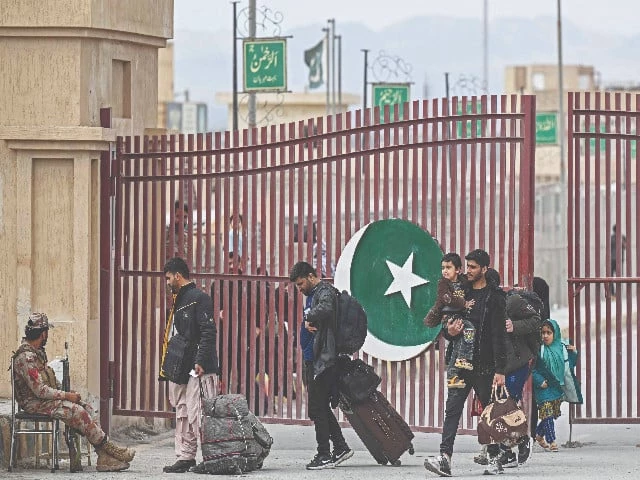
Safe passage: People enter Pakistan through the Taftan border crossing amid continued US and Israeli attacks on Iran. Photo: AFP
QUETA:
Nearly 2,000 people have entered Pakistan through the Pakistan-Iran border crossing at Taftan, including families of some diplomats, following the US and Israeli attacks on Iran, Balochistan Chief Minister Mir Sarfraz Bugti said on Friday.
He told reporters that the provincial government had put all relevant departments on high alert in view of the developing situation in the neighboring country, and authorities were closely monitoring developments along the Iranian border.
“So far, 1,979 people have entered Pakistan through the Taftan border point,” the Prime Minister said. “Among them are the families of 37 diplomats, who will be facilitated and provided with the necessary support upon their arrival.”
According to Bugti, the provincial government maintains close coordination with federal authorities while continuously reviewing the humanitarian and security situation. He said officials had been ordered to remain fully prepared to respond to any emerging circumstances.
“The arrival of Pakistani and foreign nationals through Taftan continues and essential facilities are being provided to them,” Bugti said. He added that officials in the border districts had also been directed to make necessary arrangements to manage arrivals at the crossing.
Bugti said immigration officials, security agencies and local administration were working together to ensure the process remained organized and smooth. He reiterated that the provincial government maintained close coordination with federal authorities.
Logistics
Pakistanis fleeing Iran described explosions and missile attacks across Tehran that shook the ground beneath their feet and engulfed buildings in fire and smoke in a city empty of many of its residents.
“I was in the classroom when a powerful explosion shook our university building,” Hareem Zahra, 23, a student at Tehran Engineering University, told Reuters after crossing Pakistan’s land border with Iran. “We saw thick smoke coming from many burning buildings,” she said, adding that Tehran was under attack until the moment she left.
Nearly 1,000 students, businessmen and pilgrims have fled Iran since the war began, out of a total of 35,000 Pakistanis in the country, said Mudassir Tipu, Pakistan’s ambassador in Tehran. “Now there are serious challenges. As you know, there is no Internet in most of Iran,” he said.
Tehran has seemed deserted since the conflict began, said Nadir Abbas, 25, a Persian literature student at a university in the Iranian capital. “I saw a drone hit a basketball court where six players lost their lives.” Reuters was unable to verify his account.
“The first attack happened right next to my hospital,” said Sakhi Aun Mohammad, a student at Tehran University of Medical Sciences. After reaching the border, an Iranian friend called him to check if he was safe and said: “Thank God, you have gone to Pakistan, you are all safe, but your shelter has been attacked.”
A Pakistani diplomat still in Tehran said the attacks occurred every four or five hours, adding that a missile hit a building next to his office. “Sometimes you’ll feel like something explodes right at your feet,” he said.
“The last time I went out was at night. Buildings had collapsed, some others were on fire. There is destruction everywhere.” And he added: “It’s almost like a ghost town.”
(With additional input from Reuters)


