
ISLAMABAD:
As the ongoing war between Iran and the US-Israel alliance begins to disrupt regional maritime security and threaten critical global shipping lanes, Pakistan on Monday launched a naval operation aimed at safeguarding its maritime trade and vital energy lines.
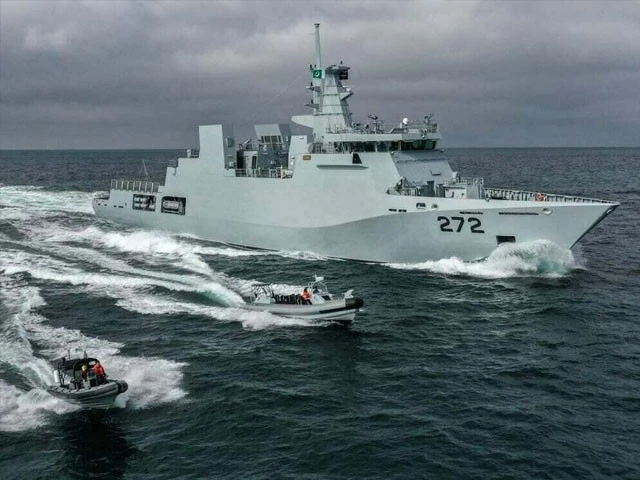
The Pakistan Navy announced the launch of Operation Muhafiz-ul-Bahr, a mission designed to ensure the safe passage of merchant ships and protect maritime lines of communication in the increasingly volatile waters of the Arabian Sea and the Gulf region.
The move comes as the escalating conflict between Iran and the US-Israel alliance has raised serious concerns about the security of the Strait of Hormuz, one of the world’s most critical energy corridors.
Tehran has repeatedly threatened to disrupt traffic through the strait, and reports of increased naval activity in the region have alarmed global markets and regional states that rely heavily on maritime trade.
Pakistan, whose economy relies overwhelmingly on maritime trade, is particularly vulnerable to any disruption.
Almost 90% of the country’s trade is carried out through sea routes, while a large part of its oil imports passes through the Strait of Hormuz before reaching Pakistani ports.
In this context, Pakistan Navy said it had activated escort operations to ensure uninterrupted flow of domestic energy supplies and maritime trade.
“In view of the evolving regional maritime security environment and potential disruptions in critical sea routes, Pakistan Navy has launched Operation Muhafiz-ul-Bahr to counter multi-dimensional threats to domestic shipping and maritime trade,” the military’s media wing said in a statement.
The navy said the initiative was aimed at ensuring security of sea lines of communication (SLOC) and protecting vessels carrying essential goods to Pakistan.
According to the statement, Pakistan Navy ships have already started escorting commercial vessels operating under the flag of Pakistan.
“PN escort operations are being carried out in close coordination with the Pakistan National Shipping Corporation (PNSC),” the statement read.
Navy ships are currently escorting two merchant ships, one of which is scheduled to arrive in Karachi later on Sunday.
The navy said it was closely monitoring the maritime situation and exercising control over the movement of merchant ships to ensure safe transit through potentially vulnerable waters.
“Pakistan Navy is fully aware of the prevailing maritime situation and is actively monitoring and controlling the movement of merchant vessels to ensure their safe passage,” the statement added.
Security analysts say the naval operation reflects growing concern in Islamabad that the growing conflict between Iran, the United States and Israel could spread to key maritime corridors, disrupting global shipping and energy flows.
Almost a fifth of the world’s oil shipments pass through the Strait of Hormuz, located between Iran and Oman. Any blockade or military confrontation in the narrow waterway could send shock waves through global energy markets and severely affect countries like Pakistan that rely heavily on imported fuel.
Recent days have seen rising tensions in the Gulf, with Iran warning that continued military pressure from the United States and Israel could force it to reconsider the security of sea lanes in the region.
International shipping companies have already begun to re-evaluate routes and insurance costs, while some vessels are reportedly avoiding high-risk areas.
For Pakistan, the stakes are high. Any prolonged disruption to shipping routes could hit oil supplies, increase shipping costs and put further pressure on an already fragile economy.
Officials say Operation Muhafiz-ul-Bahr is primarily a defensive measure designed to reassure business operators and ensure continuity of trade.
Pakistan Navy emphasized that it remains prepared to respond to emerging maritime threats and will continue to play its role in maintaining regional maritime stability.
“Pakistan Navy remains fully prepared to respond to emerging maritime security challenges and is committed to ensuring national shipping security and regional maritime security,” the statement said.
While Islamabad has not directly linked the operation to the ongoing conflict in the Gulf, analysts believe the timing clearly reflects the strategic anxieties created by the escalating confrontation between Iran, the United States and Israel.


