
Ministers cite Article 19 and warn that freedom of expression has limits in national security and foreign policy
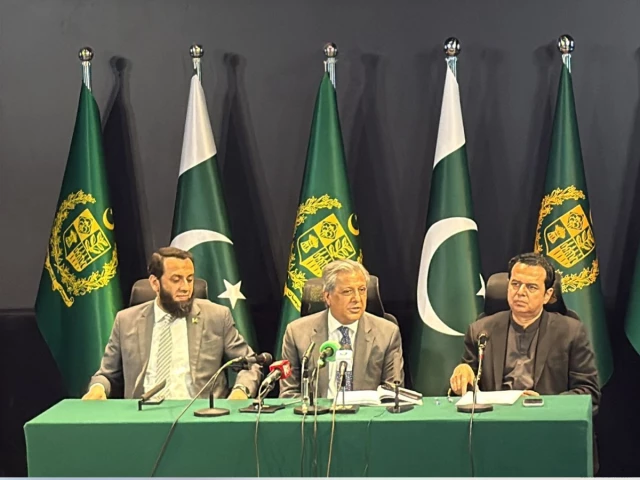
Federal Ministers Talal Chaudhry, Azam Nazeer Tarar and Attaullah Tarar address a joint press conference and affirm that Pakistan’s interests remain paramount, on March 10, 2026.
Federal ministers on Tuesday warned against “sensational” comments about Pakistan’s foreign policy, warning that action would be taken if “red lines” were crossed.
Addressing a joint press conference, Minister of State for Home Affairs Talal Chaudhry, Law Minister Azam Nazeer Tarar and Information Minister Attaullah Tarar said Pakistan’s interests remain paramount and urged social media users and commentators to avoid unnecessary comments on the country’s foreign relations.
Highlighting the constitutional provisions, the justice minister said Article 19 guaranteed freedom of expression but also imposed certain legal restrictions. Reading the clauses of Article 19, he warned that people should avoid comments that could endanger national security or harm Pakistan’s relations with friendly countries.
“Freedom of expression has limitations. Caution must be exercised when discussing religion, national security and Pakistan’s relations with friendly countries,” he said.
Azam Tarar added that while the government had maintained a fair policy, action would be taken if borders were crossed. “Only when the red line is crossed will action be taken,” he said, urging caution in comments on electronic and social media as the region goes through a difficult phase.
“The Ministry of External Affairs has played a key role during the current situation. For us, Pakistan’s interests come first,” Tarar said, adding that the country maintains close and friendly ties with regional states.
Read: Deadly protest at US consulate raises questions
Pakistan is currently engaged in hostilities with Afghanistan, which escalated in early February 2026, following a series of cross-border clashes in the border regions. Pakistan has accused Afghanistan-based militant groups known as Fitna al-Khawarij to carry out attacks on its territory, prompting increased security measures along the border.
While the United States and Israel have launched pre-emptive strikes against Iran following rising regional tensions. The latest escalation began in early March after the United States and Israel launched pre-emptive strikes against targets in Iran, leading to a sharp deterioration in regional tensions. The attacks followed the assassination of Iran’s supreme leader, Ayatollah Ali Khamenei.
The conflict has since expanded to multiple fronts in the Gulf region, with Iran vowing retaliation and warning of broader consequences.
Reverberations spread across Pakistan when protests over the assassination of Iran’s Supreme Leader Ayatollah Ali Khamenei on March 1, 2026, turned violent in Pakistan’s port city of Karachi, as hundreds of pro-Iran protesters marched toward the U.S. consulate there.
Hundreds of protesters broke through the outer wall of the consulate, vandalized the building and attempted to storm the premises amid chants of anti-American and anti-Israeli slogans.
Security forces, including local police, paramilitaries and US Navy security guards, responded with tear gas and, when the situation escalated, opened fire to repel the crowd. At least 10 protesters were killed and dozens more injured in the clashes, and the unrest led to the suspension of visa services at US consulates in Karachi and Lahore as a security measure. The violence also spread to other cities, with protesters attacking government and UN offices in parts of the north, such as in Skardu.
The minister, in today’s press conference, warned that negative vlogs or comments on relations between countries simply to gain online views could harm Pakistan’s interests.
“Creating sensationalism to gain opinions is harmful. In the current situation, spreading sensationalism is not a service to the country,” he said.
Read more: ‘The media faces an existential threat in Pakistan’
Tarar added that statements made in the Pakistani media were often interpreted abroad as the official position of the state. “In other countries, what is said in our media is taken as state policy,” he said, urging commentators not to base discussions on personal likes, dislikes or political agendas.
Law Minister Azam Nazeer Tarar said Pakistan had constantly sought diplomatic solutions and was playing an active role in regional efforts to reduce tensions. “Pakistan is a responsible nuclear state and has a clear stance on defense and foreign policy,” he said, adding that parliament had also been briefed on the ongoing conflict.
Law Minister Azam Nazeer Tarar said Pakistan has geographical importance and has sought diplomatic solutions to the current situation. He noted that Parliament has been informed about the ongoing conflict and that the Prime Minister has also issued a statement following the assassination of the Supreme Leader of Iran. He said the prime minister had issued a statement following the assassination of Iran’s Supreme Leader and was in contact with leaders of other countries to address the evolving situation. “Pakistan is a responsible nuclear state and has a clear stance on defense and foreign policy,” he added.
Earlier, Prime Minister Shehbaz Sharif on Saturday said on his social media platform
He further said that Pakistan is playing an active diplomatic role in the conflict, with the Prime Minister in touch with several world leaders, and that Pakistan has also taken an active role in the UN Security Council.
Pakistan’s Permanent Representative to the United Nations, Ambassador Asim Iftikhar Ahmad, sharply rebuked the Afghan and Indian envoys during a UN Security Council session on Afghanistan, accusing them of ignoring cross-border militancy targeting Pakistan. He said Afghan diplomat Naseer Ahmad Faiq was “isolated from ground realities” and criticized him for failing to address attacks from Afghan soil that damaged Pakistani civilians, security forces and infrastructure.
Ahmad also accused India of supporting militant groups operating from Afghanistan, including Tehreek-e-Taliban Pakistan (TTP) and the Balochistan Liberation Army (BLA), and violating international law in occupied Kashmir. Despite criticism, he reaffirmed Pakistan’s commitment to promoting peace and stability in Afghanistan, and emphasized that this required the Taliban to fulfill its commitments on counterterrorism, inclusive governance and protecting the rights of Afghan women and girls.


