
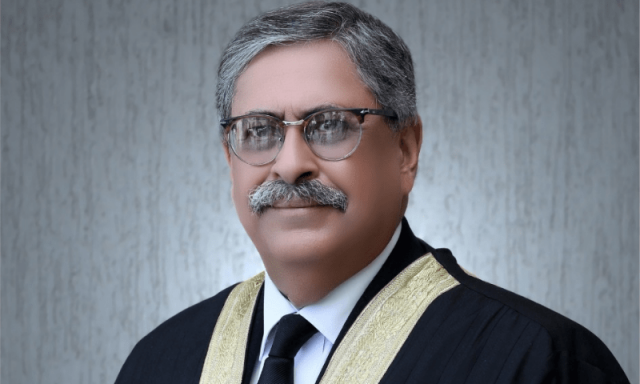
Athar Minallah, judge of the Supreme Court. PHOTO: ARCHIVE
ISLAMABAD:
Former Supreme Court Justice Athar Minallah has said that when the executive abdicates its fiduciary duty towards detainees, judicial intervention is not activism but a constitutional obligation.
Speaking at Harvard Law School, Justice (Ret.) Minallah said the true test of judicial independence lies not in speeches or rhetoric, but in whether the powerless trust the courts to protect them when their rights are violated.
Reflecting on his tenure and the institutional struggles facing the judiciary, he said courts must act as guardians of the voiceless, even when doing so requires confronting entrenched centers of power.
Justice (Retd.) Minallah recalled that when he was elevated to the Islamabad High Court (IHC), the institution was still evolving and operating within a difficult constitutional environment.
“When I was elevated to the Islamabad High Court, it was not yet a fully consolidated institution. Although it was endowed with extraordinary constitutional authority to issue the grand writs (certiorari, mandamus, prohibition, quo warranto and habeas corpus), its independence had not yet been ensured in practice. We functioned within a hybrid authoritarian constitutional culture, where power rested not on constitutional supremacy but on the uncontrolled will of the powerful elite. Serving the voiceless was dangerous and protecting them was deliberate. challenge.”
He said building judicial independence required deliberate effort and courage from judges willing to uphold constitutional values despite pressure.
“Judges of integrity had to be identified and persuaded to accept promotion despite resistance from entrenched power centers. Independence was not inherited, it was built. Those who took the oath proved brave. Some would later pay a price for that independence. We learned that institutional courage is both powerful and fragile.”
Justice (Retired) Minallah stressed that judicial independence should ultimately be judged on whether the courts inspire confidence among the most vulnerable in society.
“The true measure of judicial independence lies not in rhetoric but in whether the powerless believe that the court will protect them when they are wronged. And the powerless came.”
He also reflected on the evolving scope of constitutional rights, arguing that legal systems must reconsider their relationship to the natural world and the broader concept of life.
“When we talk about rights, we think about humans. Our Constitution, our laws, our struggles, everything centers on the human condition. But does the law listen only to the powerful human voice, or also to the silent pulse of life beyond us? If dignity and the right to exist are inherent in life itself, can constitutional compassion stop at our own species?
Addressing the global climate crisis, he said the idea of climate justice risks becoming empty rhetoric unless legal systems recognize the intrinsic value of life.
“Climate justice has emerged as a recurring theme at global summits and political forums. Yet for many victims, it remains little more than rhetoric: words spoken in the halls of power while devastation silently unfolds. The remedy begins with a simple but transformative recognition: life has intrinsic value in all its forms. Accepting this truth is the antidote to the anthropocentric mindset that has brought humanity to the brink of catastrophe.”
He said this recognition requires a moral change in humanity’s relationship with nature.
“It demands a moral recalibration: a shift from domination to guardianship. Humanity must remember that its relationship with nature is not that of conqueror or exploiter, but that of administrator, guardian. The rationality that once justified control must now demand accountability.”
Judge (Ret.) Minallah also recounted cases during his judicial tenure involving prisoners’ rights and enforced disappearances, describing them as watershed moments for constitutional protection.
“Overcrowded prisoners, without lawyers or voices, sent handwritten pleas by regular mail. For years they endured degrading conditions.”
He said these petitions eventually led to a landmark judicial ruling on prisoners’ rights.
“Their cries converged into a single, consolidated judgment on prisoners’ rights – the first comprehensive pronouncement in our jurisdiction. But constitutional protection demands more than words. I myself visited the Central Prison, Adiala, Rawalpindi, and constituted an Implementation Commission to ensure compliance.”
He added that the families of those forcibly disappeared went to court when other avenues had failed.
“The families of the forcibly disappeared came from distant corners, because no one else wanted to listen to them. The court formed an unprecedented commission, forging a jurisprudence that was not based on paper but moved in reality.”
Justice (retd) Minallah said the impact of judicial intervention became visible when the state authorities were confronted.
“When those responsible were confronted, the missing returned. At that time, the Constitution was no longer a text: it was a protection made reality. When prime ministers, journalists and human rights defenders confronted the coercive power of the State, the court reaffirmed a simple truth: the State exists to protect rights, not to crush them.”


