
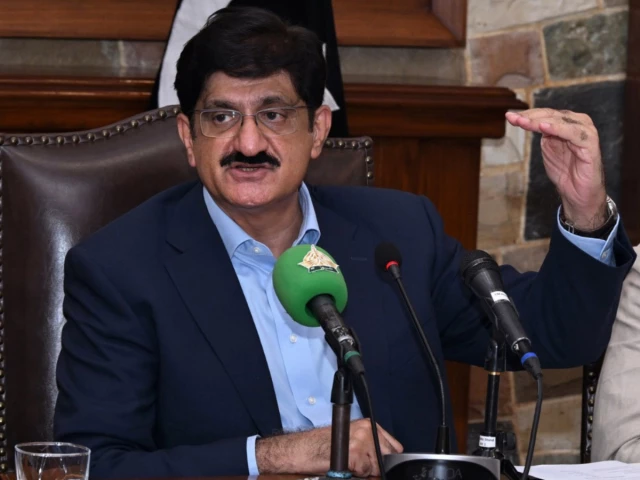
Sindh Chief Minister Syed Murad Ali Shah speaks during a press conference on Wednesday. Photo: NNI
KARACHI:
The Sindh cabinet approved a comprehensive fuel conservation and austerity plan in its meeting chaired by Chief Minister Murad Ali Shah. The cabinet also approved a series of governance, economic, social protection and educational reforms aimed at addressing the prevailing energy situation and strengthening public service delivery across the province.
The meeting, held at the CM House, was attended by provincial ministers, advisors, special assistants, chief secretary Asif Hyder Shah and relevant administrative secretaries.
Later, at a press conference, Sindh Chief Minister Sharjeel Inam mentioned that the cabinet considered a 23-point agenda, approving measures related to fiscal discipline, fuel conservation, educational reforms, women’s rights, agriculture, healthcare and institutional strengthening.
According to the minister, the Cabinet approved the launch of an austerity and fuel conservation campaign, guaranteeing the efficient use of energy resources in view of existing economic pressures.
Under the plan, the government has reduced fuel allowances for official vehicles by 50 percent for two months, a move expected to save around Rs 960.55 crore. However, operational vehicles such as ambulances, buses and emergency services will be exempt from the restriction. Additionally, 60 percent of official vehicles in government departments will remain grounded, while departments have been ordered to promote car-sharing system.
Provincial ministers, advisors and special assistants have decided to voluntarily give up their salaries and allowances for three months.
Senior government officials in BS-20 and above who earn more than Rs 300,000 a month have also been encouraged to voluntarily give up two days’ salary, except those working in the health and education sectors.
There will be a complete ban on the purchase of new vehicles until June 2026. The acquisition of computer equipment will only be allowed under the control of the relevant authorities.
The government has also imposed a ban on official visits abroad, except in unavoidable cases. Officials traveling on official trips must travel in economy class.
Government departments have been ordered to conduct meetings through virtual or online platforms to minimize travel and accommodation expenses.
The government has approved work-from-home arrangements for up to 50 per cent of staff on alternate days, except for essential services.
These measures will not apply to the banking sector, industry and agriculture, which will continue with their normal operations.
Colleges and universities will move to 100 percent online classes during this period.
The number of guests allowed at weddings and public gatherings has been restricted to 200, and the one-course rule is strictly enforced.
The cabinet also approved the landmark Student Attendance Monitoring and Remedial System (SAMRS) Policy, a technology-based initiative designed to address student absenteeism and rising school dropout rates.
To stabilize wheat supply and prices, the cabinet approved the expansion of wheat release policy to include private traders besides flour mills and chakkis.
Authorized traders will be provided wheat at the government notified price of Rs 8,000 per 100 kg bag. There are currently around 300,115 tonnes of wheat available for release, which could generate Rs 30,398 million in sales and help reduce the province’s wheat debt of Rs 109,405 million.
The cabinet approved the allocation of four acres of state land in Deh Khanto, Taluka Ibrahim Hyderi, Malir district, for the establishment of a nursing school attached to Hasan Suleman Memorial Hospital.
Additionally, the cabinet approved financial support of Rs 2,140 crore for the hospital following an expansion of its covered area from 250,000 sq ft to 325,000 sq ft and an increase in construction costs.
The 312-bed tertiary care hospital, located on the National Highway (N-5), will provide specialized healthcare services to the residents of Karachi and surrounding districts. The CM said the funds will be released from fiscal year 2026-27, subject to a matching contribution from the Hasan Suleman Foundation.
The cabinet approved the Sindh Women Agricultural Workers Rules 2026, developed with technical assistance from the International Labor Organization.
The standards formally recognize the contributions of women in agriculture, livestock and fishing, guaranteeing equal pay, maternity benefits and protection against harassment and discrimination.
Agricultural Worker Card for registration of workers and establishment of a BWSP Endowment Fund with an initial allocation of Rs 500 million to support women agricultural workers.


