
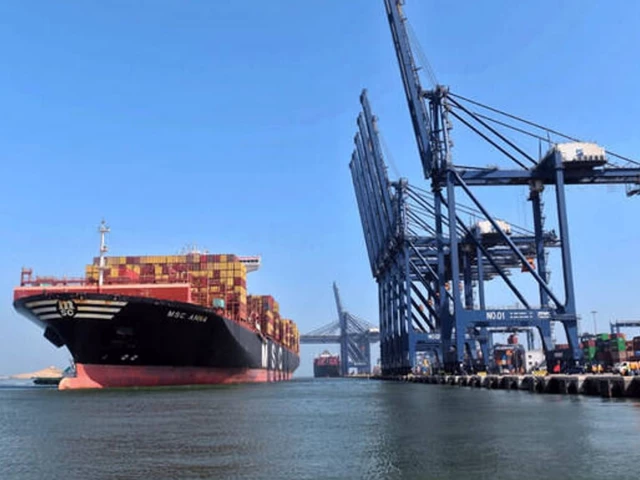
In this photo, taken and released by Karachi Port Trust, a container ship is docked at the Karachi Port in Karachi on May 29, 2024. Photo: KPT
KARACHI:
The first Pakistani ship to transit the Strait of Hormuz after its closure entered the Arabian Sea through the Gulf of Oman and reached Pakistan’s maritime zone, carrying a cargo of 80 million liters of crude oil.
The tanker MT Karachi crossed the strategically sensitive route after Iran closed it following attacks by the United States and Israel. It is the first Pakistani ship to successfully cross the strait under the current circumstances and enter the country’s territorial waters.
The ship is scheduled to dock at Karachi port on Wednesday. The officials said Iranian authorities granted MT Karachi special permission to transit through the Strait of Hormuz, using Iranian territorial waters during its passage.
The Pakistan Navy provided maritime security to the vessel throughout its journey, ensuring safe navigation through the sensitive corridor. The tanker had left the port of Das Island in the United Arab Emirates on February 28.
According to international media reports, payment for crude oil transported by MT Karachi was made in Chinese currency.
PM orders to strengthen fuel supply chain
Prime Minister Shehbaz Sharif on Tuesday directed authorities to strengthen the oil import supply chain and ordered all relevant institutions to remain ready to take emergency measures, as the government took steps to safeguard energy supply amid the escalating crisis in the Middle East.
Chairing a high-level meeting to review austerity and fuel conservation measures, the Prime Minister was informed that the country currently has sufficient reserves of petroleum products to meet national requirements, despite growing regional uncertainty and supply chain disruptions.
Officials informed those present that the austerity and energy saving measures previously announced by the government were being fully implemented, and the Prime Minister’s Office stated that their compliance was being closely monitored.
The Intelligence Bureau (IB) will submit regular monitoring reports to ensure compliance with these directives, officials said at the meeting, adding that authorities were maintaining records of oil stocks and closely monitoring the situation to detect any irregularities.
They said a system of daily reviews of fuel reserves has also been implemented to maintain oversight of the evolving energy landscape. In a broader assessment, they added, Pakistan remains adequately positioned in terms of fuel availability.
According to the report, Pakistan’s fuel needs for March were fully met and supply coverage was ensured till mid-April as per existing import and cargo planning, and efforts are being made to further expand this reserve.
In addition to fuel supplies, the Prime Minister was informed that adequate stocks of medicines were also available across the country, while the Ministry of Information Technology has completed arrangements to support government e-office systems and work-from-home operations.
Separately, Shehbaz Sharif chaired a review meeting of the Ministry of National Food Security and Research and the Pakistan Agricultural Research Council (PARC), during which he approved the restructuring of PARC.
Shehbaz directed that a comprehensive restructuring plan be prepared for PARC with a defined timeline and further directed that the organization become a leading agricultural research institution modeled after the Chinese Academy of Agricultural Sciences (CAAS).
The meeting was briefed in detail on how to transform PARC into a dynamic institution aligned with the demands of modern agricultural research, as part of a broader reform agenda to make it more effective in meeting national food needs.
(WITH INPUT FROM THE APP)


