
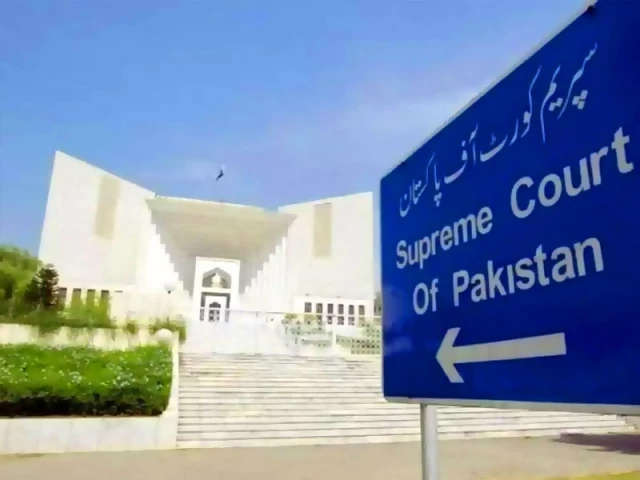
Court rules that employees of autonomous bodies or cantonment boards are not automatically public servants
ISLAMABAD:
The Supreme Court of Pakistan has decided that employees of cantonment boards are not considered public servants under the law. The decision was taken in response to a petition by a former employee of the Sialkot Cantonment Board, who challenged the disciplinary action taken against him.
The case revolves around Qaiser Mehmood, who was dismissed from the service following allegations of misconduct, including subletting government accommodation. After his discharge, Mehmood filed a service appeal, which the Federal Service Tribunal (FST) upheld and ordered a de novo investigation.
However, the cantonment board challenged the court’s jurisdiction, arguing that Mehmood was not a public servant and therefore could not invoke the jurisdiction of the FST.
Justice Muhammad Ali Mazhar, in his judgment, noted that the central issue was whether employees of cantonment boards can be classified as public servants, thereby allowing them to seek redress through the FST.
He explained the legal definitions, referring to earlier cases and statutes such as Section 2A of the Service Court Act, which had initially allowed employees of certain bodies, such as cantonment boards, to be considered public servants. However, this provision was later omitted in 2010.
“The bone of contention in this case is whether the employees of the Cantonment Boards are public servants and whether they can invoke the jurisdiction of the FST against any disciplinary action under the provisions of the Service Tribunal Act, 1973 (STA 1973), read with Article 212 of the Constitution of the Islamic Republic of Pakistan, 1973 (Constitution),” the judgment reads.
The court further cited the case of Muhammad Mubeenus Salam v. Federation of Pakistan (PLD 2006 SC 602), where the court emphasized that the legal status of a public servant is defined by Section 2(1)(b) of the Civil Servants Act (CSA), 1973, which specifies that public servants are members of All Pakistan Services or hold positions related to the affairs of the Federation.
Read also: PM Shehbaz orders measures to expand access to housing finance for low-income citizens
The court concluded that employees of autonomous bodies or local authorities, such as cantonment boards, could not automatically be considered public servants. “Every civil servant is in the service of Pakistan, but every person in the service of Pakistan is not a civil servant,” the ruling states.
The court explained that after the discontinuation of Section 2A of the STA 1973, employees of cantonment boards are no longer covered by the jurisdiction of the FST.
“Employees of the Cantonment Board cannot appeal and file a service appeal relating to their terms and conditions of service in the FST and the appropriate legal forum is the High Court under Article 199 of the Constitution.”
It concluded: “The contested ruling was issued without jurisdiction, rejecting the appeal for notification filed by the petitioner before the FST. The instructions contained in the ex officio order to carry out a de novo investigation must be complied with within a period of three months.”


