
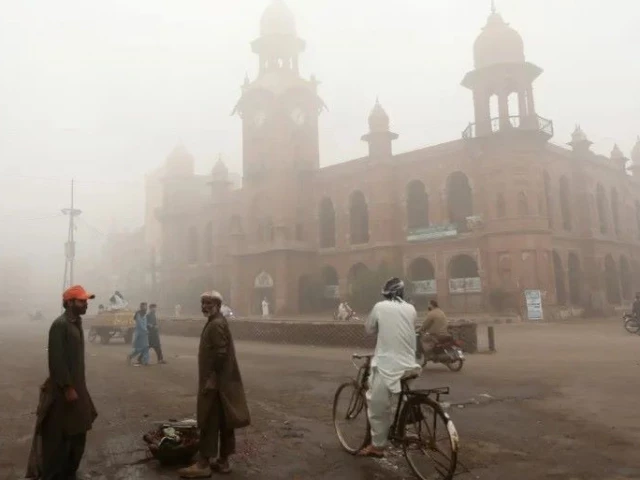
A view of smog in Punjab province. PHOTO FILE: AFP
Pakistan was ranked as the world’s smoggiest country in 2025, with concentrations of dangerous small particles known as PM2.5 up to 13 times the level recommended by the World Health Organization, research showed on Tuesday. These particles, which arise from combustion, industrial emissions and forest fires, penetrate deep into the lungs and bloodstream, contributing to heart and respiratory diseases, as well as premature deaths.
Swiss air quality monitoring company IQAir said in its annual report that 13 countries and territories kept average PM2.5 levels at the WHO standard of less than 5 micrograms per cubic meter last year, up from seven in 2024.
Karachi recorded dangerously high levels of PM2.5, with an AQI above 100, classified as “unhealthy for sensitive groups” on September 29, 2025. Cities like Hyderabad and Lahore are also facing similar air quality concerns.
The 25 most polluted cities in the world are in India, Pakistan and China. Loni in India was the most polluted city in the world in 2025, with average PM2.5 levels of 112.5 micrograms, followed by Hotan in the Xinjiang region of northwest China with 109.6 micrograms.
Bangladesh and Tajikistan ranked second and third on the list of the most polluted.
Read: Zardari urges to prioritize public aid
In total, 130 of 143 monitored countries and territories did not comply with WHO guidelines. Only 14% of the world’s cities met the WHO standard in 2025, down from 17% the previous year, and the Canadian wildfires raised PM2.5 across the United States and into Europe.
Among the countries that met the standard in 2025 are Australia, Iceland, Estonia and Panama.
Laos, Cambodia and Indonesia reported significant reductions in PM2.5 compared to the previous year, thanks mainly to wetter and windier La Niña weather. In Mongolia, average concentrations fell by 31%, to 17.8 micrograms per cubic meter.
Chad, statistically the smoggiest country in 2024, ranked fourth in 2025, but the decline in PM2.5 concentrations last year is likely the result of data gaps.
Last March, the United States shut down a global monitoring program that collected pollution data collected at its embassy and consulate buildings, citing budget constraints. “The loss of data in March made it seem like there was a significant drop in PM2.5 levels (in Chad), but the fact is we don’t know,” said Christi Chester Schroeder, lead author of the IQAir report.
The US decision eliminated a primary source of data for many smog-prone countries, and Burundi, Turkmenistan and Togo were excluded from the 2025 report due to data gaps.
In total, 75 countries reported lower levels of PM2.5 in 2025 compared to the previous year, and 54 recorded higher average concentrations, IQAir said.


