
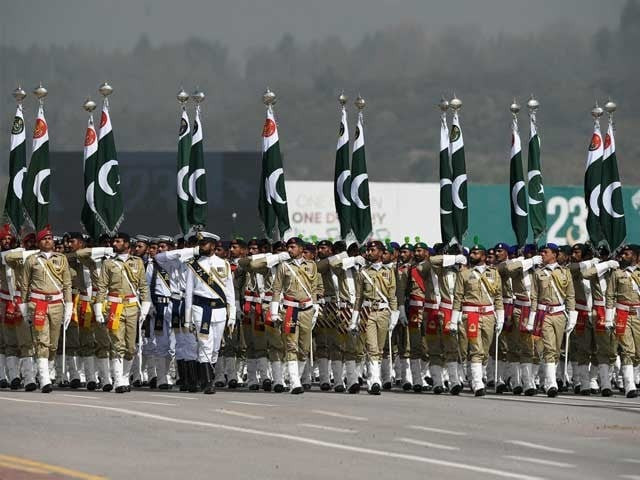
In the modern world, sovereignty has evolved; It is no longer just political; It is deeply economical
ISLAMABAD:
Every year on March 23, Pakistan commemorates the Lahore Resolution, a defining moment that set the course for the creation of a sovereign state. It was a vision rooted in dignity, self-determination and the right to forge an independent future.
More than seven decades later, Pakistan Day must be more than a memory. It must also be reflection. Because sovereignty today cannot be measured solely by flags and borders.
In the modern world, sovereignty has evolved. It is no longer just political; It is deeply economical. A country that cannot sustain its economy without external support, that repeatedly turns to institutions like the International Monetary Fund, must face a difficult question: how independent is its decision-making in practice?
Economic fragility reduces political space, limits strategic options and forces governments to make short-term decisions that often come at the cost of long-term stability. Over time, it creates an illusion of sovereignty, where there is political independence, but not economic autonomy.
Pakistan is not the only one to have emerged from colonial rule. Many nations that gained independence in the mid-20th century began their journey with similar or even weaker starting points.
Let’s think about South Korea. In the 1950s, it was devastated by war, had limited resources and was heavily dependent on aid. Today it is a global industrial and technological power. Malaysia moved from a commodity-based economy to a diversified manufacturing and services hub through consistent policy direction and export-led growth. Vietnam, once ravaged by conflict, has emerged as a major export economy, becoming deeply integrated into global supply chains.
These transformations were not accidental. They were the result of sustained political discipline, institutional coherence, and a clear understanding that economic strength is the basis of sovereignty.
Pakistan’s economic history, on the other hand, is defined by repetition. Crisis leads to stabilization. Stabilization leads to temporary relief. Aid delays reform. And the cycle begins again. Export bases remain narrow. Productivity growth is slow. Fiscal pressures are constant. Policy direction often changes with political transitions rather than long-term national priorities.
The issue is not the absence of ideas. Pakistan has developed numerous reform frameworks and policy roadmaps. The issue is continuity. Without sustained implementation, even the best strategies remain unrealized.
Why this Pakistan Day feels different
This year, Pakistan Day has a sharper character. Amid evolving regional tensions and shifting geopolitical realities, the meaning of sovereignty has become more immediate. National security is no longer limited to defense capabilities; It is inseparable from economic strength. A fragile economy is not just a development concern; It is a strategic vulnerability.
The spirit that led to the Lahore Resolution was rooted in the desire to control destiny. Today, that control depends as much on fiscal stability, export strength, and institutional credibility as it does on political independence. Pakistan does not need another diagnosis. Its challenges are well understood. What you need is discipline; expressed through three forms of coherence.
Policy coherence means that economic priorities must survive political cycles. Investors, industries and institutions respond to predictability, not periodic change. Without stable policies, even the most promising sectors fail to mature.
Coherence in reform requires that structural changes are not abandoned halfway. Tax reforms, export strategies and industrial policies cannot be crisis-driven exercises. They must be maintained, even as immediate pressures ease.
Consistency in direction is perhaps the most critical. Nations that progress do so not because they avoid setbacks, but because they do not lose sight of their long-term trajectory. Pakistan has often changed course just when continuity was needed most. Without these three forms of coherence, reform remains episodic and progress remains fragile.
From political freedom to economic strength
The generation that gathered in 1940 ensured a political future for Pakistan. The responsibility of the current generation is to secure its economy. With a population that exceeds 240 million – of which almost 65% are young – Pakistan is at a decisive moment. This demographic reality can become a powerful engine of growth or a source of economic tension.
Without economic expansion, job creation and productivity growth, the promise of youth becomes a pressure point. At the same time, the global economy is evolving rapidly. The competition is intensifying. Technological changes are redefining industries. Countries that fail to adapt risk being left behind.
Therefore, economic strength is not a luxury; It is a necessity. It is essential to safeguard political freedom. It is essential to provide dignity to citizens. It is essential to position Pakistan as a credible and secure member of the global community.
Pakistan Day is also a time of remembrance. It is a reminder of those who fought, sacrificed and imagined a state that would stand with dignity among nations. Their aspiration was not simply territorial independence, but a system that guaranteed justice, opportunity and self-sufficiency.
Honoring that sacrifice is not only remembering it but completing it. To do this, it is necessary to go beyond the symbolic celebration and achieve substantial progress. It requires building institutions that work, policies that last, and an economy that is sustained. It is necessary to ask not only what Pakistan is but what it is becoming.
A day to decide
Pakistan Day should not only celebrate what has been achieved; should define what comes next. A nation that is politically free but economically dependent remains strategically limited. When Pakistan was born, it was as a state with limited resources, fragile institutions and immense uncertainty. However, thanks to its resilience and determination, it survived, stabilized and laid the foundations of a State that functioned despite considerable difficulties.
That story is not a story of weakness; It is a story of resistance. But resistance alone is no longer enough. The world is moving faster than ever. Economies are transforming, technologies are redefining industries, and nations compete not only for survival but also for relevance. In such a world, standing still is not stability; It is decadence.
To catch up with the pace of global development, Pakistan must move forward with clarity of direction, consistency in decisions and the courage to translate ambition into execution. The vision must become policy. Policy must become implementation. Implementation must produce results. The generation of 1940 created Pakistan. This generation must now strengthen it. The promise was made. Its fulfillment is yet to come.
The writer is a doctor; former CEO, Board of Investment, Office of the Prime Minister; expert in public policy and corporate law


