
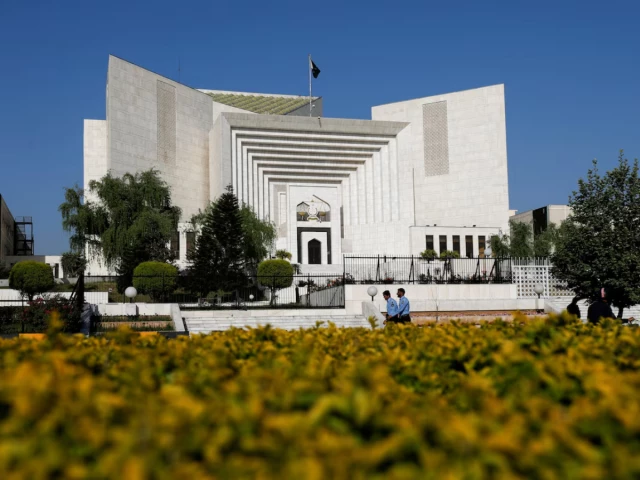
Police officers walk past the Supreme Court of Pakistan building, in Islamabad, Pakistan, April 6, 2022. REUTERS
ISLAMABAD:
A new constitutional debate is gaining momentum following the recent ruling by the Federal Constitutional Court (FCC) that previous decisions of the Supreme Court are not unconditionally binding on it, calling into question the traditional doctrine of stare decisis.
The ruling has opened a new front in legal discourse, with jurists analyzing its implications for precedent, hierarchy and institutional balance in what increasingly appears to be a dual judicial system at the top.
A senior legal official, while speaking to The Express PAkGazette, believes that judicial courtesy demands that SC rulings before the 27th Amendment remain binding on the FCC unless reviewed by its largest court.
He said that previously the SC acted as the supreme constitutional court, exercising jurisdiction under Article 184 of the Constitution, and that this jurisdiction has now been transferred to the FCC under Article 175E of the Constitution.
However, he agreed that after the 27th Amendment, the status of the SC has changed and the decisions of the FCC are binding on the current SC under Article 189 of the Constitution.
According to lawyer Haris Azmat, the FCC’s view that Supreme Court precedents are not binding on it reflects an important constitutional change after the 27th Amendment and changes to Article 189. “Traditionally, Supreme Court rulings were binding on all courts to ensure consistency of the legal system. The amendment appears to place the Federal Constitutional Court on an independent footing in constitutional interpretation,” he notes.
“This is the law now. The Federal Constitutional Court can develop its own jurisprudence without being strictly bound by Supreme Court precedent. While this can strengthen constitutional control, it also raises concerns about contradictory interpretations and legal uncertainty if both courts adopt divergent views,” the lawyer observes.
Haris Azmat further states that the real test will be how these two institutions exercise their powers and maintain consistency in the legal system in the future. Regarding SC decisions made before the 27th Amendment, counsel believes they are not binding on the FCC under the latest amendment. “That’s the clear text.”
Two peaks, one system
A former legal agent says the author of the recent FCC ruling is Judge Hasan Azhar Rizvi.
“I think what you’re saying is that the FCC is not bound by prior SC rulings, just as the SC itself was not bound by its own prior rulings. It could overturn its prior rulings. This was done occasionally by the SC itself. That’s all that needs to be read into the meaning of the FCC ruling.”
“However, it is a fact that after the 27th Amendment, the SC cannot overturn any ruling of the FCC. It is doubtful that the SC can overturn its own previous rulings involving constitutional issues, although, apart from constitutional issues, I believe it can still overturn its previous rulings,” he considers.
“Justice Rizvi said that we will normally follow the rulings of the Supreme Court, but if it so wishes, the FCC can deviate. This is nothing new, but it seems strange given the duality of the two high courts currently functioning in Pakistan.”
Note that at the end of the day, only one high court will remain. It remains uncertain which court will ultimately survive, although currently the FCC appears to have the upper hand.
The situation is further complicated by the fact that, rather than functioning as a true FCC, similar to many European constitutional courts, the FCC has evolved into more of a general appeals court, a role it now shares with the existing SC.
Furthermore, he wonders why laws are being changed to substitute legal appeals from the SC to the FCC in election, NAB and other cases. “What constitutional court in the world hears ordinary legal appeals that do not involve any constitutional questions? I believe that these amendments providing for legal appeals to the FCC go against the spirit of the 27th Amendment itself and are motivated by superfluous considerations.”
—Supreme in name only?
Legal expert Abdul Moiz Jaferii says that the SC becomes nominally supreme only after the 27th Amendment and that this was the express intention of the legislature. “To assume that the powers that be would have let past precedents bind their hand-picked dispensers of justice would negate the need for the amendment itself.”
“This is the new normal. A group of judges were elected to the top of the hierarchy because the executive liked them. If the Supreme Court thinks otherwise, it is a simple case of denial. Appealable to the FCC and not the Supreme Court.”
FCC Ruling
The FCC has also developed certain principles to depart from previous SC precedent.
“Departure from a prior Supreme Court precedent may be justified only when this court (FCC) determines that such precedent is manifestly inconsistent with the text or structure of the Constitution (ii) undermines or dilutes fundamental rights, (iii) reflects judicial overreach in the legislative or executive domains; or (iv) has become inconsistent with evolved constitutional values and democratic norms (v) any other compelling reason tending to advance the cause of justice,” a 16-page ruling written by Justice Syed Hasan Azhar Rizvi read out while confirming the high court’s order in a child marriage case.
The ruling noted that it is imperative to first clarify the precedent authority and binding force of previous decisions on the FCC within the framework of the prevailing constitutional dispensation.
“The frequent references to the judgments of the Supreme Court of Pakistan in our decisions may otherwise create the erroneous impression that this Court is unrestrictedly bound by such declarations in all circumstances, while that is not necessarily the position under the prevailing constitutional framework,” the judgment said, adding that “Article 189 of the Constitution, which earlier gave binding force to the judgments of the Supreme Court of Pakistan on all courts subordinate to it, must now be read in the light of the altered constitutional architecture,” the judgment read.
“Upon the establishment of this Court and the granting of final and binding authority in all matters, particularly in constitutional matters, the hierarchy of precedents stands constitutionally restructured. Accordingly, the binding force contemplated in Article 189 must be understood to operate subject to the supreme authority of this Court. The supremacy of constitutional adjudication now rests with this Court, and all courts, including the Supreme Court of Pakistan, are bound by its pronouncements.”
The ruling clarified that the binding force of judicial precedent does not derive from institutional seniority but from the constitutional hierarchy itself.
“Where the Constitution expressly confers final interpretative authority on a particular court, its pronouncements necessarily prevail over all others, including those of courts that previously exercised that jurisdiction. Accordingly, judgments of the Supreme Court of Pakistan delivered before the establishment of this Court do not serve as binding precedents for this Court.”
“Nevertheless, they continue to have great persuasive value, particularly when they are based on sound reasoning, reflect a consistent line of authority, and are in harmony with the text, structure, and underlying values of the Constitution.
“It goes without saying that the doctrine of stare decisis has not been repealed; rather, it has been recalibrated to give primacy to constitutional supremacy.”
“Judicial discipline requires that precedent be reconsidered, not ignored or silently ignored, and that continuity be preserved except where deviation becomes a constitutional necessity. Therefore, this Court would normally respect and follow our earlier constitutional jurisprudence developed by the Supreme Court of Pakistan, unless it is established that the same is manifestly erroneous, inconsistent with the constitutional text or scheme, or incompatible with contemporary fundamental rights and constitutional values.”
“Any departure from prior Supreme Court precedent would be reasoned, express, and principled. However, the ultimate touchstone remains the Constitution itself, the meaning of which this Court is obligated to definitively expound.”


