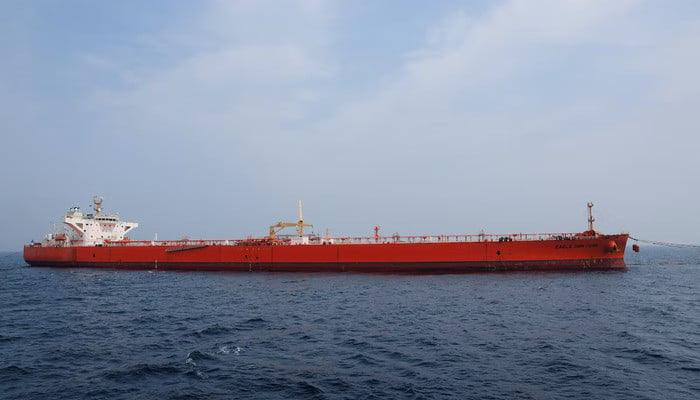
- Trump tells aides he is willing to end war with Iran without reopening Hormuz.
- Kuwait says a tanker was hit in an Iranian attack on Dubai port.
- Brent is heading for the highest monthly gain in history and WTI for the highest since 2020.
Oil prices reversed course in Asian trading on Tuesday, paring earlier gains, following a report that US President Donald Trump told aides he is willing to end the Iran war without reopening the Strait of Hormuz.
May Brent crude futures were down $1.22, or 1.08%, at $111.56 a barrel by 0210 GMT, after rising 2% earlier in the session. The May contract expires on Tuesday and the more active June contract was at $105.76.
U.S. West Texas Intermediate futures for May fell 98 cents, or 0.95%, to $101.90 a barrel after hitting their highest point since March 9 in early trading.
Analysts said the drop in prices is a temporary reaction to the idea of an end to the war, but any significant change in prices would not materialize until flows through the Strait of Hormuz are fully restored.
Trump told aides he is willing to end the military campaign against Iran even if the Strait of Hormuz remains largely closed and leave its reopening for a later date. The Wall Street Journal reported Monday, citing administration officials.
On Monday, Trump warned that the United States would “destroy” Iran’s power plants and oil wells if Tehran did not reopen the waterway.
Iran’s effective closure of the Strait of Hormuz, which normally carries around a fifth of the world’s oil supply and a large number of liquefied natural gas tankers, has sent Brent futures up 59% so far in March, its biggest monthly gain on record, while WTI is up 58% this month, the biggest rise since May 2020.
“While diplomatic signals remain mixed, reality suggests that uncertainty will persist,” said Sugandha Sachdeva, founder of SS WealthStreet, a New Delhi-based research firm.
“Even in the event of a de-escalation, restoring damaged infrastructure will take time, keeping supply limited.”
Highlighting the threat to seaborne energy supplies arising from the war between Iran, the United States and Israel, Kuwait Petroleum Corp said on Tuesday that its fully loaded Al Salmi crude oil tanker, capable of carrying up to 2 million barrels, was hit by a suspected Iranian attack on a Dubai port. Authorities also warned of possible oil spills in the area.
On Saturday, Yemen’s Iran-aligned Houthi forces attacked Israel with missiles, raising fresh concerns about possible disruptions in the Bab el-Mandeb Strait, the chokepoint linking the Red Sea and the Gulf of Aden, a key route for ships moving between Asia and Europe through the Suez Canal.
Saudi crude oil exports have been diverted through this passage, with volumes redirected from the Gulf to the Red Sea port of Yanbu reaching 4.658 million barrels per day last week, Kpler data showed, a sharp rise from an average of 770,000 bpd in January and February.
Meanwhile, in the United States, crude oil stockpiles were expected to have fallen last week, along with distillate and gasoline inventories, according to a preliminary forecast. Reuters The survey showed on Monday.
“Conflicting statements and signals about the state of the war fly thick and fast and truth and facts are the biggest victims,” said Vandana Hari, founder of oil market analysis provider Vanda Insights.
“Oil is likely to continue to be buffeted and directionless.”