
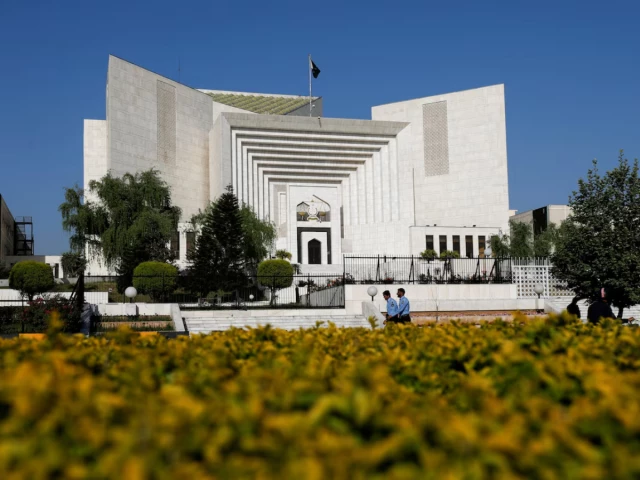
Police officers walk past the Supreme Court of Pakistan building, in Islamabad, Pakistan, April 6, 2022. REUTERS
ISLAMABAD:
Nearly five months after the creation of the Federal Constitutional Court (FCC), lawyers remain unconvinced that the sweeping constitutional reform has delivered on its central promise: faster justice, with case backlogs still stubbornly high in the two high courts.
Despite the government’s claim that the FCC would ease the burden on the Supreme Court (SC) and expedite relief for ordinary litigants, legal circles say the reform has so far amounted to little more than a reshuffling of cases rather than a significant reduction in pendency.
The federal government had conveyed that one of the FCC’s primary objectives was to facilitate ordinary litigants whose cases were delayed due to the SC’s judicial activism. Even the senior bar associations, led by the Independent Group, had fully endorsed the 27th constitutional amendment under which the supreme court (FCC) was created in November last year.
Before the FCC became operational on November 13, 2025, a total of 56,608 cases were pending in the SC, of which 22,910 were transferred to the FCC, while 33,698 remained pending in the SC. Currently, seven judges work at the FCC, while 18 serve at the SC.
Despite the increase in public funding for judges after the 27th Amendment, there has been no significant impact on pendency, as more than 56,000 cases remain pending in both high courts.
A section of lawyers blames the executive for the situation, arguing that the appointment of junior judges to the Supreme Court (FCC), without following the established criteria and with high salary packages, has negatively affected the morale of the senior judges of the SC.
They also point out that Pakistan’s Chief Justice Yahya Afridi has been accommodated through a person-specific constitutional amendment and is now recognized as Chief Justice after the 27th Amendment, although he remains bound to follow FCC court orders under Article 189 of the Constitution.
However, in the last two years there has been some improvement in the resolution of criminal cases in the Supreme Court.
Meanwhile, the SC issued a statement on Tuesday stating that “during the last three months, 3,600 cases were filed and 5,383 cases were resolved, bringing the total pending cases to 34,083.”
The status of jail petitions and death penalty appeals was also reviewed. It was noted that the number of pending death penalty cases has been reduced from 384 at the time of taking office (October 2024) to 60 cases.
“To ensure timely judgment in matters related to the right to life, it was resolved that all pending death sentence appeals will be resolved within the next 30 days. It was further decided that cases initiated up to 2018 will be resolved on a priority basis to eliminate the annual backlog,” the statement said.
Former additional attorney general Tariq Mahmood Khokhar says the “26th and 27th constitutional amendments” lack legitimacy because they were not enacted democratically. “A fortiori, its resulting consequences, including the Federal Constitutional Court, also lack legitimacy. The FCC embodies a parallel judicial hierarchy of questionable necessity. Its stated goal, the reduction of litigation, is contradicted by empirical data.”
Khokhar pointed out that before the “27th constitutional amendment” there were 56,608 cases pending in the Supreme Court. Currently, there are 33,850 cases pending in the SC and 22,325 cases in the FCC.
“Clearly, this is a case of mere redistribution, not resolution of systemic congestion. Such a transfer of cases reflects administrative displacement rather than judicial efficiency. The FCC, with seven judges, has had no success in reducing the backlog of cases. The national treasury is bearing a significant and recurring financial cost without any significant benefit to the common litigant,” he adds.
Former judicial officer Tariq Khokhar says the paucity of constitutional jurisprudence is glaring: just 15 cases reported, devoid of significant constitutional substance.
“Citizens, their supposed beneficiaries of constitutional adjudication, have derived no discernible advantage from this structural experiment.
On the contrary, the executive is no longer accountable. Worse still, their orders of dubious constitutionality are confirmed and validated.”
“The appointment mechanism, now effectively under the influence of the executive, has eroded the independence of the judiciary. The resulting judiciary bears the unmistakable imprint of control rather than independence”
He said public accusations, including those alleging that conscience has been compromised for personal gain, remain unanswered by jurisprudence. “The validation of the military trial of civilians is a permanent scar,” he points out.
Likewise, lawyer Umer Gilani says that the reshuffling of the highest level of the judiciary through the 26th and 27th amendments has not brought about any significant improvement in the expeditious disposal of cases.
“This is not surprising. The only sustainable way to reduce the backlog of cases is to disincentivize those filing false and frivolous claims, and create incentives for parties with a weak case to give in early in the litigation cycle. No serious progress has been made in that direction,” Gilani observes.
Lawyer Hafiz Ahsaan Ahmad observed that while the 26th and 27th amendments and the creation of the FCC were important steps towards strengthening the justice delivery system, the practical impact on the handling of cases remains an ongoing challenge.
The reforms were aimed at reducing the burden on the higher judiciary and ensuring faster resolution of matters of constitutional and public importance. However, despite positive intentions, ordinary litigants continue to face delays in accessing timely justice.
It noted that under the Practice and Procedure Act, important cases are expected to be set for first hearing within 15 days, but this deadline has not been consistently met, contributing to persistent delays.
Hafiz Ehsaan emphasized that the FCC’s current strength is not adequate to manage its huge backlog and, as a result, timely adjudication remains a challenge.
He stressed that the court’s judicial strength should be increased at par with the SC, ensuring that it has sufficient capacity to handle its significant caseload efficiently. Aligning resources with workload is essential to achieve the constitutional objective of access to justice provided for in Article 37(d).
Finally, he suggested that a structured dialogue on national justice should be initiated between Parliament and the judiciary. Such a dialogue would aim to develop a forward-looking ten-year reform implementation strategy, drawing lessons from other countries that have successfully prioritized judicial reforms.
By working collaboratively, setting clear priorities and implementing reforms gradually and realistically, Pakistan can ensure that the justice system is more efficient, responsive and accessible to all citizens.


