
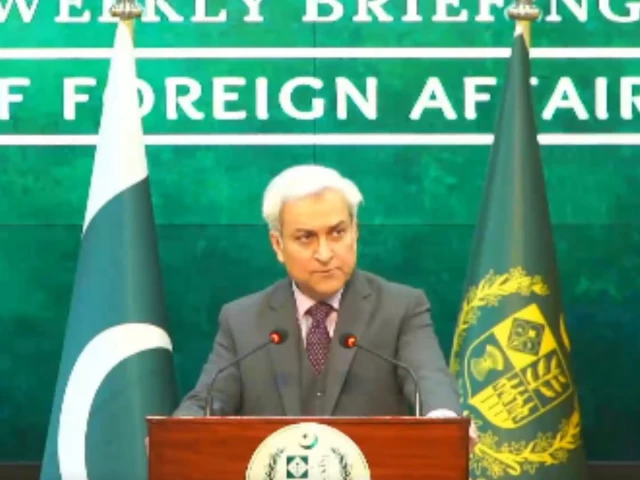
Tahir Andrabi speaking at the Ministry of Foreign Affairs weekly press conference Photo file: X/FO
ISLAMABAD:
Pakistan is holding talks with Afghanistan to end the worst conflict between the South Asian neighbors since the Taliban returned to power in 2021, Foreign Ministry spokesman Tahir Andrabi confirmed at a weekly press briefing on Thursday.
The talks in the northwestern Chinese city of Urumqi were taking place between senior officials from the two countries, the spokesperson said. He added that the purpose is to stop terrorism coming from Afghanistan.
“Our demand is that the Afghan Taliban take concrete steps against the terrorists. The Pakistani delegation is still in China for talks. Pakistan has never shied away from negotiations. We are also engaged with China on Afghanistan,” the spokesperson said.
Andrabi took note of Foreign Minister Ishaq Dar’s recent visit to China, from which he returned on Wednesday. The spokesperson mentioned the five-point peace plan jointly released by the two countries.
🔴LIVE: Spokesperson’s Weekly Press Conference 04-02-2026 at Ministry of External Affairs, Islamabad
— Ministry of Foreign Affairs – Pakistan (@ForeignOfficePk) April 2, 2026
Pakistan and China on Tuesday jointly proposed a five-point initiative aimed at restoring peace and stability in the Gulf and the broader Middle East. The plan calls for an immediate ceasefire, urgent diplomatic engagement to prevent further escalation, and the restoration of normal maritime traffic through the Strait of Hormuz.
The briefing also highlighted China’s support. “The Chinese side expressed deep gratitude and expressed that China and Pakistan are strategic cooperative partners,” the spokesperson said.
The security of sea routes was also a key issue during Dars’ visit to China. In this regard, the FO spokesperson noted that the Iranian government has allowed 20 more Pakistani-flagged ships to pass through the Strait of Hormuz, calling the move a “harbinger of peace.”
Andrabi also spoke about the meeting of the four foreign ministers of Pakistan, Saudi Arabia, Turkey and Egypt in Islamabad last week to support talks between Iran and the United States and discuss broader regional developments. “This was the second in the series; as you may remember, the first was held in Riyadh on March 19,” the spokesperson said.
The four foreign ministers arrived in Pakistan over the weekend to attend a quadrilateral meeting of foreign ministers focused on easing tensions between the United States and Iran. The foreign ministers also agreed on the need to contain the situation, reduce the risks of further military escalation and create conditions conducive to structured negotiations.
Also read: Pakistan signals talks between Iran and US in ‘coming days’
They stressed that dialogue and diplomacy remained the only viable way forward, while calling for adherence to the principles of the United Nations Charter, including respect for sovereignty and territorial integrity.
After Sunday’s four-way talks, Dar announced that Islamabad could host high-stakes talks between Iran and the United States “in the coming days.” “I briefed the visiting brother foreign ministers about the prospects of possible US-Iran talks in Islamabad. The visiting foreign ministers expressed their full support for this initiative,” he said.
He added that “Pakistan will be honored to host and facilitate meaningful talks between the two sides for a comprehensive and lasting agreement,” adding that both Tehran and Washington had expressed confidence in Islamabad’s role as a neutral facilitator.
The three visiting foreign ministers also called on Prime Minister Shehbaz Sharif and statements were issued in the media about the interactions. “The four MOFA foreign ministers reviewed the Gulf situation. Efforts to reduce tensions in the region were discussed, and the interactions provided an opportunity to address key regional challenges,” the report said.
Read more: IMF seeks fiscal target of Rs 15.6 trillion
On the telephone diplomacy front, Foreign Minister Dar has held multiple calls this week: on March 27, calls with the Foreign Ministers of Egypt, Qatar and Indonesia, and on March 29, a call with the Foreign Minister of Iran to discuss the evolving regional situation, emphasizing dialogue and diplomacy as the only viable path.
The spokesperson also reaffirmed Pakistan’s stance on the Israel-Palestine issue: “You must have seen all eight foreign ministers, including Pakistan, condemning Israel’s actions in Jerusalem,” the spokesperson said.
A joint statement issued by the foreign ministers of Pakistan, Egypt, Jordan, the United Arab Emirates, Indonesia, Turkiye, Saudi Arabia and Qatar said the countries “condemn, in the strongest terms, and reject the continued restrictions imposed by Israel on the freedom of worship of Muslims and Christians in occupied Jerusalem,” read the statement shared on X.
He also addressed misinformation circulating from India about Pakistan’s diplomacy in the Iran-US conflict. “Fake news has been published about Pakistan’s role. The statement attributed to the Iranian Foreign Ministry was also distorted and later the Iranian Foreign Ministry issued a clarification. Beware of these fake news and liars,” the spokesperson warned.
WITH ADDITIONAL CONTRIBUTIONS FROM REUTERS.


