
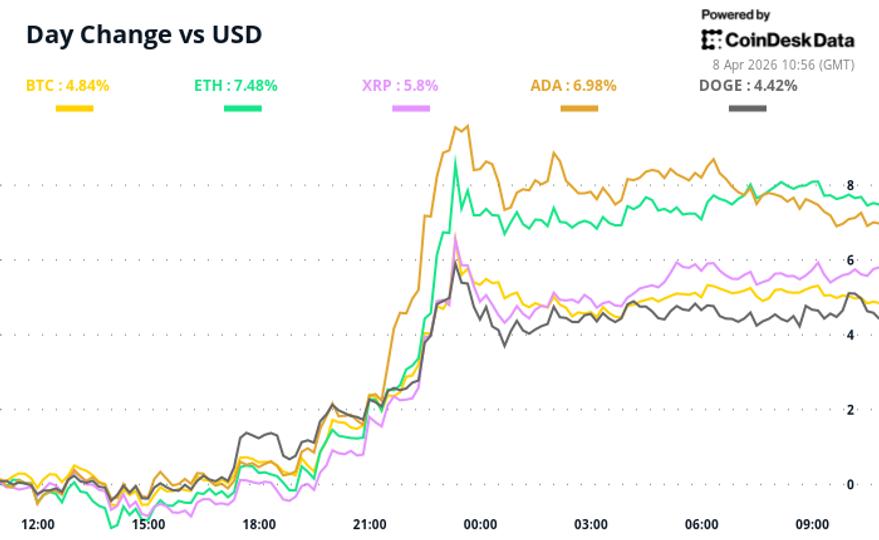
The cryptocurrency market has returned to the forefront after a two-week ceasefire between the United States and Iran removed some geopolitical uncertainty and sent oil prices tumbling. Still, the dynamics of the energy market are such that it may be too early to assume the return of animal spirits to risk assets.
bitcoin has risen 3% to $71,600 in the last 24 hours, while ether (ETH), XRP (XRP), and solana (SOL) have gained more than 5%. The CoinDesk 20 index has outperformed bitcoin, rising 4.2 percent, which is typical when altcoins outperform the market leader.
Oil has plummeted after Iran agreed to open the Strait of Hormuz, a key route for global shipping. WTI crude oil futures trading on NYMEX are down nearly 16 percent to $95 a barrel. When crude oil falls sharply, fears about inflation diminish, calls for Fed rate hikes weaken, and cryptocurrencies tend to rally.
Supporting the move is a drop in bitcoin and ether’s 30-day implied volatility, which measures market fear. Since the debut of spot ETFs two years ago, these figures have evolved into VIX-like metrics, which spike during sell-offs and calm down as the panic fades.
The mood could improve later if Morgan Stanley’s bitcoin ETF debuts with strong volumes and inflows from day one. That would reinforce the story of institutional adoption.
“The recent pattern has been that institutional demand has come back through ETFs. When there are inflows, dips are bought faster and the market maintains higher levels even as momentum cools,” Marex said.
Still, there are reasons to be cautious. The overnight rally was driven in part by the liquidation of short positions after traders betting on an escalation between the United States and Iran were caught off guard. According to Coinglass, $431 million worth of shorts were liquidated in 24 hours, the most since March 4. In cases like this, the market often spins around waiting for new demand. Without it, gains can quickly reverse.
While oil has dropped to $85, it is still $30 higher than before the conflict began on February 28. Furthermore, the ceasefire is temporary and not a permanent solution, and for oil to continue falling, Hormuz tanker traffic and insurance rates must normalize to pre-war levels.
“This remains a pause rather than a lasting agreement, with the ceasefire conditional on how Iran manages the passage through Hormuz in the coming weeks,” QCP Capital said. “That caution is important because the narrative of physical harm has not gone away.”
Until then, oil could stay near $100 and keep risk assets like cryptocurrencies in check. Stay alert.
What is trend?
Effect of Iran ceasefire: Oil plunges as European markets rise (euronews): Oil prices fell below $100 a barrel and European and Asian markets rose after the United States and Iran agreed to a two-week ceasefire that includes reopening the Strait of Hormuz.
Dollar Hits Four-Week Low as Ceasefire Boosts Risk Appetite (Bloomberg): The dollar fell as much as 0.97% to a four-week low as the deal pushed down Treasury yields, further reducing support. The South African rand and Swedish krona gained about 2% each.
European stocks soar 4% after US-Iran ceasefire deal; Travel Stocks Lead Gains Up 7% (CNBC): European stocks opened sharply higher on Wednesday. The pan-European Stoxx 600 index rose 3.4%, with all sectors except oil and gas in the green. Auto, mining and travel stocks led the gains, rising 5.6%, 6% and 7.3%, respectively.
A US bank with $1.9 trillion in assets could unveil its bitcoin ETF on Wednesday (CoinDesk): Morgan Stanley Bitcoin Trust could begin trading on the NYSE Arca under the symbol MSBT, Bloomberg ETF analyst Eric Balchunas said in X, a listing notice on the New York Stock Exchange that points to an April 8 launch.
Today’s sign
The chart shows daily bitcoin price swings in candlestick format since October. The yellow line represents the 50-day simple moving average (SMA) of the price and the white line shows the 100-day average.
As shown, the spot price has moved decisively above the 50-day average, a widely watched measure of short-term trends. The move indicates strengthening bullish momentum and follows the recent bounce from trendline support from February lows.
Therefore, prices could see more upside going forward, with $76,100, the 100-day moving average, as the next level to watch. On the downside, the late March lows near $65,000 are expected to act as a demand zone, supporting pullbacks. If that level fails, prices could fall to $60,000.


