
Appreciates Iran’s commitment in ‘Islamabad Talks’ launched to negotiate peace deal with US
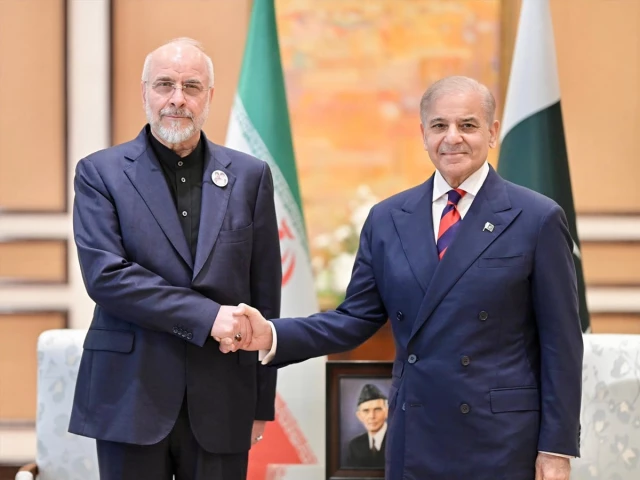
Prime Minister Shehbaz Sharif met the Iranian delegation led by Chairman of the Iranian Consultative Assembly Mohammad Bagher Ghalibaf at the talks in Islamabad on April 11, 2026. Photo: PMO
Prime Minister Shehbaz Sharif on Saturday affirmed Pakistan’s sincere determination to continue its mediation role in a meeting with the Iranian delegation as the ‘Islamabad Talks’ began to negotiate a peace deal with the United States.
According to the Prime Minister’s Office (PMO), the Iranian delegation was led by President Bagher Ghalibaf and assisted by Foreign Minister Abbas Araghchi, while Deputy Prime Minister and Foreign Minister Ishaq Dar, Chief of Defense Forces and Chief of Army Staff Field Marshal Asim Munir and Interior Minister Mohsin Naqvi attended the meeting from the Pakistani side.
“Appreciating Iran’s engagement in the ‘Islamabad Talks’, the Prime Minister affirmed Pakistan’s sincere determination to continue playing its role as a mediator to help build momentum towards achieving meaningful outcomes in the interest of regional and global peace and stability,” the statement said.
Read: ‘A springboard to peace’: US Vice President JD Vance meets PM Shehbaz ahead of ‘Islamabad talks’
Earlier in the day, Prime Minister Shehbaz met US Vice President JD Vance, along with Special Envoy Steve Witkoff and Jared Kushner, who landed in Islamabad as part of a US delegation to discuss the US-Iran ceasefire, dubbed ‘Islamabad Talks 2026’.
Washington and Tehran must begin negotiations to end the six-week war against Iran that has killed thousands of people across the Middle East, disrupted energy supplies, fueled inflation and slowed the global economy.
Prime Minister Muhammad Shehbaz Sharif met the Iranian delegation led by the Honorable Chairman of the Iranian Consultative Assembly, Mr. Mohammad Bagher Ghalibaf, at the Islamabad talks. April 11, 2026. pic.twitter.com/Lt1hp5OycD
— Prime Minister’s Office (@PakPMO) April 11, 2026
The Iranian delegation, comprising Iranian Foreign Minister Abbas Araghchi and Parliament Speaker Mohammad-Bagher Ghalibaf, also arrived in Pakistan on Friday night to attend the high-stakes negotiation talks with the United States.
The FO said the “high-powered delegation” was led by Ghalibaf and was received by Dar, National Assembly Speaker Sardar Ayaz Sadiq, Naqvi and CDF Munir. He added that Dar expressed hope that the parties would “share constructively” and reiterated Pakistan’s desire to continue facilitating them to reach a lasting solution to the conflict.
Islamabad April 11, 2026.
Prime Minister Muhammad Shehbaz Sharif today met the Iranian delegation at the Islamabad talks.
The Iranian side was led by the Honorable President of the Iranian Consultative Assembly, Mr. Mohammad Bagher Ghalibaf, assisted by Foreign Affairs… pic.twitter.com/xUSCq9sGpS
— Prime Minister’s Office (@PakPMO) April 11, 2026
Pakistan will host what could prove to be one of the most consequential diplomatic engagements in recent history, when top leaders from the United States and Iran arrive in Islamabad for high-stakes negotiations after a devastating six-week war that has left thousands dead and pushed the global economy to the brink of recession.
Read more: FO clarifies visa-on-arrival facility for ‘Islamabad Talks’ limited to journalists and delegates from US and Iran
Islamabad has effectively been placed under an unprecedented security lockdown ahead of the talks. Key routes have been sealed, large security personnel deployed and surveillance intensified to ensure the safety of visiting dignitaries. Authorities say negotiations will take place at a secure, undisclosed location, away from media attention.
Pakistan has become a key mediator in the region. Last month, the United States and Israel launched airstrikes against Iran, prompting Tehran to retaliate with attacks on Israel and US military bases in the Gulf. This escalation of tensions in the Middle East led to efforts by Pakistan’s political and military leaders to reduce tension.
To ease tensions, Pakistan had also organized a quadrilateral meeting of foreign ministers in Islamabad, with representatives from Turkiye, Saudi Arabia and Egypt. The meeting caught the attention of the world and was widely appreciated for Pakistan’s efforts.
Pakistan and China also jointly proposed a five-point initiative aimed at restoring peace and stability in the Gulf and the broader Middle East.
Dangerous ceasefire
There is a fragile conditional ceasefire between the United States and Iran, agreed after weeks of intense conflict. The agreement revolves around a two-week pause in fighting, largely aimed at stopping major military attacks and reopening strategic routes such as the Strait of Hormuz, although fundamental disagreements remain unresolved. Both Washington and Tehran have declared the ceasefire a victory of sorts, even as they cling to competing demands for a long-term deal.
At the center of the truce is a 10-point proposal from Iran, which the United States has described as a “viable basis” for negotiation. The plan reportedly covers issues such as non-aggression, control and operation of the Strait of Hormuz, lifting sanctions and cessation of hostilities on multiple fronts, including calls to end wars in related theaters. This framework will now guide peace talks, with Pakistan expected to host negotiations aimed at turning the temporary ceasefire into a more lasting peace.


