- The vote ends conservative Orban’s 16-year rule.
- The election result is significant for the EU, the US, Russia and Ukraine.
- Election officials estimate turnout will be 79% or higher, a record.
Veteran Hungarian nationalist leader Viktor Orban lost power to the upstart center-right Tisza party in national elections on Sunday after 16 years in office, marking a setback for his allies in Russia and US President Donald Trump’s White House.
Orban, 62, was celebrated by conservatives across Europe and the United States as the mastermind of the “illiberal” model of democracy, but he lost favor at home among voters who grew tired of economic stagnation, international isolation and the accumulation of wealth by oligarchs.
His crushing defeat gave Peter Magyar, 45, of Tisza, a comfortable majority in Hungary’s 199-seat legislature, opening the door to significant reforms of a system that critics in the European Union said subverted democratic norms.
With almost all the votes counted, Tisza would win 138 seats, more than the two-thirds of the Magyar majority she would need to undo Orban’s constitutional reform and combat corruption.
Sunday’s record turnout underscored how many Hungarians saw the election as a defining moment for their country.
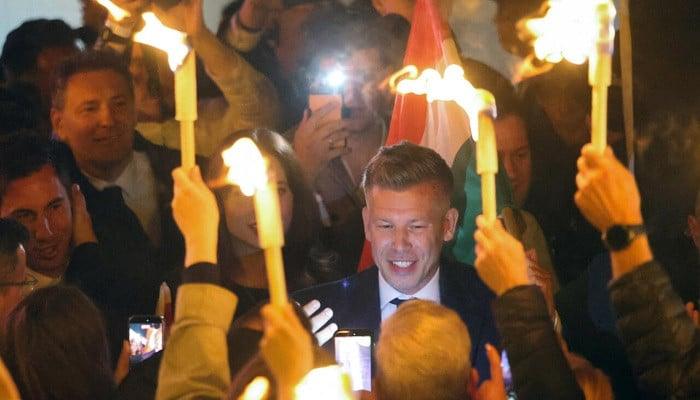
“We have done it. Tisza and Hungary have won these elections,” Magyar told tens of thousands of supporters who danced and cheered along the elegant Danube River embankment in central Budapest.
Many held candles as speakers blared Frank Sinatra’s “My Way” as Magyar walked to the stage. “Together we have replaced the Orban system and together we liberated Hungary, we took back our country,” he said.
Magyar had presented the election as a choice between “East and West”, warning voters that Orban and his confrontational stance towards Brussels would further distance the country from the European mainstream. Orban responded that Tisza would drag Hungary into an unwanted war with Russia, an accusation Magyar denied.
“The election result is painful for us, but clear,” Orban said at the Fidesz campaign offices. Some of his supporters who had gathered outside cried as they watched his speech on television screens.
Shock waves for the EU and beyond
The end of Orban’s 16-year rule will have significant implications not only for Hungary, but also for the European Union, Ukraine and beyond.
Many European leaders hope for an end to Hungary’s adversarial role within the EU, possibly opening the way for a 90 billion euro ($105 billion) loan to war-torn Ukraine that was blocked by Orban.
Mujtaba Rahman, CEO of Eurasia Group, said Magyar will be able to deliver on his promises to clean up corruption and remove Fidesz loyalists from key positions.
“On Ukraine, Magyar will agree to pave the way for 90 billion euros to flow to Ukraine. He was extremely cautious before the elections, but without the need now to try to appease Fidesz voters, we believe Hungary will move more cautiously towards the European mainstream on most issues.”
Some diplomats in Brussels warned that issues such as migration may remain thorny. “Hungary will remain a challenging partner, but a partner that other Member States can work with,” said one of them.
Ukrainian President Volodymyr Zelenskiy congratulated Magyar on Sunday and pledged to work with him to strengthen Europe and defend peace and security. “It is important when a constructive approach triumphs,” Zelenskiy wrote on Telegram.
Orban’s defeat could also mean the eventual release of EU funds to Hungary, suspended for reforms that Brussels said undermined democratic standards, something that financial markets are closely monitoring.
“Hungary has chosen Europe. Europe has always chosen Hungary,” European Commission President Ursula von der Leyen, the EU’s top executive, said after the partial results were published.
Orban’s departure would also deprive Russian President Vladimir Putin of his main ally in the EU and send shock waves through right-wing circles in the West, including the White House.
Orban had gained public backing from the Trump administration, culminating in a visit to Budapest by Vice President JD Vance last week, as well as from the Kremlin and far-right leaders in Europe.
But his campaign was rocked by media reports alleging his government was colluding with Moscow on diplomatic and political matters.
Orban, who denied any wrongdoing, said his goal was to protect Hungary’s national identity and traditional Christian values within the EU and its security in a dangerous world.
“It’s incredibly exciting,” said Dorina Nyul, 24, who attended the election night event in Tisza. “It feels like this is our first and last chance in a long time to really change the system. And I can’t even describe the feeling.”