
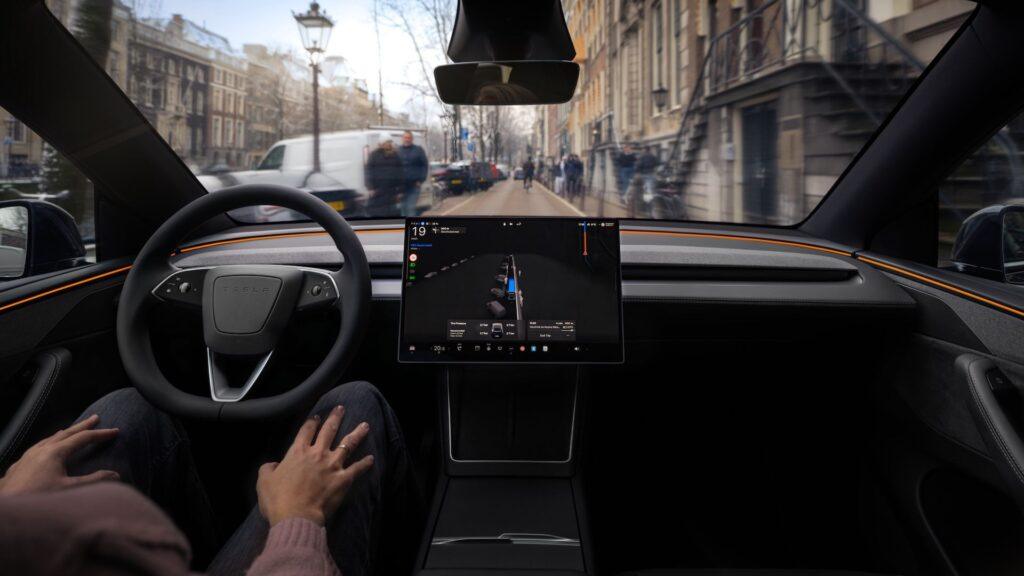
- After years of regulatory bureaucracy, FSD goes live in Europe
- It is only legal in the Netherlands, but more regions could follow.
- Some security advocates say the decision is “deeply troubling.”
For the past 18 months, Tesla has been working with the Dutch vehicle approval organization, RDW, to gain approval for its fully autonomous (supervised) semi-autonomous driving system.
After a long consultation period, which included driving almost a million miles with active FSD (Supervised) and offering test rides with 13,000 people in numerous European countries, the RDW deemed the technology safe and was given the green light.
Controversial Tesla CEO Elon Musk has long promised to introduce the partially autonomous cruise control system in other markets outside the United States, where it has been on sale for years. But the company has periodically run into regulatory bureaucracy.
Article continues below.
According to a press release issued by Tesla to promote its European debut, the company says that when FSD (Supervised) is activated, collisions are up to “seven times less likely per kilometer driven compared to manual driving alone.”
However, safety advocates, such as The Dawn Project’s Dan O’Dowd, reiterate that “59 people have died in more than 3,000 crashes involving Tesla’s self-driving software in the US since 2021 alone.”
“RDW’s decision is deeply concerning given the many well-documented safety defects of the Tesla FSD,” O’Dowd adds.
What’s more, the company’s Robotaxis, which use a similar set of hardware that relies on the vehicle’s external cameras and artificial intelligence to navigate the world, unlike a host of radar and Lidar sensors like its rivals, have made headlines because data suggests they crash four times more often than the average human driver, according to Fortune.
In a bid to bolster its security credentials, Tesla has made a number of changes to its software for the version that will go on sale in the Netherlands.
No Tesla app reported that those customers who had first-hand experience with the European-spec FSD (supervised) noticed that it differed from the technology found in the US.
Dutch owners will have to pass a mandatory safety test before the FSD is activated, for example, while the ‘Sloth’ to ‘Mad Max’ speed profiles in the US version have been ditched in favor of a simpler ‘Maximum Speed’ setting in the Netherlands.
Analysis: Europe will follow closely
While it is easy to think that the recent ruling in the Netherlands will automatically open the door to the use of FSD (Supervised) in the rest of Europe, it is very likely that many other markets will continue to act cautiously.
Even RDW, the organization that gave the green light to FSD (Supervised|) in the Netherlands, claims that the system is not “autonomous”, adding that “the driver remains responsible and must always maintain control.”
This confusion with the messaging used to promote the technology’s capabilities has caused many problems in the US, including the launch of an investigation by the National Highway Traffic Safety Administration into the safety of the technology.
Recently, it stepped up its research to “Engineering Analysis,” which it says will evaluate the system’s ability to operate under reduced visibility conditions on the road.
Meanwhile, Elon Musk continues to promote the fact that each iteration of the FSD software will “far exceed human levels of safety” and that users will soon be able to text and drive, when realistically it’s simply a Level 2 semi-autonomous cruise control system also offered by companies like Ford and BMW.
Follow TechRadar on Google News and add us as a preferred source to receive news, reviews and opinions from our experts in your feeds. Be sure to click the Follow button!
And of course, you can also follow TechRadar on YouTube and tiktok for news, reviews, unboxings in video form and receive regular updates from us on WhatsApp also.


