
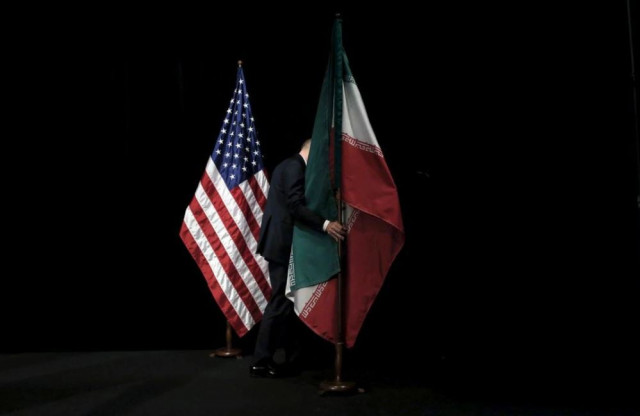
A staff member removes the Iranian flag from the stage after a group photo with foreign ministers and representatives from the United States, Iran, China, Russia, Britain, Germany, France and the European Union during the Iran nuclear talks at the International Center in Vienna, Austria, July 14, 2015. PHOTO: REUTERS/FILE
ISLAMABAD:
Pakistan is engaging in high-level contacts to bring Iran and the United States back to the negotiating table. Negotiators from the two warring countries could meet again in Islamabad for a second round of talks next week.
According to high-ranking sources in the federal capital, contacts are being made to revive the stalled negotiations between the United States and Iran, and talks could resume before the two-week ceasefire ends on April 21.
They said Prime Minister Shehbaz Sharif, Deputy Prime Minister Ishaq Dar and Field Marshal Asim Munir are making frantic efforts to secure the second round of talks that can end the Gulf War.
At some high-level meetings in Islamabad, directions have been given to prepare for the next round of talks between the top leaders of the two countries who held the first direct negotiations in 47 years in Islamabad on April 10.
According to some sources, the next round of negotiations could take place in Islamabad on April 16.
However, on the same date, Prime Minister Shehbaz Sharif is also scheduled to visit Saudi Arabia at the invitation of Crown Prince Mohammed bin Salman. The prime minister will make one-day visits to Saudi Arabia and Türkiye.
After nearly six weeks of conflict between the United States, Israel and Iran and less than two hours before US President Donald Trump’s deadline for Tehran to reopen the Strait of Hormuz, Prime Minister Shehbaz announced on April 8 that both sides had agreed to a two-week ceasefire.
On April 11, a US delegation led by Vice President JD Vance and an Iranian delegation led by the Speaker of the Iranian Parliament, Mohammad-Bagher Ghalibaf, held a marathon session in Islamabad to find a peaceful solution to a conflict that began on February 28.
The United States and Iran failed to reach an agreement.
Hope for a positive outcome of the talks
Earlier on Monday, Prime Minister Shehbaz Sharif reaffirmed Pakistan’s commitment to playing a key role in promoting lasting peace in the region, while expressing hope that the recent direct talks between the United States and Iran would yield positive results.
Chairing an emergency meeting of the federal cabinet, the prime minister expressed satisfaction with the progress of the negotiations and said Pakistan remained optimistic about a constructive outcome.
Referring to the high-level talks, Shehbaz noted that Pakistan’s diplomatic efforts helped bring both sides to the table, calling it a major achievement after decades of estrangement.
He said delegations from both countries participated in nearly 21 hours of direct negotiations, the first such engagement in 47 years. He termed this development as a historic moment and said Pakistan now had the opportunity to help transform the ceasefire into lasting peace.
The prime minister said the Islamabad talks helped dispel war clouds hanging over the region and created prospects for peace amid global economic uncertainty.
He added that throughout history, agreements like the Oslo Accords, the Geneva Accords and the Good Friday Agreement had taken years to materialise, but Pakistan’s efforts facilitated a ground-breaking dialogue between two adversaries.
He also thanked Iranian President Masoud Pezeshkian and US President Donald Trump for accepting Pakistan’s request for a two-week ceasefire.
Highlighting Pakistan’s historic role in diplomacy, the Prime Minister recalled its efforts to facilitate rapprochement between the United States and China in the early 1970s. He said that both the US and Iranian delegations appreciated Pakistan’s sincerity and constructive role.
Shehbaz Sharif further said that he had received calls from leaders, including the Japanese Prime Minister and several European counterparts, acknowledging Pakistan’s peace efforts. He described the development as a source of pride for the nation.
He attributed the achievement to the collective efforts of the government and the prayers of the people, and especially praised Deputy Prime Minister Ishaq Dar and Field Marshal Syed Asim Munir for their tireless work.
He noted that officials worked through the night to ensure progress at critical times; efforts that, he said, would be remembered with golden words.
Earlier, the federal cabinet unanimously passed a resolution expressing gratitude to the Almighty for granting Pakistan the opportunity to play a pivotal role in promoting world peace.
The cabinet paid tribute to the country’s leadership for uniting the two sides and ending nearly half a century of stalemate, and expressed hope that these sincere efforts would lead to lasting peace around the world.
The Prime Minister talks with his Canadian counterpart
Prime Minister Shehbaz Sharif received a phone call from Canadian Prime Minister Mark Carney who congratulated him on Pakistan’s peace efforts that culminated in the temporary ceasefire and led to the recently held talks between the United States and Iran.
While appreciating Canada’s endorsement and support for Pakistan’s diplomatic efforts, the Prime Minister stressed that the negotiations between the United States and Iran were an important step towards peace and assured that Pakistan would continue its efforts to urge both sides to maintain the ceasefire and make significant progress towards reducing tensions.
The two leaders also exchanged views on bilateral relations between Pakistan and Canada and expressed their desire to work together to enhance cooperation in agriculture, clean energy, mines and minerals, as well as enhance Canadian investments in Pakistan.
The Prime Minister reiterated his invitation to the Canadian Prime Minister to officially visit Pakistan at his convenience. Both leaders agreed to maintain close coordination, an official statement indicated.
PM reviews fuel situation
Shehbaz also chaired a meeting reviewing oil reserves amid a post-war fuel crisis and led continuous monitoring of oil consumption in the country.
He said that thanks to constant monitoring of oil consumption and reserves, along with an improved strategy, no shortage crisis has emerged despite regional tensions. The prime minister added that measures taken to provide relief to the public would continue.
During the meeting, the Prime Minister was briefed about the country’s current oil reserves and its future needs.
The report noted that there are sufficient quantities of petroleum products available, but that austerity must be maintained to ensure conservation. It was further informed that arrangements have already been made for the import of oil in view of future needs.
The meeting was attended by Deputy Prime Minister Ishaq Dar, Federal Minister for Economic Affairs Ahad Cheema, Minister for Petroleum Ali Pervaiz Malik, Minister for Information and Broadcasting Attaullah Tarar and senior officials.
Minister predicts talks
Defense Minister Khawaja Asif said on Monday that the next round of negotiations between Iran and the United States was expected soon and that positive progress had been noted.
Speaking to the media outside Parliament, the minister noted that the possibility of renewed dialogue between Tehran and Washington remains, adding that there was a sense of satisfaction following the latest round of talks, with no negative developments reported so far.
“Only positive developments have been observed,” he observed, indicating that ongoing diplomatic efforts were moving in a constructive direction.
Responding to a question on whether Pakistan would play a decisive role in shaping the future of the region, Asif said the final decisions rest with the Almighty.
Commenting on India, the Defense Minister adopted a critical tone and said that there seemed to be unrest there and mixed reactions were emerging.
He argued that the broader diplomatic process in the region was progressing positively and that continued negotiations were improving prospects for peace and stability.


