
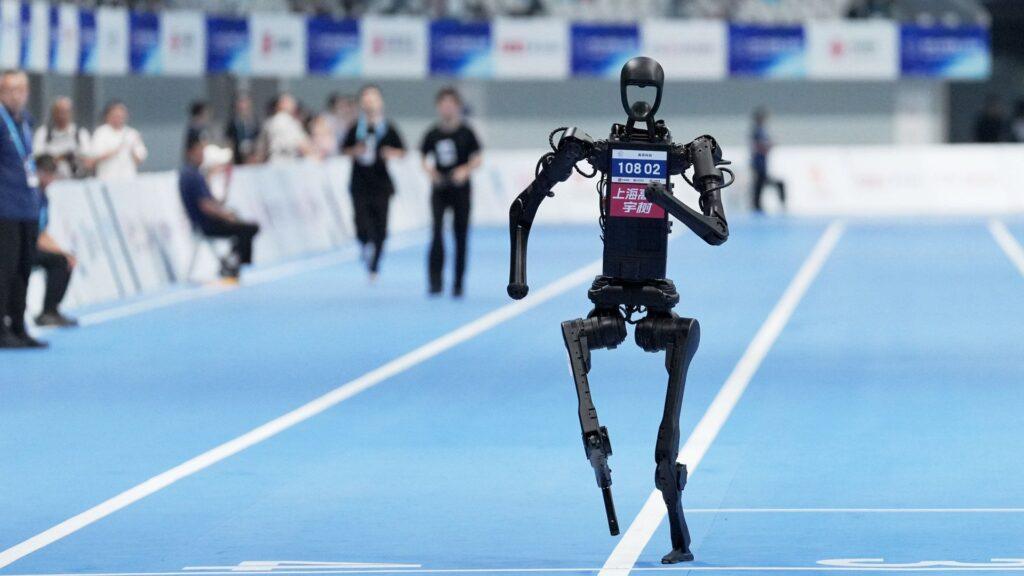
Running is a basic human skill, but when a robot runs, it’s a big deal, and when it does it while doing something you’ve probably never done before, then it’s cause for fascination, if not celebration.
This week we have the spectacle of a Unitree G1 robot chasing a group of wild boars through the night streets of Poland. In the short, now viral clip, the G1 turns a corner, appears to spot the animals, and then takes off after them as the confused or terrified wild boars flee. The chase is short and, as the wild boars run into the forest, the Unitree G1 stops and sadly says goodbye.
Article continues below.
Still, we have a strange and growing fascination with humanoid robot racers, those that can do more than wander from room to room but are up for a high-speed chase.
Many of the clips I’ve seen in the lead-up to this race show the robots running at shocking speeds of up to 4.6 mph. Of course, humans can run almost twice that speed in a marathon, but for humanoid robots, this is progress.
It’s wild out there
However, I’m not sure what all this running, chasing and competing means.
If you think about how many times you have to run, I’m sure it all comes down to catching a train and trying to stop your little one from knocking over that vase. The last time I lunged like that, I crashed into a bed frame and broke my toe. I generally try not to run when brisk walking will do.
Most home robots from companies like Neo, Figure AI, and Tesla Optimus never appear running. They all slowly and carefully move from room to room and perform most of their home care actions with the same slow, methodical care.
On the other hand, robots found in nature invariably go into action mode. They are chasing wild boars or hitting each other (and sometimes people).
At CES 2026, I watched groups of Unitree G1 robots box, and earlier this year, they surprised the world with choreographed dance and kung fu at the China Spring Festival Gala. But this, like so many other humanoid activities, is deeply trained or remotely controlled. At CES, the G1 I shook hands with had a remote control.
Half of the Humnoid Half Marathon robots will be autonomous, while the rest will be remotely controlled, like the CES Unitree G1. If I were a gambler, I’d put my money on the latter to win. Autonomy will only get you so far when half the robots don’t have the same kind of consciousness and self-determination. The G1 and other robots are sure to suffer setbacks (and each other).
Still, everyone wants to see a robot run. Maybe they’re thinking about something beyond the home or even the factory (where I bet running is frowned upon).
‼️ ZELENSKYY: For the first time in the war, an enemy position was captured entirely by ground robotic systems and drones, without infantry. A robot entered the most dangerous areas instead of a soldier and took positions. «The future is here, on the battlefield, and… pic.twitter.com/maqECUunEjApril 13, 2026
Robots are increasingly being asked to go to war. This week, Ukrainian President Volodymyr Zelensky proclaimed: “The future is here!” while announcing that a small army made up entirely of robots had captured a position. Now, I don’t know if any of the robots ran across that battlefield, but I’m sure any robot that can run and traverse difficult terrain in that situation is useful.
This is, of course, an extreme case. Meanwhile, we’re left with strange videos of robots chasing animals and racing around race tracks trying to beat their human competitors.
Our interest runs counter to all the deep-seated fears we have about a robot uprising. After all, they will be running towards us, chasing us. Why do we want to see something that looks like that?
Also, I hope those wild boars are okay.
Follow TechRadar on Google News and add us as a preferred source to receive news, reviews and opinions from our experts in your feeds. Be sure to click the Follow button!
And of course, you can also follow TechRadar on YouTube and tiktok for news, reviews, unboxings in video form and receive regular updates from us on WhatsApp also.


