
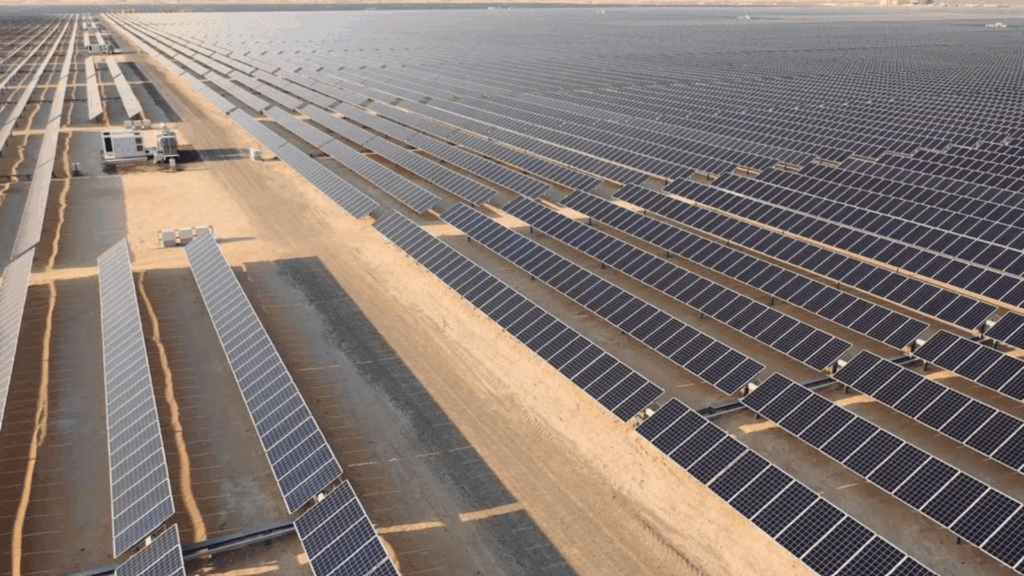
- Dark solar panels convert desert heat into rain clouds, not just electricity
- A 20 square kilometer solar farm produces more rain than a year of cloud seeding
- Moist winds from the Persian Gulf are what the desert sun needs to produce rain
In the United Arab Emirates, where water is more valuable than oil, new research suggests that large solar farms could cause their own storms.
A modeling study led by climate scientist Oliver Branch of the University of Hohenheim found that dark solar panels absorb more heat than the reflective desert sand that surrounds them.
This temperature difference drives updrafts that can cause rainfall, potentially providing water to tens of thousands of people.
Article continues below.
How dark solar panels create their own climate
The researchers modeled the solar panels as nearly black surfaces that absorb 95% of incoming sunlight.
When the solar farms exceeded 15 square kilometers, the increase in heat contrasted sharply with the reflective sand that surrounded them, increasing the updrafts that drive cloud formation, but a source of atmospheric moisture is needed.
However, the model showed that moist, high-altitude winds from the Persian Gulf would be sufficient.
A 20 square kilometer solar field would increase rainfall by almost 600,000 cubic meters under the right conditions, equivalent to 1 cm of rain falling in an area the size of Manhattan.
If such storms occurred ten times in one summer, they would provide enough water for more than 30,000 people for a year.
“Some solar farms are reaching the right size right now… It may not be science fiction that we can produce this effect,” Branch said.
One limitation is that the simulated solar panels were darker than what most manufacturers currently make, as some modern solar panels are designed to be reflective to cool their surroundings, which would reduce the rain effect.
Zhengyao Lu, a climate scientist at Lund University, called the new work “very stimulating” but highlighted this concern.
Branch is hopeful the idea can be tested in the real world, noting that the solar farms up and running in China are almost big enough.
He suggests planting dark, drought-tolerant crops, such as jojoba bushes, between the rows of panels to enhance the effect.
The United Arab Emirates funded Branch’s modeling research, but the country remains committed to its cloud seeding program, carrying out approximately 300 missions each year.
This means that local authorities are not yet convinced that solar-induced rain is a practical alternative.
According to Branch and his team, this model could work in other arid regions, including Namibia and Mexico’s Baja California Peninsula.
If future research validates these findings, the rain-producing potential of solar farms could provide an unexpected incentive to expand renewable energy in drier regions of the world.
Follow TechRadar on Google News and add us as a preferred source to receive news, reviews and opinions from our experts in your feeds. Be sure to click the Follow button!
And of course you can also follow TechRadar on TikTok for news, reviews, unboxings in video form and receive regular updates from us on WhatsApp also.


