
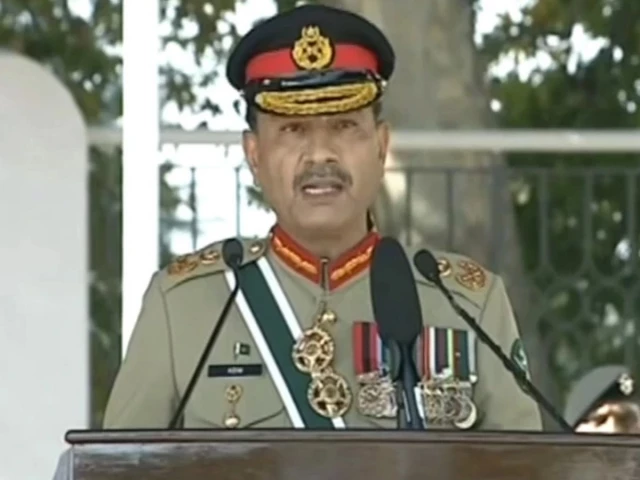
CDF Munir, the president of Iran, and senior leaders discuss de-escalation; Prime Minister and Emir of Qatar highlight regional stability
ISLAMABAD:
Chief of Army Staff and Chief of Defense Forces Field Marshal Syed Asim Munir on Thursday held a series of high-level meetings in Tehran with Iran’s top political and military leaders, including President Masoud Pezeshkian, as part of Islamabad’s efforts to lay the groundwork for the next round of Iran-US talks expected in Islamabad.
During the visit, Field Marshal Munir called on President Pezeshkian and discussed the evolving regional situation, with special focus on tension-reduction efforts and the importance of sustained diplomatic engagement.
Both sides exchanged views on the prospects for peace and stability in the region and underlined the need for continued coordination to reduce tensions.
In a series of parallel engagements, the army chief met with the speaker of the Iranian Parliament, Mohammad Baqer Ghalibaf, and with senior commanders of the Islamic Revolutionary Guard Corps (IRGC), including the head of the Central Headquarters Khatam al-Anbiya.
Discussions with Iranian military leaders focused on steps taken under the emerging framework to end hostilities. Field Marshal Munir also shared insights from his recent interactions in Tehran, as both sides deliberated on the broader regional security environment.
He stressed that efforts aimed at ending the conflict and reducing tensions must be carried out with coherence and seriousness, highlighting the importance of maintaining momentum in ongoing diplomatic and backchannel engagements.
The meetings are seen as part of Pakistan’s stepped-up diplomatic effort to facilitate renewed dialogue between Tehran and Washington. Islamabad has increasingly positioned itself as a key intermediary amid increased regional volatility.
Pakistan’s role has also received rare public support from Washington. A day earlier, the White House acknowledged Islamabad’s mediation efforts, with press secretary Karoline Leavitt stating that President Donald Trump viewed Pakistan as the main channel for engagement with Iran.
He noted that while several countries had offered assistance, the United States preferred to continue its outreach through Pakistan, describing Islamabad as an “effective and reliable mediator” who had helped bring both sides closer to a possible agreement.
Meanwhile, on the diplomatic front, Prime Minister Shehbaz Sharif arrived in Doha on Thursday and held an extensive meeting with Emir Sheikh Tamim bin Hamad Al Thani of Qatar.
The two leaders discussed the evolution of the situation in the Middle East and agreed on the need to reinforce efforts aimed at de-escalation and regional stability.
Qatari leaders appreciated Pakistan’s constructive role in promoting dialogue, while Prime Minister Shehbaz reaffirmed solidarity with Qatar and condemned the recent attacks on the Gulf States.
Both sides also reviewed bilateral relations and agreed to enhance cooperation in key sectors, including security, defense and energy, while emphasizing the importance of ensuring uninterrupted global energy supplies amid current tensions.
The officials said the flurry of diplomatic engagements in Tehran and Doha reflects a coordinated effort by Pakistan to build consensus and create conducive conditions for the resumption of meaningful negotiations between Iran and the United States.
Meanwhile, Prime Minister Shehbaz Sharif arrived in Türkiye on Thursday on an official visit to attend the 5th Antalya Diplomacy Forum.
The governor of Antalya, Hulusi Sahin, warmly received the prime minister and the Pakistani delegation at the airport.
Pakistan’s ambassador to Turkiye, Yusuf Junaid, along with senior diplomatic officials, was also present on the occasion.
The prime minister will attend the 5th Antalya Diplomacy Forum tomorrow.
During the forum, the Prime Minister will participate in the ‘Leaders Panel’ to present Pakistan’s perspective.
Bilateral meetings of the prime minister with President Recep Tayyip Erdogan and other key world leaders are also expected on this occasion.
Deputy Prime Minister and Foreign Minister Senator Ishaq Dar, Information and Broadcasting Minister Attaullah Tarar, Special Assistant Tariq Fatemi and Prime Minister’s Spokesperson for International Media Musharraf Zaidi are accompanying the Prime Minister as part of the Pakistani delegation.
A key conference of foreign ministers of four nations will be held in Turkiye on Saturday (tomorrow), bringing together Pakistan, Turkiye, Egypt and Saudi Arabia to deliberate on pressing regional developments, particularly the security situation in the Middle East.
Diplomatic sources said the high-level meeting will feature foreign ministers from these countries, and discussions are expected to focus on regional stability, emerging security challenges and seeking coordinated diplomatic responses to ongoing crises.
Pakistan will be represented at the conference by Deputy Prime Minister and Foreign Minister Ishaq Dar, who will lead the country’s delegation to the consultations. The meeting is part of an ongoing process, following an earlier round held in Islamabad, officials said.
The meeting is expected to examine in detail the continuing tensions between Iran and the United States, along with the broader implications of instability in the Middle East, as well as regional cooperation in various fields.
Diplomatic sources indicated that the agenda will include an in-depth review of current regional volatility, possible risks of escalation and the development of a shared strategy to support peace and stability in the region.
In addition to security-related issues, participating countries are also expected to discuss broader areas of cooperation, including counter-terrorism efforts, energy collaboration and strengthening regional connectivity frameworks.
The meeting takes place at a time of heightened tension between Iran and the United States. Diplomatic observers believe the outcome of the discussions could play an important role in shaping future efforts aimed at maintaining peace and stability in the Middle East.


