
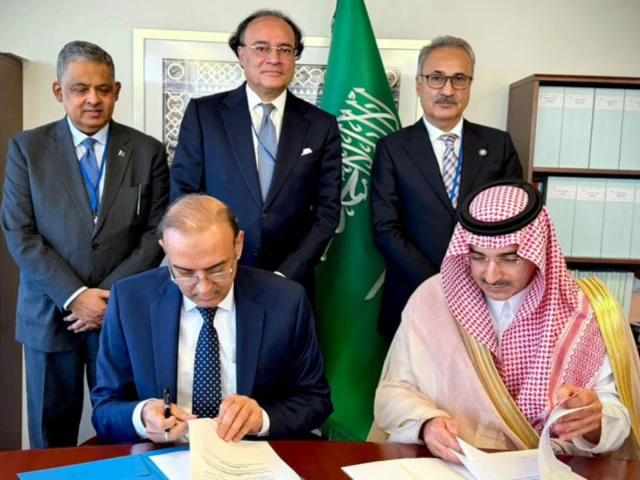
FinMin witnesses the signing ceremony of an “important financial agreement” in Washington, DC
The SFD signs an agreement to expand the deposit of 3 billion dollars with the SBP. PHOTO: Radio Pakistan
The Saudi Fund for Development (SFD) on Friday signed an agreement with the State Bank of Pakistan (SBP) to extend the maturity of its $3 billion deposit. Radio Pakistan reported.
“The agreement, signed between the Saudi Fund for Development (SFD) and the State Bank of Pakistan (SBP), provides for the extension of the maturity of a $3 billion deposit placed by the SFD in the State Bank of Pakistan,” according to X post.
Finance Minister witnesses signing of Saudi deposit extension agreement with State Bank of Pakistan
Federal Minister of Finance and Revenue, Senator Muhammad Aurangzeb, witnessed the signing of a major financial agreement in Washington, DC, in the presence of… pic.twitter.com/2BCoaWPhNL
— Ministry of Finance, Government of Pakistan (@Financegovpk) April 17, 2026
The agreement was signed by Sultan bin Abdulrahman Al-Marshad, Chief Executive Officer (CEO) of the SFD, and SBP Governor Jameel Ahmad on behalf of the SBP.
Finance Minister Muhammad Aurangzeb witnessed the signing ceremony of a major financial agreement in Washington, DC, in the presence of Pakistan’s Ambassador to the United States, on the sidelines of the 2026 Spring Meetings of the World Bank and IMF.
According to the X post ministry, the extension underlines the strong and long-standing economic partnership between Pakistan and the Kingdom of Saudi Arabia. It is expected to support the stability of the country’s external sector.
Yesterday, Pakistan received a financial flow of $2 billion from Saudi Arabia, offering timely relief to its foreign exchange reserves just as the country prepares to return $3.5 billion to the United Arab Emirates (UAE) this month.
Read: SBP receives a Saudi loan of 2 billion dollars
The SBP verified the receipt of the funds from Saudi Arabia’s Finance Ministry, while the Finance Ministry said the assistance is part of a broader $3 billion financial commitment by Riyadh aimed at stabilizing Pakistan’s reserves.
Additionally, Saudi Arabia has ensured the renewal of its existing $5 billion deposits over an extended period, eliminating the previous requirement for annual renewals.
Officials said this support would significantly ease pressure on reserves, particularly in light of the large repayment from the United Arab Emirates, which accounts for almost 18% of Pakistan’s official foreign exchange holdings.
The influx comes at a critical time as Pakistan seeks to meet its external financing needs and maintain reserve targets under its IMF programme.
According to Finance Ministry sources, the government aims to increase reserves to around $18 billion, equivalent to approximately 3.3 months of import coverage, in the coming months.
At the same time, Islamabad has finalized agreements to repay $3 billion to the UAE in a phased manner.
Of this figure, $2 billion is expected to be paid on April 17, followed by the remaining $1 billion on April 23.
On the other hand, Pakistan has already settled a long-standing loan of $450 million it owed to the United Arab Emirates.
On Wednesday, FinMin said Saudi Arabia has committed $3 billion in additional deposits, with disbursement expected next week. He further stated that the current $5 billion Saudi deposit would no longer be subject to the previous annual renewal agreement and would instead be extended for a longer period.
Additional IMF loan
Government sources said The express PAkGazette that it had been decided to seek an additional loan from the IMF under the existing package and that there was a good chance that the IMF would honor Pakistan’s request.
The IMF managing director has said her organization was expecting $50 billion in funding requests from member countries to deal with the shocks of war in the Middle East.
Read more: Saudi largesse plugs Pakistan’s sudden reserve hole
Sources said IMF executive directors were also urging the Fund’s management to increase existing programs or provide new financing windows. They added that it may not be possible to seek a new line of financing from the IMF, but the existing program can be expanded with additional loans.
Pakistan can avail up to 600% of its quota in the IMF and has so far exhausted 350% of the total quota. Sources said there was a window available of between $2 billion and $2.5 billion, which Pakistan wanted to use to deal with the effects of the war in the Middle East.
Sources said Pakistan was eligible to avail additional financing from the IMF to cope with the shocks of the war. They said there was a good chance that the IMF would accept Pakistan’s request to increase the size of the loan.
Extending a loan to Pakistan to cope with the impact of the war would not be a favour, but would help the country tide over the crisis, sources said.
With 600% quota, Pakistan can avail a total loan of $16 billion and has exhausted $9.5 billion. This makes a strong case for an increase under the current Expanded Fund Facility (ESAF) programme.


