
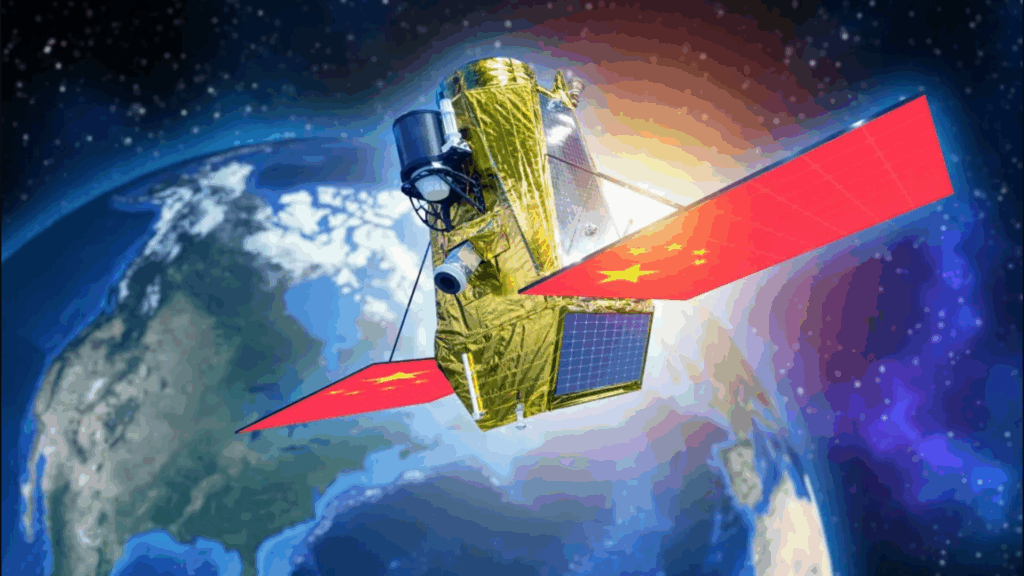
- China successfully demonstrates geosynchronous satellite tracking of moving maritime targets
- Persistent surveillance from orbit reduces dependence on low-Earth satellite constellations
- Three satellites could provide continuous global monitoring of high-value naval assets
China has released radar images showing for the first time a satellite in geosynchronous orbit successfully tracking a moving maritime target.
The satellite locked onto the Towa Maru, a 340-meter Japanese oil tanker that was traversing rough seas near the Spratly Islands, from an altitude of 35,800 kilometers above Earth.
This development could provide Beijing with continuous surveillance of US naval fleets across all oceans.
Article continues below.
How three satellites could achieve global coverage
Unlike low-orbit satellites that pass over a location for only a few minutes at a time, this geosynchronous radar platform maintains persistent surveillance despite cloud cover, darkness, and severe interference from the ocean.
Lead researcher Hu Yuxin stated that the new processing architecture could isolate weak ship echoes from violent marine disorder at distances previously considered physically impracticable.
With just three of these strategically placed satellites, China could achieve 24/7, all-weather, global reconnaissance coverage of high-value targets, including U.S. carrier strike groups.
To match this capability using conventional low-orbit systems, other countries may need to deploy hundreds or even thousands of satellites.
The demonstration is especially consequential because American carrier strike groups approaching Taiwan or the South China Sea could now be detected, tracked and attacked much sooner than previously assumed.
A surveillance architecture requiring just three satellites would also reduce China’s reliance on vulnerable low-orbit constellations, making its maritime reconnaissance network substantially more difficult to disrupt during times of war.
For Pentagon planners, the satellite’s success represents not simply a Chinese technical milestone, but the possible emergence of a new battlespace in which cloaking at sea may no longer exist.
The U.S. Navy has long relied on weather, distance, and predictable gaps between low-orbit reconnaissance satellites to conceal operational movements.
If China integrates this capability with long-range radars, underwater sensors, drones, and long-range anti-ship missiles, it could strengthen its surveillance network.
As a result, alert times for US naval commanders across the Indo-Pacific could be dramatically reduced.
The achievement threatens to change the strategic competition between Washington and Beijing, since it is no longer just about controlling sea routes; Attention is shifting to the orbital infrastructure domain that determines who gets first visibility.
The technology is undeniably impressive, but a single successful tracking of a commercial tanker does not automatically translate into reliable tracking of evasive military vessels.
Geosynchronous radar must deal with enormous signal travel distances, and adverse space weather or electronic countermeasures could degrade performance.
China has not yet deployed the entire three-satellite constellation and the timeline for operational capability remains unclear.
Through Defense Security Asia
Follow TechRadar on Google News and add us as a preferred source to receive news, reviews and opinions from our experts in your feeds.


