
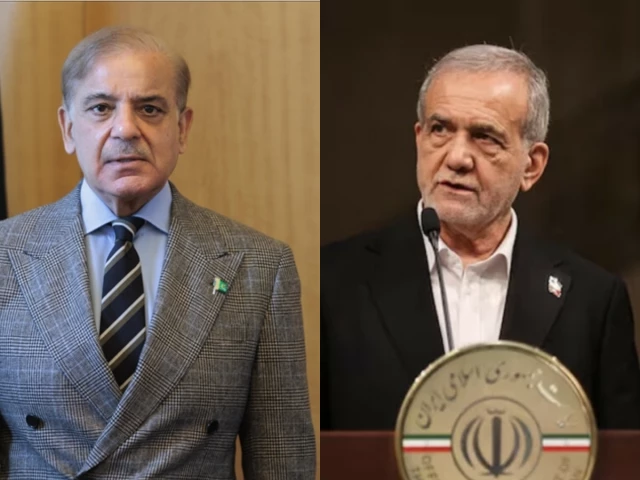
Both leaders discuss regional developments and agree on continued engagement and diplomatic efforts.
Prime Minister Shehbaz (right) holds talks with Iranian President Masoud Pezeshkian (left) on the US-Iran ceasefire.
Prime Minister Shehbaz Sharif on Sunday reaffirmed Pakistan’s commitment to promoting regional peace and security with the support of its partners during a telephone conversation with Iranian President Masoud Pezeshkian.
The two leaders held talks after US President Donald Trump confirmed another round of talks and said US representatives would travel to Islamabad for a second round of talks with Iran aimed at addressing the Middle East crisis.
According to the Prime Minister’s Office (PMO), the two leaders discussed the evolving regional situation during the call, which lasted around 45 minutes and included detailed exchanges on ongoing developments.
“The prime minister thanked Pezeshkian and the Iranian leadership for sending a high-level delegation, led by Mohammad Bagher Ghalibaf and Abbas Araghchi, for the talks in Islamabad on April 11-12,” he said.
Read: “My representatives will be in Islamabad tomorrow afternoon”: Trump on negotiations between the United States and Iran
“Recent engagements with the leaders of Saudi Arabia, Qatar and Turkiye have been helpful in building consensus in support of sustained dialogue and diplomacy,” Prime Minister Shehbaz said, adding that such efforts were aimed at achieving lasting peace in the region.
Prime Minister Muhammad Shehbaz Sharif had a phone call with His Excellency Dr. Masoud Pezeshkian, President of the Islamic Republic of Iran
During their warm and cordial conversation that lasted about forty-five minutes, the two leaders engaged in detailed exchanges… pic.twitter.com/Fd8PMkKx3g
— Government of Pakistan (@GovtofPakistan) April 19, 2026
He also thanked Iranian leaders for their talks with Chief of Army Staff and Chief of Defense Forces Field Marshal Asim Munir during his recent visit to Tehran.
“The Prime Minister reiterated that Pakistan will remain fully committed to promoting regional peace and security with the support of its partners, and conveyed his greetings to the Supreme Leader of Iran,” the statement said.
President Pezeshkian, in turn, appreciated Pakistan’s commitment to peace efforts and said that Iran-Pakistan relations will continue to strengthen in the coming days.
Read also: Foreign Minister Dar highlights need for continued dialogue to resolve issues in call with Araghchi
Earlier today, Deputy Prime Minister and Foreign Minister Ishaq Dar spoke with his Iranian counterpart Abbas Araghchi and emphasized the need for continued dialogue and engagement to resolve current issues.
According to a statement issued by the Ministry of Foreign Affairs (MOFA), Dar stressed that continued dialogue and engagement were essential for the timely resolution of current issues and to promote peace and stability in the region and beyond.
“Both leaders agreed to remain in close contact and also agreed on a phone call between the President of Iran and the Prime Minister of Pakistan later today,” the statement said.
After 40 days of airstrikes, American and Iranian negotiators began talks in Islamabad earlier this month, again focused on the familiar balance between nuclear restrictions and economic relief.
When American and Iranian negotiators met last weekend in Islamabad, the United States proposed a 20-year moratorium on all Iranian nuclear activity, while Iran suggested a three- to five-year moratorium, according to people familiar with the proposals.
Iran’s Deputy Foreign Minister Saeed Khatibzadeh said no date had been set for the next round of negotiations, adding that a framework of understanding must first be agreed upon.
Read more: Pakistan pushes for dialogue as standoff persists
There were some signs in the Pakistani capital on Sunday of preparations for the resumption of face-to-face negotiations.
Although negotiations have yet to formally begin, US President Donald Trump indicated on Sunday that a US delegation would arrive in Islamabad on Monday night for a new round of talks with Iran aimed at resolving the ongoing conflict, a development seen as offering a renewed ray of hope for diplomacy.
“My representatives are going to Islamabad, Pakistan; they will be there tomorrow afternoon for negotiations,” President Trump said in a post on Truth Social.
Diplomats said a skeleton deal, built around a nuclear package and an economic package, is possible. But they warned that the nuclear component remains, by far, the most controversial.
The talks focus on Iran’s stockpile of about 440 kilograms (970 pounds) of 60% enriched uranium, material that could be used for several nuclear weapons if further enriched.
Beyond the reservations lies the deeper dispute over Iran’s right to enrich uranium. Trump has publicly pushed for zero enrichment, while Iran insists it has the right to enrich uranium for civilian purposes and denies it is seeking a bomb.
The war has hardened Iran’s stance, diplomats said, showing it can absorb pressure even as it seeks financial relief.
Tehran’s main demand is a guarantee of non-aggression after being attacked by the United States and Israel during previous diplomatic efforts.


