
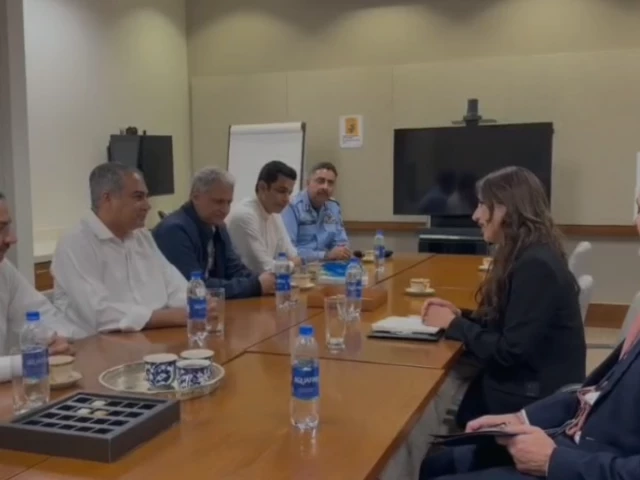
Natalie Baker expresses her appreciation for the country’s efforts and its role in ensuring a safe environment amid regional tensions.
Interior Minister Mohsin Naqvi met US Chargé d’Affaires in Pakistan Natalie Baker at the US Embassy on Monday to discuss security arrangements ahead of the expected US-Iran talks in Islamabad, according to the Interior Ministry.
During the meeting, both sides reviewed the overall security situation and detailed agreements with Baker expressing appreciation for Pakistan’s efforts and its role in ensuring a secure environment amid regional sensitivities.
The statement said senior officials including FIA Director General Dr Usman Anwar, Chief Commissioner Sohail Ashraf, Inspector General of Police Ali Nasir Rizvi and Deputy Commissioner Irfan Memon were also present.
وفاقی وزیر داخلہ محسن نقوی امریکہ کے سفارتخانے آمد
وزیر داخلہ محسن نقوی بیکر سے ملاقات
ملاقات میں پاک امریکہ تعلقات کے فروغ اور خطے کی تازہ ترین صورتحال پر تفصیلی تبادلہ خیال pic.twitter.com/z50mgSuZQ2— Ministry of Home Affairs GoP (@MOIofficialGoP) April 20, 2026
Naqvi said that “special security arrangements have been made for all distinguished guests” who attended the talks, adding that Pakistan is fully prepared to ensure foolproof security, the ministry added. He expressed hope for the success of the next round of talks in Islamabad.
Pakistan took center stage as it negotiated a 14-day ceasefire between the United States and Iran, followed by high-stakes talks in Islamabad attended by senior delegations from the two countries. Although the talks did not yield the desired results, the ceasefire remains intact and confidence-building measures are being implemented to ensure a permanent truce.
A second round of talks is expected to be held in Islamabad as US President Donald Trump announced on Sunday that his representatives will arrive in Islamabad on Monday night.
Twin cities on alert
Authorities in Islamabad and Rawalpindi have implemented extensive security and administrative measures ahead of the next scheduled round of US-Iran talks in the federal capital, effectively putting the twin cities on high alert.
The Red Zone has been sealed, and all public and private offices and schools have been instructed to move online, while government operations have moved to remote work.
Heavy and public transport in Islamabad and Rawalpindi have been suspended until further notice, while Metro Bus service between Saddar and Pak Secretary has also been suspended.
متبادل ٹریفک پلان
اسلام آباد میں غیر ملکی وفود کی آمد۔
ریڈ زون اور توسیعی ریڈ زون ہر قسم طور پر بند رہے گا۔
کورال سے زیرو پوائنٹ تک ایکسپریس وے ہر قسم بند ہوگا۔
سری نگر ہائی وے پر بھی مختلف اوقات میں ٹریفک روکی جاسکتی ہے۔
اسلام آباد میں… pic.twitter.com/5QOdaRYCYN
— Islamabad Police (@ICT_Police) April 20, 2026
Major roads, including key arteries in the Red Zone and surrounding areas, have been closed or restricted, and extensive detour plans have been implemented to manage traffic flow. Universities have moved classes online and postponed exams, while hostels, hotels and guest houses in sensitive areas have been ordered to close.
Security has been significantly beefed up with the deployment of over 10,000 police personnel in Rawalpindi and there are expected to be around 18,000 security personnel in total, including police, rangers and Frontier Corps. More than 600 checkpoints have been established, with strict surveillance at entry and exit points.
Sensitive areas around Nur Khan air base and Islamabad international airport have also been sealed, along with banning the use of drones, aerial shooting and pigeon flying, as authorities describe the measures as part of foolproof security arrangements for visiting foreign delegations.


