
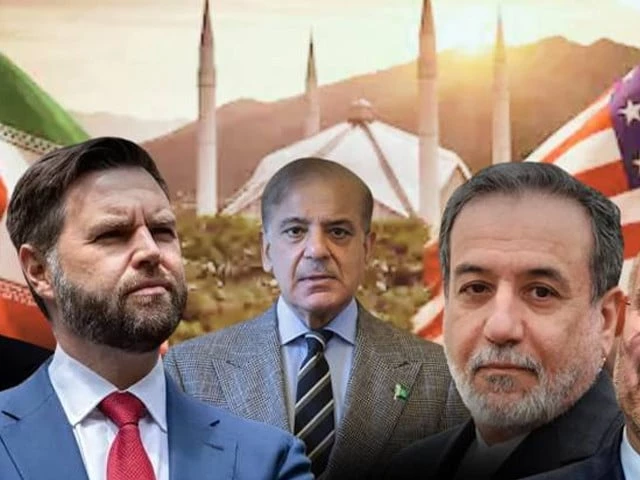
Holding talks at that level has already given Islamabad a big boost to its reputation.
ISLAMABAD:
All eyes are on Islamabad as Pakistan prepares to host the second round of talks between Iran and the United States. The fragile ceasefire between the two sides is about to expire, leaving almost no room for failure.
Both sides had signaled they would attend the long-awaited negotiations, with US Vice President JD Vance and Iran’s Parliamentary Speaker Mohammad Bagher-Ghalibaf expected to lead their delegations. However, uncertainty hangs in the air as Iran has yet to formally confirm its participation.
On Tuesday, Pakistan’s Federal Minister for Information and Broadcasting Attaullah Tarar posted on
US President Donald Trump does not hide his impatience. He has warned that he “expects to be bombing” if there is no progress, and has made clear that he will not extend the ceasefire unless an agreement is reached.
At the same time, he has expressed optimism that a deal remains possible, even as U.S. operations against Iranian vessels continue.
The crisis erupted on February 28, 2026, when the United States and Israel launched coordinated attacks across Iran.
The attacks targeted leadership compounds in Tehran, nuclear facilities, ballistic missile sites and military installations, and killed Supreme Leader Ayatollah Ali Khamenei, along with several senior officials.
Iran counterattacked with missile bombardments and indirect actions, pushing the region to the brink of full-scale war while closing the Strait of Hormuz, sending global oil prices soaring.
Pakistan acted quickly to contain the danger. Building on decades of working relations with both Washington and Tehran, Islamabad opened side talks.
In early April, Prime Minister Shehbaz Sharif and Field Marshal General Syed Asim Munir helped negotiate a two-week ceasefire that came into effect on April 8. The first round of direct negotiations, known as the Islamabad Talks, took place on April 11 and 12 at the Serena Hotel.
A large American team led by Vice President JD Vance faced off against an Iranian delegation led by Parliamentary Speaker Mohammad Bagher-Ghalibaf and Foreign Minister Abbas Araghchi, mediated by Pakistani officials.
The sessions lasted more than 21 hours. There was no final agreement to end the war, but both sides agreed to continue dialogue. That result of “neither progress nor rupture” kept the ceasefire alive until today.
Now the pressure is stronger than ever. A deal could stabilize oil markets and reduce fears of new fighting in the Strait of Hormuz. Failure could reignite fighting, send energy prices soaring and send economic pain far beyond the Middle East.
What experts see ahead
Three experienced voices – former ambassadors Asif Durrani and Ali Imran, and foreign policy analyst Michael Kugelman – lay out the most likely paths and what they would mean for Pakistan and the world.
Durrani frames the standoff as a high-stakes confrontation between Iran, on the one hand, and Israel plus the United States, on the other. In his view, success would end new hostilities and open the door to resolving larger issues through dialogue.
For Pakistan this would be a genuine victory, based on what he calls Islamabad’s “unique” position, its strong relations and a degree of trust with both Tehran and Washington.
Ali Imran hopes for something more substantial, a broader agreement that will keep the process alive even if differences persist. “If the talks are successful,” he says, “Pakistan will be seen as having played a key role in preventing a major conflict.”
Kugelman stops short of optimism, but sees a realistic opening.
Facilitating even a limited agreement, truce extension or quiet understandings in flashpoints like the Strait of Hormuz would present Pakistan as a responsible and peace-oriented actor, potentially unlocking investment and deeper international engagement.
For the rest of the world, the reward would be calmer energy markets and a lower risk of a major war. However, he warns that global attention is often diverted once the immediate crisis fades, and a weak agreement could simply gloss over deeper problems and postpone the next confrontation.
Best case scenario if talks fail
Even failure is not a total loss. Kugelman points out that Pakistan could still get credit for making a sincere effort to reduce tension. In a contained burst, the world could gain clearer leverage for future rounds or accelerate moves toward alternative energy sources.
Worst case scenario if talks fail
This is where the warnings become serious. Durrani says a breakup would mean a resumption of attacks and a broader regional escalation. Pakistan is already feeling the pressure of rising oil prices; Greater problems would generate a strong economic shock and at the same time destabilize the region in general.
The ripple effects go far beyond the immediate players: the entire Middle East is already under pressure, and global energy prices – already rising even in the United States – would rise even further.
Imran is equally direct. The nightmare scenario, he says, is that Iran simply doesn’t show up. “That would lead to a breakdown of engagement and broader conflict,” he warns, with destabilizing effects across the Middle East and new inflationary pressure felt around the world.
For Pakistan, the risk to its reputation is real after investing so visibly in mediation, the failure of which could affect its credibility as a negotiator. Kugelman agrees that this could expose Islamabad to criticism for overestimating its influence, although he believes the country could still command respect simply by staying at the table.
Pakistan’s diplomatic balancing act
All three experts praise the approach taken so far by Islamabad. Durrani calls the positioning “unique.” Imran describes it as “positive and constructive”, rooted in Pakistan’s long tradition of trying to reduce conflict in the Muslim world and the Middle East.
He warns, however, that this second round will be tougher: a more assertive American stance faces a more cautious Iranian one.
Kugelman sees the mediation effort as part of Pakistan’s broader push for strategic autonomy and a better global image. Whether there is a breakthrough today or not, simply hosting the talks at this level has already given Islamabad a boost to its reputation.


