
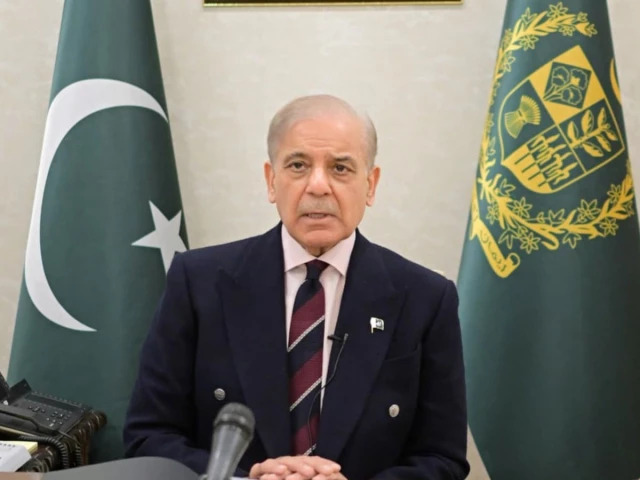
Prime Minister Shehbaz Sharif addresses the nation on Friday. Photo: PMO
ISLAMABAD:
Prime Minister Shehbaz Sharif on Wednesday chaired a high-level meeting on promotion of electric vehicles (EV) and announced that government employees up to BPS-16 would be provided with e-bikes on easy timelines.
The meeting was told that the government aimed to switch 30 percent of vehicles to electric power over the next five years, a move that was expected to save approximately $4.5 billion in fuel imports.
The Prime Minister directed the relevant authorities to accelerate ongoing initiatives aimed at promoting the adoption of electric vehicles across the country.
During the briefing, officials informed the Prime Minister that 72 manufacturing certificates for motorcycles and electric rickshaws have been issued so far, along with four certificates for electric cars. In addition, 123 applications have been received for the installation of electric vehicle charging stations nationwide.
Prime Minister Shehbaz Sharif on Wednesday reaffirmed the government’s determination to completely eradicate polio from Pakistan and noted encouraging progress as only one case has been reported so far in 2026.
Polio eradication
Prime Minister Shehbaz Sharif reaffirmed the government’s determination to completely eradicate polio from Pakistan and noted encouraging progress as only one case has been reported in 2026 so far.
Chairing a high-level review meeting on polio eradication at the Prime Minister House, the prime minister appreciated the tireless efforts of anti-polio teams working across the country and reiterated that eliminating the disease remains a national priority, according to a press release from the Prime Minister’s Office.
The Prime Minister emphasized that sustained coordination between federal and provincial authorities, frontline workers and partner organizations would remain essential to achieve the goal of a polio-free Pakistan.
During the briefing, the meeting was informed that only one polio case had been reported in Sujawal district this year, compared to 74 cases in 2024 and 31 cases in 2025, reflecting a significant downward trend.
No cases have been reported so far in 2026 from Punjab, Khyber-Pakhtunkhwa, Balochistan, Islamabad, Gilgit-Baltistan or Azad Jammu and Kashmir.
Officials further informed the meeting that the number of polio-affected districts decreased from 67 in the first quarter of 2025 to 23 in the first quarter of 2026. The national household coverage during anti-polio campaigns remained consistently high at 98 percent.
Participants were told that better access and increased vaccination efforts in the southern districts of Khyber Pakhtunkhwa had significantly reduced the number of children lacking polio vaccines. A substantial decline in local poliovirus transmission was also recorded in Quetta block.
In Karachi, encouraging results from environmental surveillance showed that no poliovirus was detected in 10 of 12 environmental samples collected in March. Similarly, no polio case has been reported in Dera Ismail Khan district since September 2025, while the number of high-risk union councils in Bannu has been drastically reduced from 62 to just six.
The meeting also reported that a strategy is being finalized to integrate the Expanded Program on Immunization (EPI) with the Polio Eradication Initiative (PEI) at the federal and provincial levels. Efforts are also underway to link certain Benazir Income Support Program interventions with anti-polio measures to further strengthen outreach.


