
Home Minister says Prime Minister Shehbaz and Field Marshal Munir are making vigorous efforts at all levels to resolve the issue.
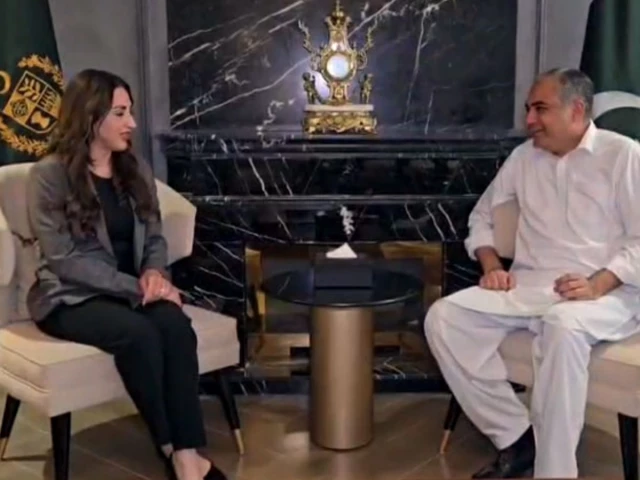
Mohsin Naqvi met Natalie Baker in Islamabad on Wednesday, April 23, 2026.
The US chargé d’affaires in Pakistan, Natalie Baker, met with Interior Minister Mohsin Naqvi on Thursday, where the two discussed diplomatic efforts related to the second round of negotiations in Islamabad.
According to the Ministry of Interior, the two sides discussed the evolving regional situation and “reviewed the progress of diplomacy ahead of the second round of Islamabad talks.”
Naqvi stated that positive developments were also expected from Iran as Prime Minister Shehbaz Sharif and Chief of Army Staff and Chief of Defense Forces Field Marshal Asim Munir were making vigorous efforts at all levels to resolve the issue.
“Both sides are expected to give a chance to diplomacy and a peaceful solution,” Naqvi said.
2 ملاقات
ملاقات میں خطے تازہ ترین صورتحال پر تفصیلی تبادلہ
آباد مذاکرات کے دوسرے راؤنڈ کے انعقاد کے حوالے سے سفارتی کاوشوں پر بھی بات چیت pic.twitter.com/CA7ylfcxWR— Ministry of Home Affairs GoP (@MOIofficialGoP) April 23, 2026
The statement further added that the Interior Minister thanked US President Donald Trump for his initiative to extend the ceasefire, calling it “an important step forward” towards easing tensions in the region.
“Natalie praised Pakistan’s constructive role in establishing peace in the region and resolving the conflict,” the statement concluded.
US-Pakistan ties in the context of the current crisis with Iran reflect a pragmatic security-driven partnership in which Islamabad has positioned itself as a key intermediary.
Trump’s decision to extend the ceasefire – explicitly acknowledging the requests of Prime Minister Shehbaz and CDF Munir – underscores Washington’s dependence on Pakistan’s secondary diplomacy at a time of heightened regional volatility.
Read more: ‘Good news’ about peace talks possible Friday, Trump tells NY Post
Despite historically fluctuating ties, particularly after the war in Afghanistan, the current engagement signals a renewed convergence in which Pakistan’s geographic influence and diplomatic access are critical to managing the risks of escalation in the Gulf.
At the same time, the dynamics of war complicate this cooperation, as the United States continues to maintain military pressure on Iran through blockades and deterrence postures, even as it supports talks facilitated by Islamabad. Pakistan’s role as an “honest broker” allows it to engage with both Washington and Tehran, but also puts it in a delicate position amid competing strategic expectations.
For the United States, working with Pakistan offers a channel to reduce tension without direct concessions, while for Islamabad, mediation improves its global diplomatic standing without direct military involvement. However, the sustainability of this alignment will depend on whether negotiations produce tangible results or whether renewed hostilities force both sides to return to a more transactional, security-focused relationship.


