
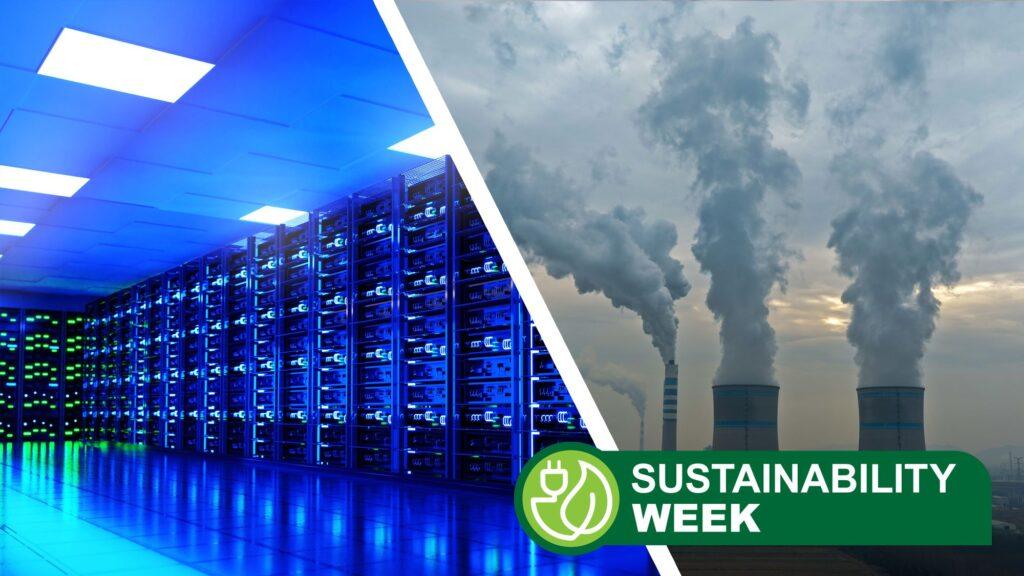
- New AI data centers in the US could produce more emissions than an entire nation
- 11 sites have the potential to emit 129 million tons of greenhouse gases per year
- The future sustainability of AI remains unclear
Sustainability Week 2026
This article is part of a series of sustainability-themed articles we are publishing to commemorate Earth Day 2026 and promote more sustainable practices. Check out all our Sustainability Week 2026 content.
A report has found that new AI data centers in the US could have the capacity to produce more greenhouse gases than an entire nation, subjecting the technology to greater scrutiny and raising more questions about its sustainability.
A Wired investigation has revealed that 11 gas-powered AI data centers could generate more greenhouse gases than all of Morocco by 2024, with a potential 129 million tonnes emitted per year from the sites.
And it’s not just one AI company that is linked to these new data center campuses, as OpenAI, Meta, Microsoft and xAI are mentioned in the report.
Article continues below.
Wired notes that projects have been announced or are already under construction, as AI companies seek to bypass power grid restrictions in the US by building their own gas-fired power plants with the sole intention of powering data centers.
This level of emissions could play a role in the ongoing battle against climate change. The construction of gas stations could impact local communities, and the actions could lead AI users to question whether this is a technology they want to support.
Analysis: AI can be great, but at what cost?
There’s no doubt that AI can do impressive things, like solving a 12-year-old’s math problem, but it also has its fair share of critics. From mind-blowing results and a perceived lack of quality in some circumstances, to well-documented sustainability issues and climate issues.
Wired’s investigation highlights that a natural gas project from which Microsoft intends to purchase energy “could emit more than 11.5 million tons of greenhouse gases each year.” That’s more than Jamaica’s annual emissions.
Meanwhile, xAI’s (the company behind Grok) gas turbines in Memphis, Tennessee, and Southaven, Mississippi, could each emit 6.4 million tons of CO2 equivalent per year.
The list goes on, as the full report details AI data center projects in Texas, New Mexico, Ohio, Wisconsin, and more, including OpenAI and Meta.
It is worth noting that the emissions data comes from models of power plants constantly operating at full capacity, which does not happen in reality. Emissions could be two-thirds less than models suggest, but it would still be a considerable production of greenhouse gases.
There is no guarantee that all the gas-powered stations mentioned in the research will be built, but as demand for AI processing remains strong, technology companies will likely look to keep up.
Hope remains, however, as some believe AI can be a catalyst for sustainability, but for now the path to cleaner AI is far from set in stone.
Follow TechRadar on Google News and add us as a preferred source to receive news, reviews and opinions from our experts in your feeds. Be sure to click the Follow button!
And of course you can also follow TechRadar on TikTok for news, reviews, unboxings in video form and receive regular updates from us on WhatsApp also.


