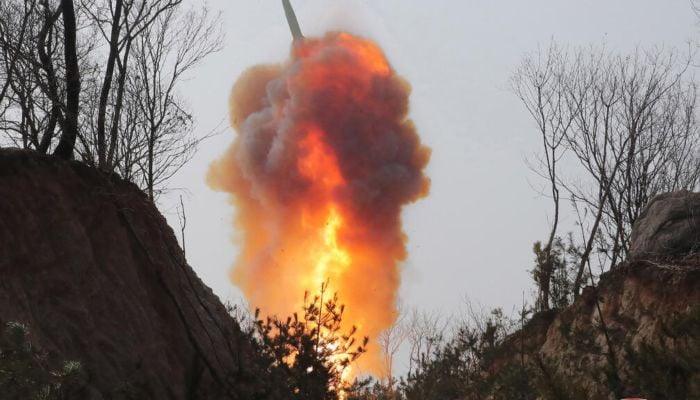
- World nuclear reserves show a renewed upward trend.
- Trust is eroding under the non-proliferation treaty.
- The summit risks stalling amid tensions between Ukraine and Iran.
UNITED NATIONS: Signatories to the historic nuclear non-proliferation treaty will meet at the UN starting Monday as hopes for a deal fade and tensions between atomic powers rise.
In 2022, during the latest review of the treaty considered the cornerstone of nonproliferation, UN Secretary-General Antonio Guterres warned that humanity was “one misunderstanding, one miscalculation away from nuclear annihilation.”
The situation has only gotten worse since then.
“I think there is a sense of shared crisis, so to speak, by all states parties,” said Izumi Nakamitsu, UN High Representative for Disarmament Affairs.
“We do not have any bilateral arms control agreement between the two largest nuclear weapons states,” he said, referring to the February expiration of the New Start treaty between Moscow and Washington.
“We are also beginning to see a quantitative increase in nuclear capabilities in all nuclear weapons states.”
Nakamitsu said rising geopolitical tensions had halted the post-Cold War disarmament trend.
The nuclear non-proliferation treaty (NPT), signed by almost every country on the planet (with notable exceptions such as Israel, India and Pakistan), aims to prevent the proliferation of nuclear weapons, promote complete disarmament and encourage cooperation on civil nuclear projects.
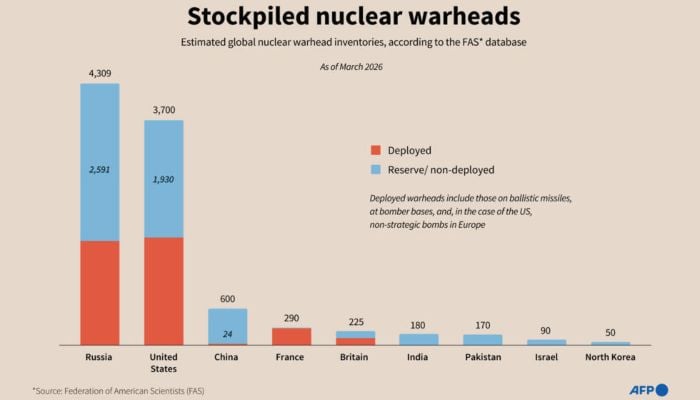
The nine nuclear weapons states (Russia, the United States, France, the United Kingdom, China, India, Pakistan, Israel and North Korea) possessed 12,241 nuclear warheads as of January 2025, according to the latest report from the Stockholm International Peace Research Institute (SIPRI).
The United States and Russia possess almost 90% of the world’s nuclear weapons and have carried out major programs to modernize them in recent years, according to SIPRI.
China has also rapidly increased its nuclear arsenal, SIPRI said, and the G7 raised the alarm on Friday about Moscow and Beijing increasing their nuclear capabilities.
US President Donald Trump has indicated his intention to carry out new nuclear tests because “other countries are doing it too.”
In March, French President Emmanuel Macron announced a dramatic change in the nuclear deterrent, in particular an increase in the atomic arsenal, which currently has 290 warheads.
The NPT could “fall apart”
“It is obvious that trust is eroding, both inside and outside the NPT,” said Nobel Peace Prize winner Seth Sheldon of the International Campaign to Abolish Nuclear Weapons (ICAN). AFP.
He questioned the likely outcome of the four-week summit.
Decisions on the NPT must be agreed upon by consensus, and the two previous conferences failed to adopt final political declarations.
In 2015, the stalemate was largely due to opposition by Washington, Israel’s archenemy, to the creation of a nuclear weapons-free zone in the Middle East.
In 2022, the stalemate was mainly due to Russian opposition to references to the Ukrainian Zaporizhzhia nuclear power plant, occupied by Moscow.
This year’s summit could encounter numerous obstacles.
The ongoing war in Ukraine, Iran’s nuclear program and the war there, non-nuclear states’ fears about proliferation, and North Korea’s developing arsenal could be decisive factors.
If there is a third consecutive failure, the treaty “could not implode overnight,” said Christopher King, secretary general of the conference.
But there is a risk that “over time it will fall apart.”
Artificial intelligence could be a prominent topic as some countries call on all parties to maintain human control over nuclear weapons.