
ISLAMABAD:
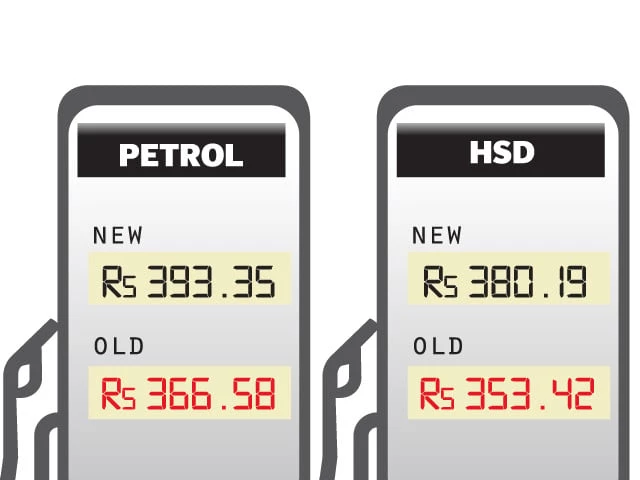
Prime Minister Shehbaz Sharif on Friday increased the prices of both high-speed diesel and petrol by Rs 27 per liter even though there was no need to increase petrol rates and to raise its price, the prime minister imposed nearly Rs 27 more per liter fuel tax.
Accordingly, the price of high-speed diesel has been fixed at Rs 380.2 per liter, down from Rs 353.42 per liter. This represents an increase of 7.5%. Diesel prices remain significantly lower from their peak of Rs 520.4 on April 10. Diesel is considered the most inflationary fuel due to its widespread use in freight transportation and the agricultural sector.
The Prime Minister approved increasing petrol prices to Rs 393.4 per liter, up from Rs 366.6. This shows an increase of 7.3% over existing prices. Petroleum Division officials said there was no change in petrol prices in the international market and rates had to increase due to the tax increase.
The Finance Ministry spokesperson was not available for comment.
The new rate of petrol tax has been fixed at Rs 107.4 per liter as Shehbaz Sharif again opted to recover the tax that was to be recovered from diesel consumers from petrol consumers, a policy he had earlier implemented and later revoked after public backlash.
Last month, the prime minister had raised tax on petrol to a record Rs 160 per liter amid skyrocketing prices. The prime minister later took credit for reducing the tax to Rs 80.
Sources said the International Monetary Fund has asked the government to start levying a tax of Rs 80 per liter on diesel and petrol. Instead of introducing a petroleum tax on high-speed diesel, the prime minister has increased the tax on petrol to Rs 107.4 per litre.
The IMF still demands to further increase the tax by Rs 53 per liter. Sources said the government would take a decision next week whether the remaining tax of Rs 53 per liter should be recovered from diesel or petrol users.
Finance Ministry sources said the government has already collected just over Rs 1.2 trillion in oil taxes during the first nine months of this fiscal year. This is equivalent to 82% of the annual target of Rp 1,468 trillion.
However, the government has chosen to further increase the burden on petrol consumers, mostly poor motorcycle owners and car owners belonging to lower middle income to higher income groups.
Prime Minister Shehbaz Sharif’s government is trying to appease diesel users but may end up irritating both diesel and petrol consumers as prices continue to rise in both categories.
Earlier, the government had cut the federal development budget by 17% or Rs 173 billion to offset the impact of reducing petroleum tax on diesel and partially subsidize the product.
Currently, the government is collecting around Rs 36 per liter of diesel, including Rs 33 as customs duty and Rs 2.5 as climate support tax. Total taxes on petrol amount to Rs 134 per litre, including petroleum tax of Rs 107, customs duty of Rs 24 and climate support tax of Rs 2.5.
As per the agreement with the IMF, the climate support tax would be further increased by Rs 2.5 per liter on both products, reaching Rs 5 per liter from July 1.
Government officials remain unable to convince the IMF to relax punitive conditions, even during times of war. The demand to further increase the rates of the oil tax and the climate support tax shows the lack of convincing power of the negotiators.
The IMF is expected to approve the fourth tranche of the loan and the third review of the $7 billion rescue package in the first week of May.
Due to the reduction in world prices, the premium prices of kerosene and light diesel have been reduced. Kerosene oil prices have reduced from Rs 429 per liter to Rs 365 per liter. There is a reduction of Rs 63.6 per liter in the price of kerosene. The government is charging a tax of Rs 20.4 per liter of oil.
Light diesel prices have been reduced from Rs 299 to Rs 270 per litre, a reduction of Rs 29 per litre. The price includes the tax of Rs 15.8 per liter of oil.


