
Welcomes Iran’s participation in the Islamabad talks and reaffirms its support for sustained dialogue and diplomacy.
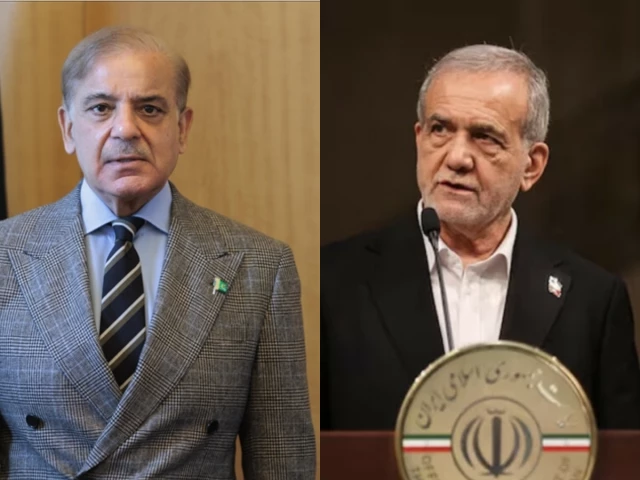
Prime Minister Shehbaz (right) holds talks with Iranian President Masoud Pezeshkian (left) on the US-Iran ceasefire.
Prime Minister Shehbaz Sharif told Iranian President Masoud Pezeshkian on Saturday that Pakistan would continue its “sincere and serious” efforts for peace in the region after the latest setback in talks between the United States and the Islamic republic.
The development comes after US President Donald Trump canceled a planned visit by envoys Jared Kushner and Steve Witkoff to Pakistan for talks with Iranian officials. The Iranian Foreign Minister also left the country after a visit to senior officials.
According to a statement from the Prime Minister’s Office, Prime Minister Shehbaz and the Iranian President held a 50-minute “warm and cordial” telephone conversation on Saturday evening, during which they exchanged views on the prevailing regional situation and ongoing efforts for peace and stability.
Read: US-Iran peace process hampered as Trump cancels envoys’ trip and Foreign Minister Araghchi leaves Pakistan
Reiterating Pakistan’s position, the prime minister said, “Pakistan will continue its sincere and honest efforts to promote regional peace and security.”
He added that Prime Minister Shehbaz appreciated the participation of the high-level Iranian delegation in the talks held in Islamabad on April 11-12, while welcoming Iran’s decision to send a delegation led by Foreign Minister Araghchi to Islamabad today.
Islamabad: April 25, 2026.
Prime Minister Muhammad Shehbaz Sharif had a telephone call this afternoon with His Excellency Dr. Masoud Pezeshkian, President of the Islamic Republic of Iran.
During their warm and cordial conversation that lasted fifty minutes, the two leaders had a…
— Prime Minister’s Office (@PakPMO) April 25, 2026
Sharing details of his diplomatic outreach, the prime minister said his contacts with world leaders had helped build “a broader consensus in support of sustained dialogue and diplomacy aimed at achieving lasting peace in the war-affected region.”
He also praised the “fruitful talks” held between the Iranian leadership and Chief of Defense Forces and Chief of Army Staff Field Marshal Asim Munir during the latter’s recent visit to Tehran earlier this month.
President Pezeshkian thanked Prime Minister Shehbaz, CDF Munir and Foreign Minister Ishaq Dar for their “significant contribution to the peace efforts.” He also expressed Iran’s desire for peace and said he was confident that “brotherly ties between Iran and Pakistan will continue to strengthen and expand in the future.”
The prime minister also conveyed his “respectful regards and greetings” to Iran’s Supreme Leader Ayatollah Mojtaba Khamenei.
Read also: Turkish FM says Iran nuclear issue could be resolved in next round of talks in Pakistan
Both leaders agreed to remain in close contact and continue coordination on matters of mutual interest.
The prime minister said in a subsequent post on X that he had a “warm and constructive telephone exchange” about the evolving regional situation.
“I appreciated Iran’s continued commitment, including the high-level delegation to Islamabad led by Foreign Minister Abbas Araghchi, whom I had the pleasure of meeting today. I reaffirmed that, with the support of friends and partners, Pakistan remains committed to serving as an honest and sincere facilitator, working tirelessly to promote lasting peace and lasting stability in the region.”
This afternoon I had a warm and constructive telephone conversation with my brother, President Masoud Pezeshkian, about the development of the regional situation.
I appreciated Iran’s continued commitment, including the high-level delegation to Islamabad led by Foreign Minister Abbas Araghchi, who…
– Shehbaz Sharif (@CMShehbaz) April 25, 2026
Washington remains trapped in a costly impasse with Tehran, as tensions between the two sides continue to disrupt global energy markets. Iran has reportedly tightened controls over the Strait of Hormuz – a key shipping route that normally carries around a fifth of the world’s oil supply – while the United States continues to restrict Iranian oil exports. The standoff, along with a broader regional conflict involving Israel, has sent energy prices to multi-year highs, fueling inflation and weakening global growth prospects.
However, Iran has stated that its officials do not plan to meet with US representatives to discuss ending the ongoing conflict, which has reportedly caused heavy casualties among Iranian and Lebanese civilians and shaken global markets.
The situation briefly appeared to improve earlier this week when US President Donald Trump unilaterally extended a ceasefire on Tuesday, giving negotiators additional time to resume talks.
Read: Pakistan’s envoy to the United States says Islamabad is committed to diplomacy and regional stability
Diplomatic efforts appeared to be regaining momentum after an earlier round of inconclusive discussions involving US officials JD Vance, Steve Witkoff and Jared Kushner, along with Iranian Foreign Minister Abbas Araghchi and Iran’s Parliamentary Speaker Mohammad Bagher Ghalibaf. Those talks, held in Islamabad two weeks ago, failed to make any progress.
On Friday, Trump told Reuters that Iran was expected to make an offer aimed at meeting US demands, although he did not specify its details.
Subsequently, Iranian Foreign Minister Abbas Araghchi announced a visit to Pakistan on Friday. Around the same time, Trump also said he would send a US delegation to Islamabad, reportedly including Jared Kushner and Steve Witkoff, to continue negotiations.
However, when Araghchi arrived in Islamabad, the president announced that he had canceled the planned visit of US envoys Jared Kushner and Steve Witkoff for peace talks with Iran.
When asked by Axios if the cancellation indicated a possible resumption of hostilities, Trump said: “No. It doesn’t mean that. We haven’t thought about it yet.”
Later, in a post on his social media platform Truth Social, the US president said the decision was made due to what he described as unnecessary travel and workload considerations.


