
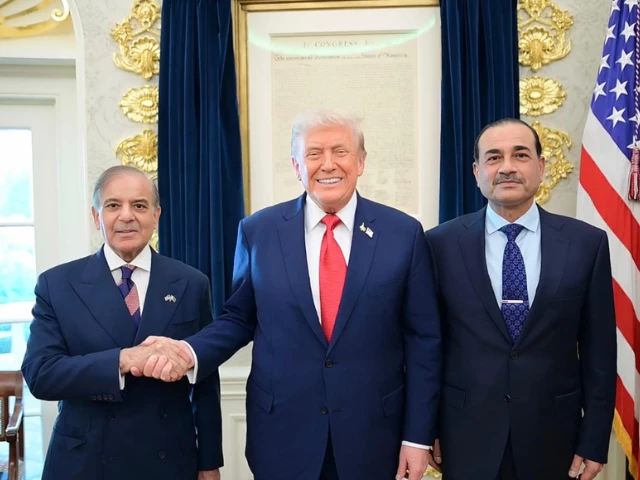
“Pakistan is fantastic,” Trump said, adding that Prime Minister Shehbaz and CDF Munir would like something to happen.
Prime Minister Shehbaz, Field Marshal Munir and US President Donald Trump at the White House Photo: PMO X account
US President Donald Trump has once again praised Prime Minister Shehbaz Sharif and Chief of Defense Forces (CDF) and Chief of Army Staff Field Marshal Asim Munir for their efforts in facilitating peace and negotiations with Iran, despite another pause in the diplomatic process.
His comments came after Trump canceled a planned visit by envoys Jared Kushner and Steve Witkoff to Pakistan for talks with Iranian officials. The Iranian foreign minister also left Pakistan after meeting senior officials.
“I think Pakistan is fantastic. The quarterback (Asim Munir) is fantastic. I think the prime minister of Pakistan (Shehbaz Sharif) is fantastic and, you know, they would like something to happen,” Trump said in a video posted by Pakistan TV on X.
However, he announced that he would not send his team to Islamabad, citing the long journey and travel costs. “But we’re not going to travel 15 or 16 hours to meet with people no one has heard of,” he said, adding that it would be very expensive and that he is “a very cost-conscious person.”
He reiterated that Iran should not be allowed to obtain a nuclear weapon and said Tehran had “offered a lot, but not enough.”
“They won’t have a nuclear weapon. It’s very simple. The whole thing is not complicated. Iran cannot have a nuclear weapon,” he said.
This is the second time this month that the US president has publicly praised Prime Minister Shehbaz and Field Marshal Munir for their commitment to efforts to facilitate talks with Iran aimed at ending the conflict.
Read: US-Iran peace process hampered as Trump cancels envoys’ trip and Foreign Minister Araghchi leaves Pakistan
On April 17, Trump similarly praised Pakistani leaders, describing them as “fantastic people.” In a post on his social media platform Truth Social, he wrote: “Thank you to Pakistan and your great Prime Minister and Field Marshal, two fantastic people!”
The United States and Israel launched a joint offensive against Iran on February 28, killing dozens of senior military officers, including then-Supreme Leader Ali Khamenei, before Pakistan brokered a two-week ceasefire earlier this week.
Tehran retaliated with drone and missile attacks against Israel, as well as Jordan, Iraq and Gulf countries hosting US military assets, and restricted the movement of ships through the Strait of Hormuz, a key passage for oil and gas shipments.
Fighting later spread to Lebanon after Israel launched an offensive there, widening the conflict, while the United States and Israel continued attacks on Iran.
As the conflict continued to expand and intensify, Pakistan emerged as a mediator along with other regional powers in the escalating crisis. When the negotiation process began, the United States and Iran exchanged their respective positions, but the first discussions did not produce progress. However, after sustained diplomatic efforts by Pakistan, both sides agreed to hold talks in Islamabad last week.
But Washington and Tehran failed to reach an agreement in Islamabad over the weekend during talks that were part of broader efforts to end the conflict.
Washington remains locked in a costly impasse with Tehran as tensions between the two sides continue to roil global energy markets. Iran has reportedly tightened controls over the Strait of Hormuz, a key shipping route for global oil flows, while the United States maintains restrictions on Iranian oil exports. The standoff, along with a broader regional conflict, has driven energy prices to multi-year highs and fueled concerns about global inflation and growth.
Iran has said its officials do not plan to meet with US representatives to discuss ending the conflict, which has escalated tensions across the region.
The situation briefly appeared to improve earlier this week when US President Donald Trump extended a ceasefire to allow more time for negotiations, following earlier inconclusive talks involving US and Iranian officials in Islamabad.
On Friday, Trump told Reuters that Iran was expected to make an offer to address the US demands, but declined to provide details. However, when Iranian Foreign Minister Abbas Araghchi arrived in Islamabad, Trump announced that he had canceled a planned visit by US envoys Jared Kushner and Steve Witkoff for peace talks with Iran.
Trump’s history of praising Pakistan’s leadership
This was not the first time that Trump praised Pakistan’s civilian and military leadership, as last year, while addressing an international event on peace in Gaza on October 13, 2025, he said: “I want to thank Prime Minister Sharif of Pakistan and I also have to say that my favorite field marshal of Pakistan is not here, but the prime minister is… give him my regards.”
In other cases, he also appreciated Prime Minister Shehbaz and CDF Munir, crediting them for helping prevent escalation in South Asia.
The relationship between Pakistan and the United States experienced a major thaw in 2025-2026, moving from a cold period to a warm, strategic and pragmatic engagement during Trump’s second term. This shift was largely driven by a major reset in relations following President Trump’s intervention in regional conflicts, particularly his role in mediating a ceasefire between Pakistan and India in May 2025.
The first thaw in Pakistan-US relations came through secret counterterrorism exchanges, indicating substantial cooperation. In March last year, Trump unexpectedly praised Pakistan’s counterterrorism efforts during a national address, prompting a policy shift.
The brief but intense skirmish with India in May 2025 became a decisive turning point, revealing Pakistan’s military discipline, strategic approach and asymmetric capabilities, qualities that reportedly surprised Trump.
Despite repeated denials from India, Prime Minister Shehbaz continued to praise President Trump for his role in mediating a ceasefire between the two nuclear-armed neighbors, and nominated him for the Nobel Peace Prize, saying his intervention had helped save millions of lives.
The praise was reciprocated: Trump praised the prime minister and also praised CDF Munir, while reiterating claims that he had helped prevent a war between Pakistan and India in May 2025.
Ties between the countries took a new turn when Trump invited CDF Munir to a lunch (the first such meeting for a Pakistani military chief) followed by a red carpet visit to the US Central Command headquarters for high-level talks.
Following a ceasefire following the protracted war in Gaza, Trump announced the formation of a “Peace Board” that included Pakistan, and again singled out Prime Minister Shehbaz for praise during his inaugural summit.
Addressing the event, Trump said, “I like this guy,” referring to the prime minister, as he recounted the efforts that led to last year’s ceasefire between Pakistan and India. He also praised the CDF Munir during his speech.


