
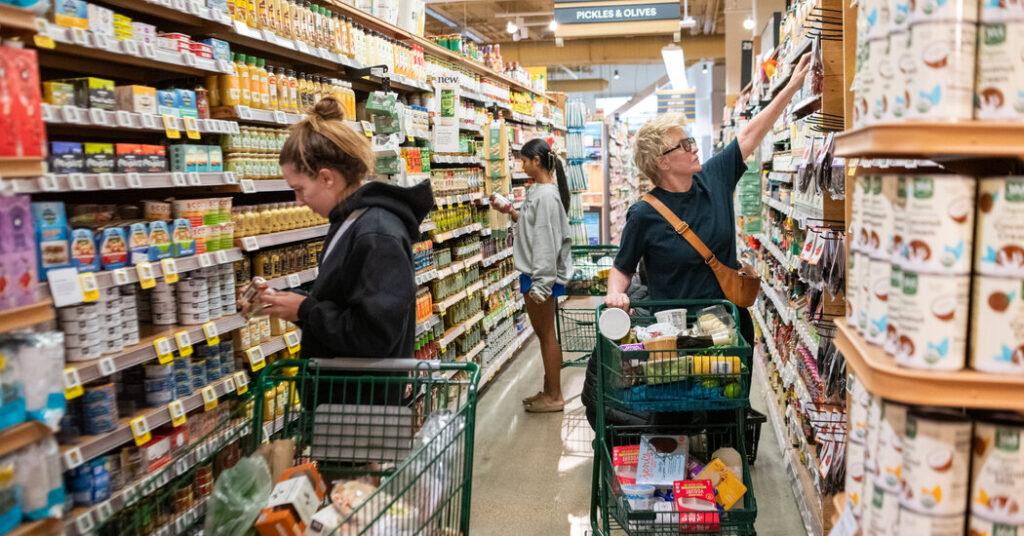
Trying to come up with a single description for ultra-processed foods is baffling federal regulators.
For months, Health Secretary Robert F. Kennedy Jr. has promised to create a definition of ultra-processed, a crucial part of the Make America Healthy Again agenda. In mid-April, he testified before Congress that the Food and Drug Administration had sent a definition to other agencies, including the Department of Agriculture.
But behind the scenes, officials said, the process of defining ultra-processed foods is still up in the air. The agencies are struggling to reach an agreement and it is unclear when a definition will be released.
“It’s not final until it is,” said Calley Means, Kennedy’s senior adviser, adding that the definition would ultimately be the result of hundreds of conversations with scientists, agency staff and other interested parties.
For the food industry, which is already seeing demand for many of its products weaken as some consumers cut back on spending while others use weight-loss drugs, the debate over what is and isn’t an ultra-processed food has potentially far-reaching consequences.
According to a classification widely used among the scientific community, essentially any food or drink made with ingredients not found in a home kitchen is defined as ultra-processed. If regulators adopt that kind of definition, nearly three-quarters of the food sold in the United States could be considered ultra-processed.
The food industry is arguing against a strict definition that would label chicken nuggets, strawberry yogurt and whole-wheat tortillas as ultra-processed.
Under that definition, deli turkey could be classified the same as a pot pie, the National Turkey Federation wrote in a comment letter to regulators last fall. He said certain food additives and processing steps were critical to keeping turkey fresh and that those “benefits are especially important for low-income households, where access to high-quality, nutrient-rich protein may otherwise be limited.”
One fear that emerged in interviews with food companies, lobbyists and regulators, most of whom declined to be named, is that foods labeled as ultra-processed could be restricted or eliminated entirely from the country’s school meal programs. They are multibillion-dollar revenue streams for companies that make sandwich breads, cereals, sauces and other foods. Others worry that regulators could create new rules for warning labels on food packaging in grocery stores.
But Kennedy, who has frequently referred to ultra-processed foods as “poison” and suggested restricting them from the diets of Americans, particularly children, faces increasing pressure from the MAHA movement, which is credited with helping elect President Trump to his second term. A Politico poll published in April showed that eliminating ultra-processed foods from the American diet was a key principle for people who identified as MAHA followers.
“If we can have a federal definition that is robust and based on science, it will open the door to meaningful policies,” said Vani Hari, a health advocate known online as “Food Babe” and a prominent voice in the MAHA movement. He added that “anything positive that comes out of the administration on food reform is popular with voters.”
Many scientists support a strong definition, noting that evidence has grown over the past decade linking ultra-processed foods to a number of chronic diseases, including obesity, type 2 diabetes, heart disease and some cancers.
Defining ultra-processed foods is “one of the most important policy actions around food that the American government has taken for probably 25 years or more,” said Dr. Dariush Mozaffarian, a cardiologist and director of the Food Is Medicine Institute at Tufts University. “The industry is going to fight tooth and nail because this is a fundamental threat to its entire model,” he added.
Dr. Mark Hyman, a physician and friend of Kennedy, called ultra-processed foods “the greatest threat to public health ever seen.” He called the food industry lobby on the definition “their usual antics.” It is “obfuscating, confusing and undermines the credibility of scientists,” he said.
While the food industry is trying to make its case to federal regulators, it is also facing a dizzying array of new regulations from states. Emboldened by the MAHA movement, many states are not waiting for the federal government. Instead, they are writing their own rules for eating. Last year, Texas and Louisiana passed laws requiring warning labels on foods containing any of 44 additives, while California banned certain ultra-processed foods from school lunch programs. Other states are considering similar measures.
Tufts’ Dr. Mozaffarian and some other health experts argue that the federal definition should adhere closely to a food classification system called Nova, which is used in the vast majority of research linking ultra-processed foods to poor health.
Nova’s definition considers a wide range of products ultra-processed, including candy, soft drinks and sausages. It also includes some foods traditionally considered healthy, such as many whole-grain breads, peanut butters, and yogurts.
The definition focuses mainly on the ingredients. Peanut butter, if it contains nothing more than peanuts or salt, would not be considered ultra-processed. But most peanut butters sold in grocery stores contain hydrogenated vegetable oils, which puts them in the ultra-processed category, according to Nova. Likewise, plain yogurt would not be considered ultra-processed. But when ingredients such as emulsifiers and flavorings are added, the food becomes ultra-processed.
In testimony before Congress in mid-April, Kennedy said that once a definition existed, his agency would move forward with a plan that would require color-coded labels to be placed on the front of food and beverage packages.
“If there is a red light, don’t eat it,” he said during his testimony. Green, he said, would signal to consumers that the food is healthy.
Kennedy also suggested that by following a federal definition of ultra-processed foods, states could restrict them from their food stamp programs, jeopardizing billions more in revenue for food companies.
In conversations with regulators and members of Congress, the food industry broadly says that an overly strict definition of ultra-processed foods like that of the Nova system could focus on nutritious foods, that more research is needed, and that greater regulation could lead to higher prices for consumers.
Using a broad brush to categorize foods “fails to capture the important reality that not all processed foods are created equal,” cereal maker WK Kellogg wrote in a comment letter last year when the FDA asked how ultra-processed foods should be defined. The National Chicken Council wrote in another comment letter that “the gummy bears and chicken nuggets in this comparison are technically ‘ultra-processed’ by common definitions. However, it is clear which has the potential to contribute significant nutrients to a higher-quality diet.”
Some of those arguments are gaining traction within the Department of Agriculture, which oversees the nation’s school meal programs. Officials there say it’s unclear whether the definition will be tied to policy, and if it is, they expressed concern that food manufacturers could abandon the programs, leaving school officials with fewer options for children’s lunches.
Lindsey Smith Taillie, a professor of nutrition at the University of North Carolina Gillings School of Global Public Health, who met with FDA officials in mid-April, said there was a middle ground. He argues that regulators can still create a strong federal definition similar to Nova’s while crafting useful policies (like warning labels or school meals) by exempting products that are “healthy,” according to FDA standards.
The FDA defines a healthy food as one that contains a certain amount of real food (such as fruits, vegetables, or milk, as opposed to processed ingredients like cornstarch) and not too much saturated fat, sodium, or added sugars.
Dr. Taillie said most ultra-processed foods don’t meet the definition of “healthy.” But a policy like this could motivate food companies to reformulate products to fit that criteria, he added.


