
The line separating crypto derivatives from traditional finance has virtually dissolved, and the two markets are now so intertwined that perpetuals, once a purely crypto instrument, could soon become both a stock and cryptocurrency trading product.
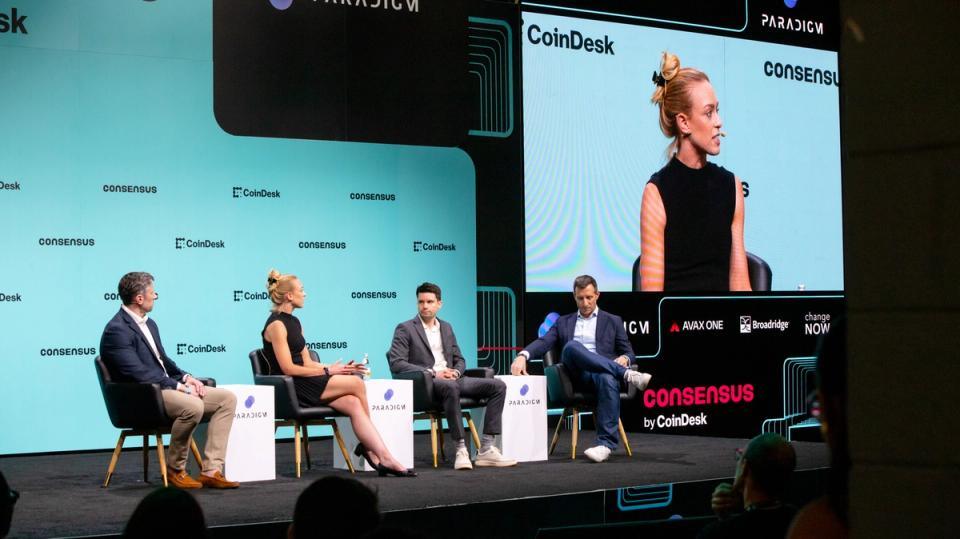
That’s the main takeaway from the “Digital Asset Derivatives: Building Ecosystems and Establishing Opportunities” panel at Consensus 2026 in Miami this week. Krista Lynch, senior vice president of ETF Capital Markets at Grayscale; Mike Harvey, head of franchise operations at Galaxy, and Griffin Sears, head of derivatives at FalconX (three executives from different lanes of the market) converged on the same point, and the case was based on working infrastructure rather than hype or vision.
Harvey made a bold statement about where that convergence leads. “There has been a lot of talk about tokenized stocks, and within the next two to three years, the volume of foreign-traded stock criminals will be greater than crypto criminals,” Harvey said.
Short for perpetual futures, felons are a type of derivative widely used in crypto markets, especially on unregulated offshore exchanges. They are similar to traditional futures, but with one key difference: they have no expiration date. As the name suggests, you can hold the perpetual contract forever.
By early 2026, derivatives accounted for more than 70% of global cryptocurrency trading, led by perpetual futures. Monthly volumes typically run into billions of dollars. While perpetual companies linked to traditional assets such as oil, stock indices and individual stocks have seen a surge in interest in platforms such as Hyperliquid and Binance, particularly during periods of geopolitical volatility, their share of total activity remains limited.
Harvey expects this segment to become dominant in the coming years. His point is that the infrastructure needed to bring stocks onto the blockchain rails is already in place, and it doesn’t matter what asset sits on top of it or is traded on top of it. Daily operations at Galaxy underscore that reality.
“As brokers, we are the glue that holds those markets together. We have to have the ability to move natively between an offshore exchange, an onshore exchange, futures and ETFs,” he said.
In other words, the boundaries between different markets and locations have operationally dissolved, and what remains is for volume to continue.
The regulatory foundation that facilitates convergence is more advanced than most market participants realize. Regular clarity has been the biggest driver, specifically the Securities and Exchange Commission’s generic listing standards, which she said drew formal attention to the link between derivatives and spot eligibility for ETFs, Lynch said.
“Having a derivative on an underlying crypto token is kind of an indication that it should also be available in spot format,” he added. The standards establish three paths for a protocol to be eligible for spot ETFs, two of which are executed directly through derivatives. It requires a futures market that has existed and is under the supervision of a regulator for a defined period. The other, which Lynch acknowledged is “a little more complicated,” allows spot eligibility if an ETF already offers significant exposure to an underlying asset through swaps or similar instruments.
“There’s a lot of continuity between those two worlds,” he said.
FalconX’s Sears pointed in the same direction across the panel. Crypto venues, including decentralized exchanges, are already offering contracts linked to precious metals and commodities as an extension of their perpetual offerings, he noted. But the more structural opportunity, Sears said, lies in cross-margining, where a trader can use different asset classes as collateral for each other within the same account. Talk about unlocking capital efficiency by bringing TradFi assets to the blockchain rails!
“What will be really powerful for all players in the space will be the cross-margin potential that RWA [real-world asset tokenization] can unlock,” Sears said. “And I think that benefits the industry as a whole.”
Sears expects a traditional financial asset to rank in the top five by volume on a crypto exchange. His final decision went one step further. “Not only will trading volume grow, but I think we’ll also see direct IPOs, direct stock listings on chains rather than traditional venues,” Sears said. “And it will be an extremely exciting time to see billion-dollar IPOs being done completely on-chain.”
The panelists also rejected the conventional framing of this convergence. The common assumption is that traditional finance is taking over cryptocurrencies and blockchain, that is, banks, asset managers and exchanges are adopting digital assets on their own terms.
“Cryptocurrencies are actually putting TradFi on the rails and forcing all of these traditional exchanges to innovate to the level that crypto derivatives are at,” he said.
The 24/7 trading and settlement model pioneered by crypto markets is now something that all major traditional exchanges have publicly aspired to replicate, a sign that innovation is flowing in one direction.
The IBIT options market offers perhaps the clearest example of that speed. In less than two years, BlackRock’s bitcoin spot ETF options became one of the top five ETFs globally by options volume, Sears noted.


