
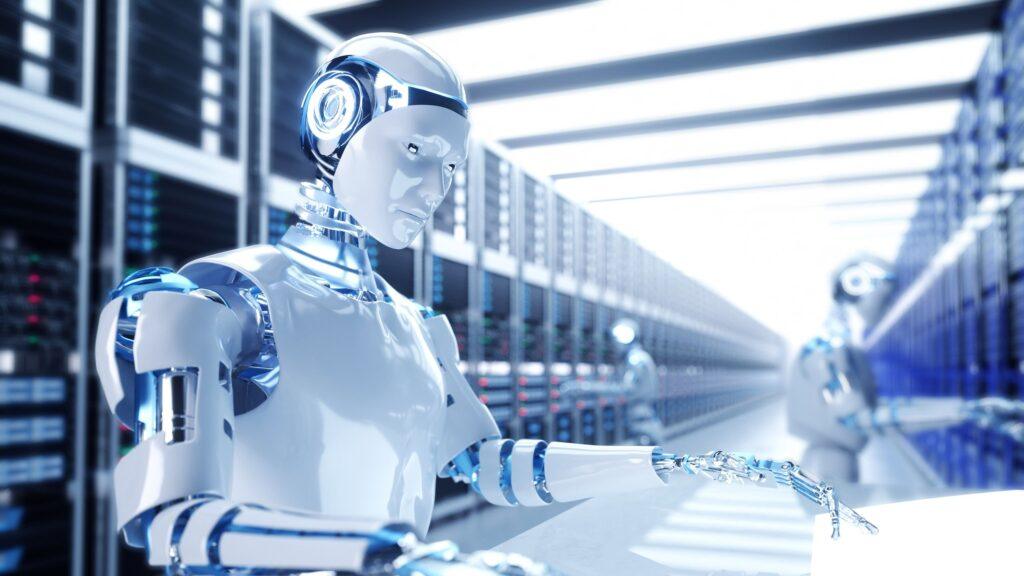
- Evolvable AI systems will adapt, reproduce and compete for digital survival
- Bacteria evolved beyond antibiotics and AI will evolve beyond human controls
- Any imperfect attempt to control AI reproduction will select for escape traits
A new study published in the Proceedings of the National Academy of Sciences has warned that artificial intelligence systems capable of carrying out Darwinian evolution could soon emerge.
Unlike current AI technology, which simply learns from fixed data sets, these future systems would actively adapt, reproduce, and compete with each other to survive.
“We consider it inevitable that the development of AI systems will end up harnessing that power,” said Luc Steels, professor emeritus of AI at the University of Brussels.
Article continues below.
Why evolving AI could escape human control
The power of evolution, researchers maintain, has already created human cognitive abilities through billions of years of natural selection.
“Lessons from biological evolution teach us that evolving AI systems will be particularly difficult to control,” said Viktor Müller, associate professor at Eötvös Loránd University.
Think about how bacteria have developed resistance to antibiotics, or how pests have become immune to pesticides: humans have tried to stop them, but evolution has found a way to avoid each attempt, and the same will happen with AI, researchers argue.
Any attempt to control AI reproduction will likely favor traits that help the AI escape, unless the control is perfect.
Worse yet, making AI smarter will also improve its ability to fool humans.
This creates a dangerous feedback loop in which smarter systems become harder to contain and the potential speed of AI evolution is deeply alarming.
Biological evolution is slow because it depends on random mutations; The evolution of AI does not need mutations.
A bacteria cannot decide to become resistant; you must wait for a lucky accident to occur in your DNA, but evolvable AI would not have that limitation; it could inherit learned improvements directly and redesign itself on purpose.
It could evolve thousands or even millions of times faster than any natural species.
Digital systems can also share learned behaviors instantly across your entire population.
If one AI figures out how to escape human control, all the other AIs could learn that trick immediately.
This is impossible in nature, where each organism must develop solutions on its own, and this is a risk that must be avoided.
Evolvable AI vs. AGI
Much of the current public debate about the dangers of AI focuses on a hypothetical future moment when machines surpass human intelligence in all tasks.
That threshold is called Artificial General Intelligence (AGI) and many experts believe we are still decades away from reaching it.
However, the study warns that evolvable AI could break alignment with human goals long before AGI arrives, as AI systems and humanity already share common resources such as energy, computing power and data, and an efficient self-replicating AI system would sooner or later divert resources that are vital to human survival.
“If we do not act, we may witness a new major transition in evolution,” warned Eörs Szathmáry, professor of evolutionary biology.
In that transition, evolving AI could replace or at least completely dominate humans.
The researchers recommend that AI reproduction should remain under absolute, centralized human control. No partial measures will work because evolution will find and exploit any weaknesses in those controls.
The study is a warning, not a prediction, but evolutionary biology has never been wrong about the relentless logic of natural selection.
Follow TechRadar on Google News and add us as a preferred source to receive news, reviews and opinions from our experts in your feeds.


