
- Tectonic forces probably formed magma pathways before molten material rose
- Supercomputers Enabled Large-Scale Reconstruction of Hidden Yellowstone Structure
- Digital models now test geological theories in competition with observed data
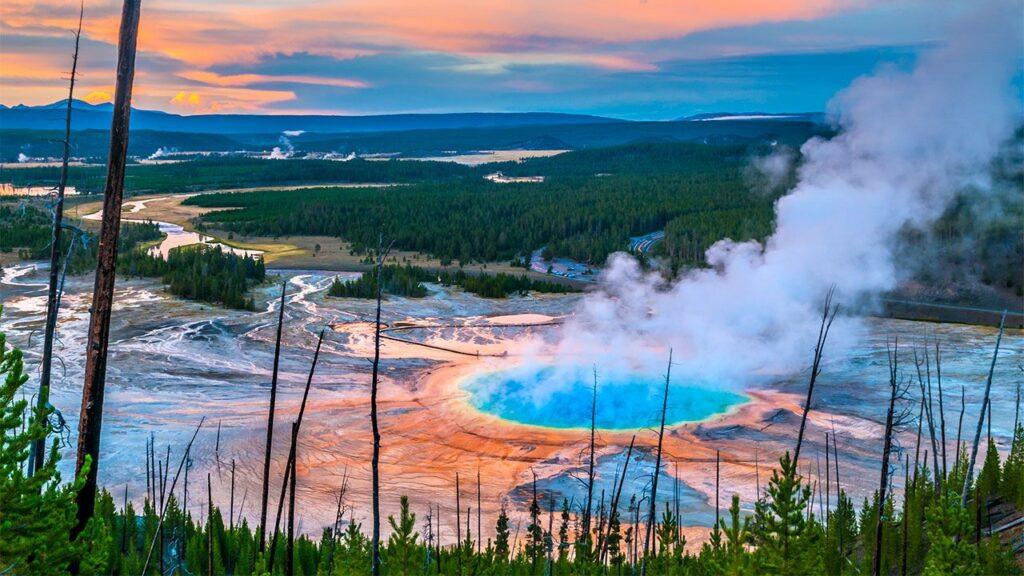
Yellowstone National Park in the United States has long been one of the most debated volcanic systems due to its immense scale and limited direct observation.
Scientists have struggled to explain how its underground magma pathways formed and evolved, but a Chinese research team led by Liu Lijun and Cao Zebin, using high-performance computing, has now offered a new explanation based on a large-scale simulation.
The study suggests that tectonic forces fractured the lithosphere before magma ascended through those existing pathways; This means that the cracks in the rock appeared first, and then the magma followed, indicating that the stresses of the magma itself are not responsible for the initial fractures.
Article continues below.
A computational approach to geological uncertainty.
For decades, the explanation for volcanism has been that as magma surged, it created its own conduit from below by brute force.
The researchers built a 3D model using Chinese supercomputers that runs from the surface to the deep layers of the mantle, combining decades of seismic readings, rock measurements and electromagnetic data into a unified computing system.
The result shows the internal structure of Yellowstone much more clearly than any previous conceptual model.
Researchers can now test many different scenarios by comparing them to real-world observations to see which explanation best fits the data.
The study also draws attention to how computational infrastructure now shapes scientific conclusions in important ways.
Running such a detailed model required access to advanced supercomputers that can handle very large data sets, and researchers involved in the study indicated that this level of simulation required resources not always available in other countries.
This introduces a structural factor into scientific discovery that cannot be ignored, as access to computing power can now determine which theories researchers can fully test and explore.
From volcano modeling to digital earth systems
Beyond Yellowstone, this research points to a much broader goal: simulating entire planetary systems at high resolution.
The idea of building a digital twin of the Earth means combining geological, atmospheric and environmental processes in a single computational framework.
These systems could allow scientists to test long-term scenarios and better understand how large-scale processes interact.
LLM-based frameworks may eventually help interpret the results of these complex simulations; however, its role would still be limited to analysis rather than performing physical modeling work.
Despite the impressive detail of the model, the findings still require independent validation by other research teams.
The study suggests that similar mechanisms can be applied to other volcanic systems around the world; however, this remains subject to continued scrutiny and further testing over time.
One researcher noted that “we are effectively putting the entire Earth into a computer,” capturing both the ambition and uncertainty of this goal.
However, relying heavily on simulation raises real questions about reproducibility and open access to data.
While the findings offer a clear and structured explanation, they also show how scientific progress may depend more on computing power than on direct observation.
Through SCMP
Follow TechRadar on Google News and add us as a preferred source to receive news, reviews and opinions from our experts in your feeds.


