
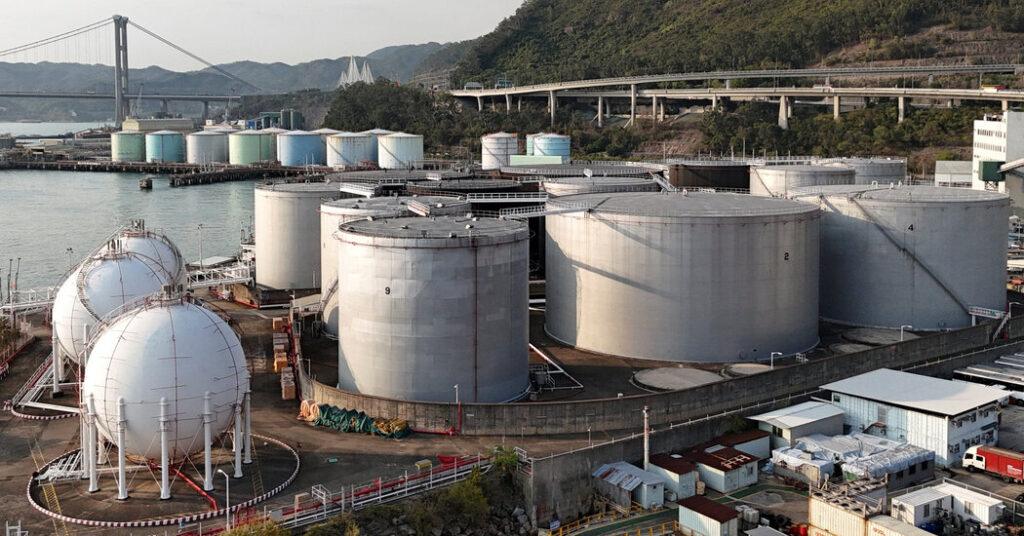
As the war in Iran drags on, China has deepened its influence with its fuel-hungry neighbors, offering to ease shortages while boosting its renewable energy technology.
In the days after the United States and Israel attacked Iran and the Strait of Hormuz was closed, China banned exports of petroleum products, putting pressure on Asian countries that rely on its refineries for jet fuel, gasoline and diesel.
Across Asia, governments are calling on Beijing to mitigate the impact of the war. Unlike the rest of the region, China is approaching the situation from a position of strength. It is the world’s largest importer of crude oil, but has built up huge reserves, spent decades reducing its dependence on foreign oil and invested hundreds of billions of dollars in clean energy technology.
Vietnam appealed to Beijing over its looming jet fuel shortage. The Philippines called on China not to restrict fertilizer exports. After a visit to China last month to press the issue, Australia’s foreign minister said Beijing would cooperate with Australian companies on jet fuel shipments.
The rapprochement produced assurances from China to address regional energy security issues, as well as commitments from other countries to advance diplomatic dialogue with Beijing and, in some cases, cooperate on future renewable energy projects, according to government readings. Diplomacy kept Chinese fuel flowing, helping Asia avoid some of the worst-case scenarios that experts feared at the start of the war.
Since the war began, Beijing has held high-level talks with officials from the Philippines, Australia, Vietnam, Cambodia, Laos, Thailand, Myanmar and Bangladesh.
China’s message has been consistent: it did not start the war and does not want to close the Strait of Hormuz, but it offers an alternative to fossil fuels.
Beijing has presented itself as a leader of a future powered by renewable and domestically-sourced energy, in contrast to President Trump’s embrace of oil and natural gas, which leaves much of the world exposed to volatility in regions such as the Middle East.
“China is stepping in cautiously to support its neighbors,” said Michal Meidan, head of China energy research at the Oxford Institute for Energy Studies, an independent research group. “They are using this as a soft power tool to say, ‘We will try to support your energy security with the caveat that China comes first,’ laying the groundwork for green technology sales as a form of security in the future.”
For years, China has used its economic power and technological know-how to extend its global influence through the Belt and Road Initiative, doling out roughly $1 trillion in loans and grants for infrastructure projects around the world, mostly in developing countries. But the war in Iran has allowed it to expand its influence without the reputational risk associated with lending to heavily indebted countries.
“Chinese officials are aware of the consequences and see clean energy as a remedy to the poor image of the Belt and Road Initiative,” said Dan Wang, China director at the Eurasia Group.
Oil continued to flow from China during the first month of the war, although experts caution against reading too closely the export figures, which can vary wildly from month to month. China’s jet fuel shipments to Vietnam rose 34 percent, fertilizer exports to the Philippines rose 33 percent and diesel exports to the Philippines rose 187 percent in March, compared with the previous month.
Asian economies are still recovering from the costs of war, which have reached a scale not seen since the Covid-19 pandemic halted much of global trade. Economists warn that the longer the strait remains closed, the more devastating the long-term damage will be for a region still heavily dependent on Middle East oil.
But continued shipments of some Chinese oil products to select countries have offered relief and underscored how Beijing uses carrots in times of crisis to generate goodwill, analysts and energy experts say.
“China’s ban was not a complete ban,” Ms. Wang said. “It was more selective and it seemed that good diplomatic relations played an important role.”
Vietnam and Australia, for example, have benefited because their relationship with Beijing has been improving. “So they got some fuel, although not the full amount they needed,” said Wang, who recently traveled to China and met with industry experts.
At times, China has offered the prospect of assistance in exchange for acceptance of its political terms. In March, as Taiwan scrambled to secure new energy sources, China’s Taiwan Affairs Office presented a thinly veiled deal to the self-governing island, which Beijing claims as its own.
Taiwan, the office said, would enjoy “better resource security after peaceful reunification, with a strong homeland as support.” The island imports more than 96 percent of its energy and about 60 percent of its oil transits through the strait.
The war in Iran has exposed many of Asia’s vulnerabilities, and China is not the only one using its resources to keep the region afloat. Japan pledged $10 billion to help Southeast Asian nations cope with rising oil prices and support factories that supply important equipment to Japanese industry.
But for China, the war has also created an opportunity to boost its renewable energy technology across the region. China dominates the world in the manufacturing of equipment for solar parks, wind farms and smart grids, as well as in the production of electric vehicles. Shipping these products abroad helps keep China’s exports booming, a critical growth engine for a stagnant domestic economy.
“The conflict provides them with a springboard to achieve the goal of becoming an energy power,” said Erica Downs, a senior fellow at the Center for Global Energy Policy at Columbia University. “To the extent they can use that energy technology as a carrot or a stick, it’s useful.”
In an opinion essay written weeks before the start of the war against Iran, Chinese state media argued that becoming an “energy power” would strengthen China’s “strategic initiative” in great power competition. The article reflects Beijing’s broader push to make China more resilient and self-sufficient in energy, raw materials, critical minerals and supply chains.
China has “fully taken advantage of the positive role of energy diplomacy,” Wei Xiaowei, director of the International Cooperation Department of the National Energy Administration, wrote in a report days after the war began. He pointed to projects in dozens of countries, many of them backed by Chinese state-owned companies, including wind farms in Kazakhstan and Montenegro and solar plants in the United Arab Emirates, Argentina and Algeria.
The war in the Middle East has given China an outlet for its glut of electric vehicles, solar panels and other green technologies. Chinese exports of solar panels more than doubled in March compared to the previous month, while exports of electric vehicles also rose despite tariffs aimed at keeping them out of many markets.
Complaints that Chinese manufacturers are flooding the global market with cheap products have softened amid the energy crisis.
“There are many countries that were critical and upset about China’s overcapacity and its dumping in the international market,” Ms. Downs said. “But when you’re in the middle of a crisis, that doesn’t seem so bad anymore.”


