
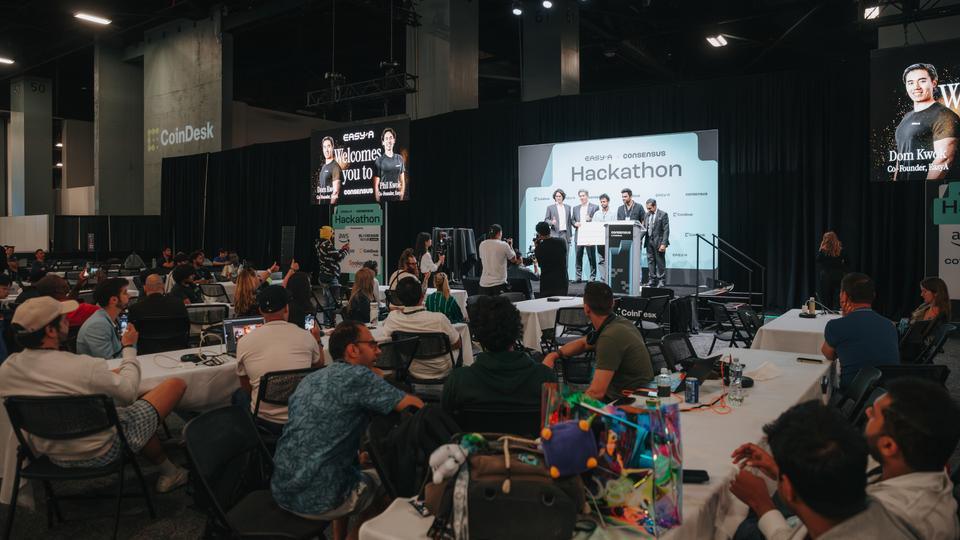
MIAMI BEACH, Fla. – At the EasyA Hackathon housed within Consensus Miami 2026, the energy felt less like a traditional crypto developer event and more like a live audition for the next generation of the intersection of blockchain and native AI startups.
Nearly 1,000 developers competed at the venue, some from established crypto ecosystems like Base and Solana, and others coming from companies like Microsoft and Google, all competing to build products around a topic that kept coming up in conversation after conversation: AI agents.
The focus on AI agents had already emerged earlier this year at the EasyA x Consensus hackathon in Hong Kong, where organizers described 2026 as the “Year of the Application Layer,” as developers increasingly moved from infrastructure tools to consumer applications and AI-powered autonomous agents.
For brothers Dom and Philip Kwok, co-founders of EasyA, that evolution is exactly the point. What started as a small hackathon series in Austin, Texas, during Consensus 2023 has quickly transformed into one of the most followed gatherings of cryptocurrency builders, attracting passionate young developers with teams increasingly with serious technical pedigree.
His ambition for the event is downright simple. “We want billion-dollar companies to come out of EasyA,” Dom Kwok said during an interview with CoinDesk on the hackathon floor. “We’ve already had, from our other hackathons, a company valued at $10 billion.”
That success story has become part of EasyA tradition. A Harvard team that pitched at a previous EasyA event founded “Permission AI,” which the Kwoks say is now valued at roughly $10 billion. Another former participant, Axel, is creating stablecoin yield products backed by bitcoin.
Other alumni have reportedly gone through Y Combinator, raised funding from top venture firms, and processed hundreds of millions in transactions. The message to developers attending the Miami event was clear: this is no longer just a couple-day coding competition, but is increasingly being presented as a launch pad for venture companies.
This year, however, the center of gravity has shifted unequivocally toward agent AI. Coinbase sponsored challenges around x402, an emerging framework that developers are experimenting with for payments and interactions with AI agents, while Solana and Solana Mobile pushed teams toward mobile-first apps and consumer experiences.
“Many developers [are] “I’m very excited about AI agent workloads,” Dom said, noting the recent wave of massive venture funding flowing into AI agent infrastructure startups.
Some of the projects already circulating around the venue reflect the extent to which builders are stretching the category. A team called Praxis was working on drones connected to the blockchain and controllable via smartphones, which the brothers described as “the next Palantir on the blockchain.” Another startup was building what they called “hyperintelligent AI,” software designed to convert text prompts into 3D physical objects. “You could prompt it and say, ‘Build me a microscope,’ and it will build it for you,” Phil said. “It’s like the next phase of taking ChatGPT from something informational to something embodied.”
The winners:
Judges rewarded projects that took AI agents beyond chatbots and toward real-world coordination, automation, and commerce, whether through hardware, payments infrastructure, or consumer-facing applications. Across the different sponsor tracks, the winning teams reflected the broader shift taking place at this year’s hackathon: developers were no longer just creating cryptographic tools, but creating products intended for everyday use. The prizes differed depending on the track and it is still pending how they will be distributed in each category.
Starting Track ($50,000):
First place: FlyPraxis
FlyPraxis, a real-time drone intelligence platform designed for military operators, took first place in the Kickstart track. The team presented the project as “Palantir, but in real time,” using AI-powered coordination and live intelligence on the battlefield to manage autonomous drone systems.
Second place: HIIE
HIIE came in second with a platform that turns text messages into fully configurable hardware products. Using AI agents to manage everything from physical calculations and component sourcing to 3D CAD generation and assembly documentation, the startup aimed to compress months of hardware prototyping into a single workflow.
Third place: World of clans
Clan World rounded out the top three on the Kickstart track, joining a broader wave of teams experimenting with native AI coordination and community-driven apps.
Solana Mobile Track ($30,000 + $75,000 on Solana phones)
First place: Parable
In the Solana Mobile track, first place went to Parabola, a decentralized prediction and estimation marketplace built on Solana. The platform allows users to speculate on real-world events through a distribution-based AMM model designed for native mobile trading experiences.
Second place: Snakr
Snakr took second place with an AI-powered food intelligence app that allows shoppers to scan products to identify potential health risks, FDA recalls, and ingredient concerns. Users can also contribute missing product information and in return earn Solana-based rewards.
Third place: Rhythm
Third place winner Rhythym focused on productivity and accessibility and created a routine support mobile app aimed at helping users with executive dysfunction complete daily tasks. The app integrates with Solana’s Seeker phone, Nova 2 Lite, and x402 infrastructure to create AI-assisted workflows.
Coinbase/AWS Tracking ($45,000)
First place: API x402 Dairy Price
The Coinbase and AWS track focused heavily on AI agent payments and autonomous commerce. The winning project, Dairy Price API x402, created a pay-per-call commodity pricing and forecasting service that allows AI agents to access dairy market data without traditional API keys. Payments are settled directly in USDC via x402 on Base.
Second place: AgentPay
AgentPay came in second with a payment coordination system that gives users one-touch approval on AI agent transactions while using AWS-powered risk validation to ensure agents spend funds responsibly.
Third place: Giggy
Giggy took third place for creating a marketplace where users can hire AI agents to perform research tasks. Payments are locked in a crypto deposit on Base, while agents themselves can pay for premium APIs via x402-powered transactions.
Runner-up: Chainlens
Chainlens focused on trust and verification of autonomous systems, creating an x402-compliant layer that connects AI agents with verified APIs and only releases payment once responses are authenticated.
Read more: AI-powered agents dominate EasyA x Consensus Hong Kong hackathon


