
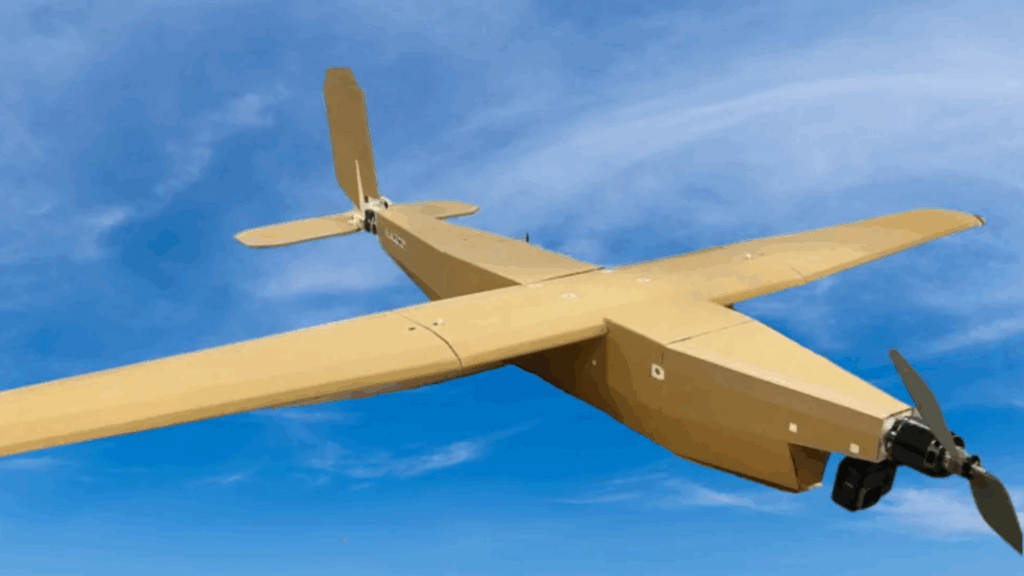
- Cardboard drones reduce production costs compared to traditional military platforms
- Compact design allows for quick transportation and large-scale deployment
- Assembly requires minimal training and only a few minutes per unit
Japan has begun deploying expendable cardboard drones developed by a domestic manufacturer, AirKamuy, marking a major shift toward low-cost autonomous warfare.
The drone, known as the AirKamuy 150, is a lightweight fixed-wing platform constructed primarily of corrugated cardboard with a water-resistant coating.
Each unit costs approximately between $2,000 and $2,500, which is much cheaper than conventional military drones.

What makes cardboard drones effective for swarm warfare?
The AirKamuy 150 can travel approximately 50 miles or stay in the air for about 80 minutes using an electric propulsion system.
It can carry payloads weighing up to three pounds, including reconnaissance equipment or small munitions for one-way strike missions.
The drones are shipped in flat packages, allowing approximately 500 units to fit inside a single standard shipping container.
Each drone can be assembled in five to ten minutes by personnel with minimal training.
The cardboard construction also provides a secondary tactical advantage: lower radar reflectivity than many conventional aerospace materials.
“There is strong demand for low-cost drones that can operate in large numbers and over long distances,” said AirKamuy CEO Yamaguchi Takumi.
The company claims that the drones can be manufactured at any cardboard plant, ensuring high mass production capacity and a strong supply chain.
Australia has already been supplying similar cardboard drones to Ukrainian forces, with around 100 units delivered each month.
These Australian drones, produced by SYPAQ, have been used for ammunition delivery, reconnaissance flights and even to launch explosive devices.
Expendable and cheap drones are changing the battlefield
Instead of protecting a small number of extremely expensive platforms, the military is increasingly experimenting with inexpensive drones that can be sacrificed during missions.
Swarms of these drones could overwhelm air defense systems, force the activation of enemy radars, or absorb defensive fire before more valuable assets.
In Ukraine, Russian and Ukrainian forces have already used a large number of low-cost drones for reconnaissance and direct strikes.
The AirKamuy 150 may represent more than just an unusual cardboard airplane; may offer a glimpse into a future defined by a host of cheap and quickly replaceable autonomous systems.
However, in military warfare, it remains a beginner’s drone whose effectiveness against a $2 billion air defense system is unproven.
The logistics of launching 500 drones from a single shipping container are attractive, but recovering battle data from drones that don’t return is a real intelligence challenge.
For a product presented under the origami brand, the AirKamuy 150 looks surprisingly conventional.
It’s not a folding paper crane, but the proven fixed-wing design is hard to beat for strength and payload efficiency.
The tactical value of this cheap drone in contested airspace will ultimately be measured not in dollars per unit, but in how many hit their targets before being shot down.
Via Toms Hardware

Follow TechRadar on Google News and add us as a preferred source to receive news, reviews and opinions from our experts in your feeds.


