
President Trump’s sweeping campaign to punish perceived critics in the media has reached newspapers such as The Wall Street Journal, The Des Moines Register and The New York Times; broadcast media such as the BBC, NBC News and CBS News; and late-night hosts Jimmy Kimmel and Stephen Colbert.
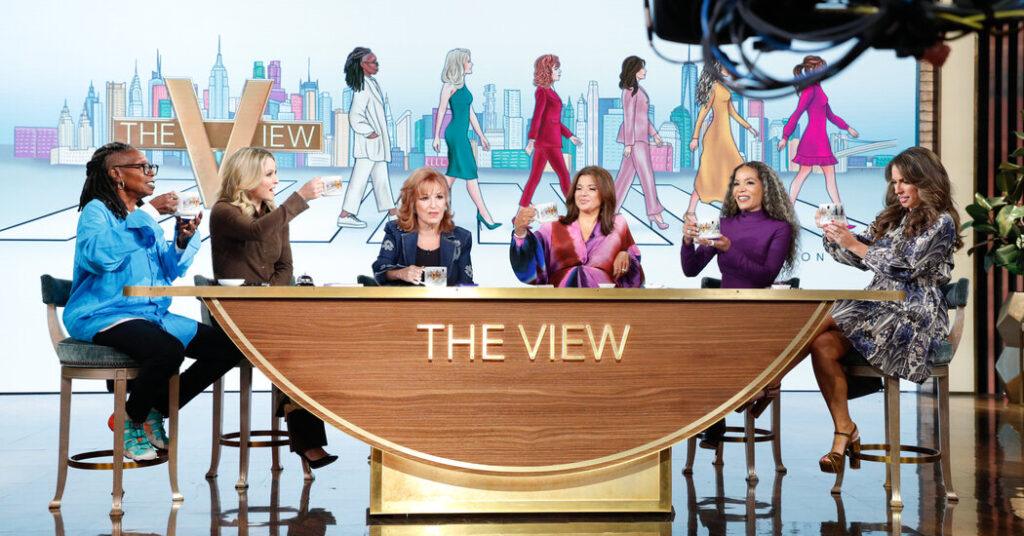
But now he’s closing in on a new opponent, one that remains politically potent and has a historic place in Trump’s oeuvre of media showdowns: ABC’s long-running morning talk show, “The View.”
The Federal Communications Commission has been quietly investigating the show for months, examining whether “The View” violated long-standing federal rules requiring the same air time as rival political candidates. The investigation could also contribute to a broader agency review of whether ABC should be allowed to continue owning some of the country’s largest local television stations.
The clash between ABC and the Trump administration could lead to a protracted, high-stakes legal battle over free speech. The network claims the FCC’s action could have “a chilling effect on free speech protected by the First Amendment in the run-up to the 2026 election” and affect which political guests, if any, will book talk shows.
The central role of “The View” is a testament to the lasting influence of an old-fashioned television show that ABC anchor Barbara Walters started 29 years ago, describing it “like a kaffeeklatsch with more caffeine.” People in both parties say the show continues to have significant political power, even as streaming, podcasts and social media gain more attention.
“The View” draws 2.7 million viewers a day, about the audience it has had for a decade, according to Nielsen.
“It would be easy for us to say, ‘Who watches that garbage?’” said Tim Graham, leader of the Media Research Center, a conservative group that has long criticized the show. “But the answer is: a lot of people.”
Representatives for “The View” declined to comment or arrange interviews with the hosts or anyone involved in the production.
Ms. Walters’ intention, as she said in the premiere episode in 1997, was to make the show a destination for a broad spectrum of women “from different generations, backgrounds and points of view.” The show’s panel has long included a conservative presence to balance the progressivism of its longtime hosts Joy Behar and Whoopi Goldberg.
Trump, who was good friends with Walters, used to be a frequent guest and once saw the show as a great platform to promote himself, his business and his family. During an appearance in March 2006, Trump, sitting next to Ivanka Trump, famously mused: “If Ivanka wasn’t my daughter, maybe I’d be dating her.” (“Who are you, Woody Allen?” Behar snapped, causing Trump to burst out laughing.)
Weeks later, Melania Trump gave the show her first interview after the birth of her son, Barron, revealing details about the birth (“very, very easy”) and informing viewers that Trump had chosen to stay out of the delivery room. Sometimes Mr. and Mrs. Trump even appeared together: In 2010, they made a joint appearance when Mrs. Trump promoted her QVC jewelry line.
But “The View” also set the stage for a founding feud between Trump and former host Rosie O’Donnell, which began in 2006. She called him a “snake oil salesman”; He called her “a bum” and worse.
The final break in the relationship between the show and Trump came shortly after he entered politics. He clashed with Goldberg over his description of Mexicans as “rapists” in 2015, and subsequently rejected invitations from “The View.” He made 18 appearances in total.
The hosts became more critical of Trump over the past decade, and he attacked them back. The two Republicans on the panel – a first-term Trump spokesperson, Alyssa Farah Griffin, and longtime strategist Ana Navarro – are frequent critics of Trump. And anti-Trump critics are even harsher.
“It’s amazing to me,” Sunny Hostin, a host, said this week, “that there are still people, even though they don’t have health care, even though the Department of Education has been destroyed, even though they can’t afford to buy eggs, they’re still with their boy.”
Conservatives accuse the show of interviewing primarily Democrats. This spring, the Media Research Center released a report titled “The View kicks off midterm year with 27 liberal guests and 1 Republican.” (The study included celebrities in its count.)
In its filing with the FCC, ABC noted that the guest appearances did not reflect the full range of invitations. The network said the show had invited numerous Trump allies over the past two seasons, including Vice President JD Vance, Health Secretary Robert F. Kennedy Jr., Sen. Lindsey Graham, Elon Musk and Secretary of State Marco Rubio, all of whom declined.
ABC’s lawyers said the bookings were “based on newsworthiness, anticipated audience interest and their potential to ‘make news’ on the show.”
The administration has intensified its attacks over the past year. In July, he issued a statement supporting the cancellation of the show, after Behar unfavorably compared Trump to former President Barack Obama.
The seriousness of the FCC investigation into “The View” came to light when ABC responded forcefully this week. The agency is investigating whether the show was improperly operating outside longstanding broadcast rules that require entertainment shows to give equal airtime to candidates for the same office.
ABC lawyers noted that “The View” had received a news exemption from the agency in 2002 and that the exemption had not been challenged in the 24 years since.
Their response, which was made public on Friday, accused the FCC of violating the network’s First Amendment rights and indicated that they were prepared to take the case all the way to the Supreme Court.
The network maintains that the mixing of its guests should not be the government’s concern. “Of course, government officials are free to express their own views on ‘The View,'” ABC’s lawyers said in the filing. “But they cannot use the coercive powers of the state to punish views with which they disagree.”
The show has long been under a political microscope, not only because of what its hosts say but also because of the makeup of its audience.
The two highest-rated media markets for “The View,” according to Nielsen, are Philadelphia and the Flint-Saginaw-Bay City market in Michigan’s industrial corridor, both in swing states. The show also draws significant audiences in Pittsburgh, Atlanta, Milwaukee, Chicago and New York, Nielsen said, as well as West Palm Beach, Florida; Kansas City, Missouri; and Hartford, Connecticut.
That audience is made up of a privileged demographic of voters; two-thirds of its viewers are 65 or older, and nearly 90 percent are over 50. Seventy percent are women. And 60 percent of its viewers are white and a quarter are black, according to Nielsen.
“Women are one of the most important undecided segments of the electorate,” said Daniel Suhr of the Center for American Rights, the conservative legal group that in March urged the FCC to deny “The View” an exemption from equal airtime rules as a “bona faith” news program.
Having hosts who “constantly criticize the president and the party” on a show that appeals to such undecided voters, Suhr said, “has a real effect on our politics.”
Lis Smith, a Democratic strategist who has long viewed “The View” as an important stop on any major candidate’s campaign calendar, said she thought conservatives were picking on the show primarily to whip up the faithful against a favorite media target. But, he added, “The View” has its uses for Democrats.
“They reach a huge audience of women, and Democrats need women to vote to win,” she said.


