
President Zardari pays tribute to nation, armed forces on Marka-e-Haq anniversary, praises Field Marshal’s leadership
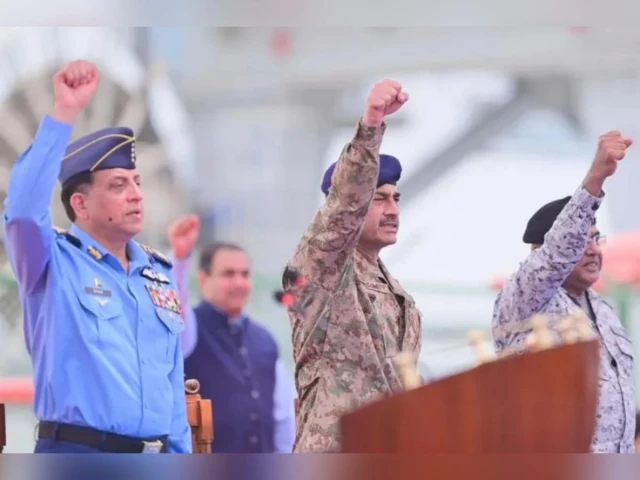
Field Marshal Asim Munir (centre), Chief of Air Staff Air Chief Marshal Zaheer Ahmad Baber Sidhu (left) and Chief of Naval Staff Admiral Naveed Ashraf (right) on May 19. Photo: ISPR
Chief of Defense Forces (CDF) and Chief of Army Staff Field Marshal Syed Asim Munir will lead a ceremony at the General Headquarters (GHQ) in Rawalpindi on Sunday morning to mark the completion of one year since last year’s victory against India in May 2025.
The term “Marka-e-Haq” refers to the 2025 conflict with India, which began with the Pahalgam attack on April 22 and concluded with a ceasefire on May 10 following Operation Bunyanum Marsoos.
administered by the state Radio Pakistan informed that CDF Munir will be the chief guest at the ceremony, which will also be attended by Chief of the Air Staff Air Chief Marshal Zaheer Ahmed Baber Sidhu and Chief of the Naval Staff Admiral Naveed Ashraf.
Read: ‘No one can harm Pakistan; We are ready to respond to any aggression’: DG ISPR on Marka-e-Haq anniversary
A wreath will be laid in front of the monument to the martyrs and then the contingents of the three armed forces will salute. CDF Munir will also deliver a speech on the occasion.
معرکہ حق کی فتح کا ایک سال مکمل ہونے پر جی ایچ کیو راولپنڈی میں صبح پروقارتقریب کاانعقاد کیا جائے گا
مارشل سیدعاصم منیر ہوں گے
آف نیول اسٹاف ایڈمرل نوید اشرف بھی تقریب… pic.twitter.com/87cKWYwtXo
– PTV News (@PTVNewsOfficial) May 9, 2026
Meanwhile, President Asif Ali Zardari paid tribute to the nation and the armed forces on the first anniversary of Marka-e-Haq.
According to a statement issued by the President’s Office, the President said CDF Munir’s leadership, strategy and “courageous decisions” were key to the success of Marka-e-Haq.
He also praised the air chief and the Pakistan Air Force for their “exceptional skill and professionalism”.
President Zardari praised the chief and the naval forces and described their full operational readiness and defense capabilities as a source of national pride.
“Pakistan is a responsible and peace-loving state. By giving a strong but measured response to enemy aggression, we have conveyed our defensive capabilities to the world,” the president said.
He said the issue of Jammu and Kashmir should be resolved in accordance with the United Nations resolutions.
Read also: On Marka-e-Haq day, forces signal firm resolve
“Pakistan will continue to provide moral, political and diplomatic support to the people of Kashmir,” he said.
Terming India’s attempt to suspend the Indus Waters Treaty as “water aggression”, he said water was a matter of life for millions of Pakistanis.
Regarding cross-border terrorism from Afghanistan, he said Kabul must ensure that its territory is not used for terrorism against Pakistan or other countries in the region.
He said terrorism backed by external support must be eliminated to achieve lasting peace in the region.
The President said Pakistan was emerging as a symbol of balance and stability in the region thanks to the efforts of Prime Minister Shehbaz Sharif and CDF Munir.
He added that Pakistan’s diplomatic efforts for a peaceful resolution of the Iran-US conflict had been widely appreciated globally.
“The nation and armed forces of Pakistan are fully prepared to face all challenges and defend the homeland,” President Zardari said.
Pahalgam and Marka-e-Haq attack
On April 22, 2025, escalation between Pakistan and India began when an attack in Pahalgam killed 26 people. India immediately blamed Pakistan for the incident. However, Pakistan categorically rejected India’s blame.
In response, India took a series of hostile actions the next day on April 23, 2025, including suspending the 65-year-old Indus Waters Treaty (IWT), canceling visas for Pakistani citizens, closing the Wagah-Attari border crossing, ordering the closure of the Pakistan High Commission in New Delhi, and reducing diplomatic staff in each country’s embassies.
Tensions escalated further in the early hours of May 7, 2025, when missile strikes hit six cities in Punjab and Azad Jammu and Kashmir (AJK), destroying a mosque and killing dozens of civilians, including women, children and the elderly.
In a swift military response, Pakistan’s armed forces shot down Indian fighter jets, including three Rafale jets. The standoff escalated again in the early hours of May 10, 2025, when India attacked several Pakistani air bases with missile strikes. In retaliation, Pakistan launched Operation Bunyanum Marsoos, which damaged Indian military installations, including missile storage sites, air bases and other strategic targets.
On May 10, 2025, US President Donald Trump announced that a ceasefire had been reached after intense overnight diplomatic efforts. Minutes later, the agreement was confirmed separately by Pakistan’s Foreign Minister Ishaq Dar and India’s Foreign Minister.


